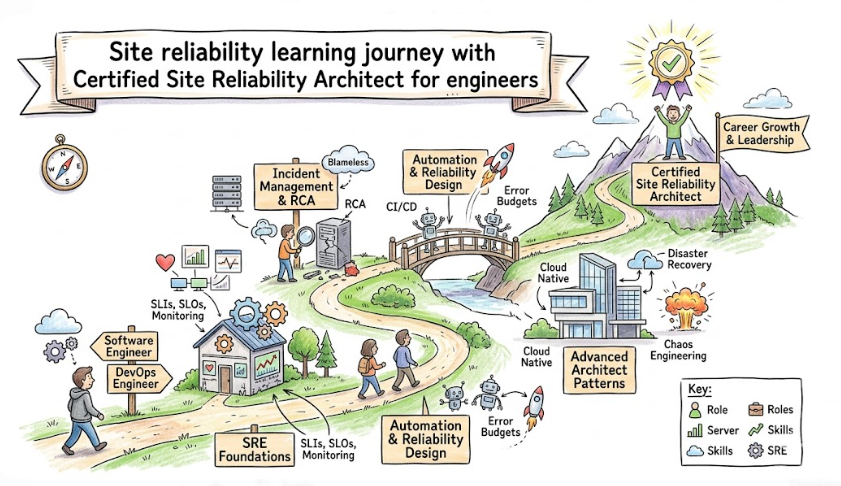
Introduction
The traditional approach to managing software was often focused only on development speed. However, it is now understood that a fast release is only valuable if the system stays online for the users. Site Reliability Engineering (SRE) was introduced to bring an engineering mindset to operations. Within this framework, the Architect is the one who builds the foundation for reliability. Instead of reacting to problems, the Architect designs systems that are resistant to failure. This certification is intended for those who want to move beyond daily tasks and into the world of strategic system design.
What is Certified Site Reliability Architect?
The Certified Site Reliability Architect is an advanced professional designation that focuses on the high-level design of reliable platforms. It is understood that a system’s reliability is determined by its architecture. This certification validates the skill of designing frameworks that allow for automatic recovery, massive scalability, and deep observability. It is a transition from simply fixing problems to preventing them through better engineering and design. The focus is placed on the interaction between software components and the underlying infrastructure.
Why it Matters Today?
In a world where almost every service is delivered through the cloud, downtime is viewed as a major business threat. It is calculated that even a few minutes of unavailability can result in significant financial loss for global corporations. As companies move toward microservices and containerized environments, the number of moving parts in a system is greatly increased. A Certified Site Reliability Architect is needed to manage this complexity. By ensuring that every part of the architecture is built for reliability, the risk of a total system collapse is minimized.
Why Certified Site Reliability Architect Certifications are Important?
A formal certification in site reliability architecture provides a standard that is recognized by employers worldwide. The importance of this certification is seen in several areas:
- Standardization of Skills: It is ensured that all certified professionals follow the same high-level principles and best practices.
- Professional Recognition: The expertise of an individual is formally validated, making them a preferred choice for senior roles.
- Reduced Operational Risk: By hiring certified architects, organizations are able to build more stable systems, which leads to lower maintenance costs.
- Career Advancement: A clear path is provided for engineers who wish to move into leadership or high-level design positions.
Why Choose SRESchool?
SRESchool is selected by thousands of professionals because of its dedicated focus on the SRE domain. The following reasons highlight why it is a top choice:
- Specialized Curriculum: Unlike general IT training, the content is built specifically for reliability and platform engineering roles.
- Industry Alignment: The courses are designed to reflect the actual needs of the global technology market, including India.
- Expert Guidance: The materials are prepared by individuals who have deep experience in managing large-scale systems.
- Practical Focus: The training is not limited to theory; it is focused on how architectural principles are applied in real-world scenarios.
Certification Deep-Dive: Certified Site Reliability Architect
What is this certification?
This is a master-level program that explores the architectural design required for high-availability systems. It covers the bridge between software engineering and system reliability at an advanced level.
Who should take this certification?
This program is intended for Senior DevOps Engineers, SREs, Platform Architects, and Engineering Managers. It is also suitable for Software Engineers who are moving into system design roles.
Certification Overview Table
| Track | Level | Who it’s for | Prerequisites | Skills Covered | Recommended Order |
| SRE | Master | Senior Engineers | SRE/DevOps basics | Reliability Design, Scalability | 3rd in SRE Path |
| DevOps | Intermediate | Developers | Linux/Cloud basics | CI/CD, Automation | 1st in Path |
| DevSecOps | Intermediate | Security Leads | DevOps knowledge | Security Automation | 2nd in Path |
| AIOps | Advanced | Data Engineers | SRE knowledge | AI for Operations | 4th in Path |
| DataOps | Intermediate | Data Architects | Database knowledge | Data Pipeline reliability | 2nd in Path |
| FinOps | Intermediate | Managers | Cloud knowledge | Cost Optimization | 3rd in Path |
Skills You Will Gain
- Resilient System Design: The ability to design platforms that remain functional even when individual components fail is mastered.
- Error Budget Implementation: A deep understanding of how to balance development speed with system stability is developed.
- Advanced Observability: Skills are gained in creating deep monitoring systems that provide a clear view of system health.
- Automation at Scale: Techniques for automating complex operational tasks across thousands of servers are learned.
- Incident Management Strategy: Plans are created to handle major system failures in a calm and structured manner.
Real-World Projects Post-Certification
- Multi-Region Disaster Recovery: A system is designed that can automatically switch traffic to a different part of the world if a data center fails.
- Chaos Engineering Framework: A project is implemented where failures are introduced on purpose to find and fix weak points in the system.
- Cost-Effective Scaling System: An architecture is built that automatically grows during high traffic and shrinks when not needed to save money.
- Self-Healing Microservices: A framework is created where microservices can detect their own errors and restart without human help.
Preparation Plan
7–14 Days Plan (The Intensive Review)
- The first week is spent reviewing the official exam domains and core SRE concepts.
- Daily practice sessions are conducted using sample questions to understand the logic of the exam.
- Focus is placed on key definitions like SLOs, SLIs, and SLAs.
30 Days Plan (The Standard Journey)
- The first two weeks are used to study architectural patterns and reliability case studies.
- The third week is dedicated to hands-on labs where resilient systems are built and tested.
- The final week is used for mock exams and reviewing any difficult topics.
60 Days Plan (The Deep Mastery)
- The first month is spent reading widely on the topics of SRE, DevOps, and cloud architecture.
- Complex scenarios are built in a controlled environment to see how different architectural choices affect stability.
- The second month is used to refine these skills and prepare for the final certification exam.
Common Mistakes to Avoid
- Focusing Too Much on Tools: It is often forgotten that tools change, but architectural principles stay the same.
- Ignoring the Human Factor: Reliability is not just about code; it is also about how teams work together and learn from mistakes.
- Over-complicating the Design: Simple systems are easier to maintain and are often more reliable than complex ones.
Best Next Certification After This
- Same Track: Certified SRE Director (for those moving into executive leadership).
- Cross-Track: Certified DevSecOps Architect (to add deep security layers to the platform).
- Leadership / Management: Certified Engineering Manager (to lead large technical organizations).
Choose Your Learning Path
1. DevOps Path
This path is best for those who are just beginning their journey in automation. It provides the foundation needed for all other advanced roles.
2. DevSecOps Path
This is designed for professionals who want to ensure that security is not an afterthought but is built into every step of the process.
3. Site Reliability Engineering (SRE) Path
The core path for those focused on system uptime and performance. It is ideal for people who enjoy solving technical problems with code.
4. AIOps / MLOps Path
A forward-looking path for those who want to use artificial intelligence to make system operations smarter and more efficient.
5. DataOps Path
Best for data engineers who want to apply the principles of automation and reliability to large-scale data pipelines.
6. FinOps Path
This path is for those who are responsible for managing the costs of cloud systems while maintaining high performance.
Role → Recommended Certifications Mapping
| Role | Primary Recommendation | Secondary Recommendation |
| DevOps Engineer | Certified DevOps Professional | Certified Site Reliability Engineer |
| SRE | Certified Site Reliability Architect | Certified AIOps Professional |
| Platform Engineer | Certified Site Reliability Architect | Certified Kubernetes Expert |
| Cloud Engineer | Certified Cloud Architect | Certified FinOps Practitioner |
| Security Engineer | Certified DevSecOps Expert | Certified Site Reliability Architect |
| Data Engineer | Certified DataOps Professional | Certified MLOps Professional |
| FinOps Practitioner | Certified FinOps Professional | Certified Cloud Architect |
| Engineering Manager | Certified Engineering Manager | Certified Site Reliability Architect |
Next Certifications to Take
One Same-Track Certification
The Certified SRE Director program is the logical next step. It is designed for those who want to lead multiple teams and set the reliability strategy for an entire company.
One Cross-Track Certification
The Certified DevSecOps Architect is a highly recommended choice. This allows the professional to combine reliability with advanced security practices, creating a truly robust system.
One Leadership-Focused Certification
The Certified Engineering Manager certification is suggested for those moving into management. It helps in developing the skills needed to manage people and technical projects successfully.
Training & Certification Support Institutions
DevOpsSchool
This institution is recognized for its wide range of courses in the DevOps and SRE fields. Practical training is provided to help engineers gain the skills needed for modern job roles.
Cotocus
A focus on technical consulting and advanced training is offered by Cotocus. They are known for helping organizations transition to the latest cloud-native technologies and practices.
ScmGalaxy
This is a popular community and learning platform for configuration management and automation. A wealth of resources is provided for those looking to improve their technical knowledge.
BestDevOps
Simplified and easy-to-follow training programs are offered here. The focus is placed on making complex DevOps concepts understandable for learners at all levels.
devsecopsschool.com
This platform is dedicated to the world of secure software delivery. Specialized certifications are provided for those who want to integrate security into the heart of their operations.
sreschool.com
The primary provider for SRE-related certifications. Deep technical knowledge and architectural principles are taught here to prepare students for the highest levels of reliability engineering.
aiopsschool.com
Training is provided on how to use artificial intelligence and machine learning to improve IT operations. This is a key resource for those looking at the future of the industry.
dataopsschool.com
This institution focuses on the automation and reliability of data workflows. It is designed for professionals who work with large-scale data systems.
finopsschool.com
Education is provided on how to manage and optimize cloud costs. This is an essential resource for anyone looking to master the financial side of technology operations.
FAQs Section
- What is the primary goal of the Certified Site Reliability Architect program?
The goal is to teach professionals how to design systems that are inherently stable, scalable, and easy to maintain. - Is previous SRE experience required for this certification?
While it is not mandatory, having a basic understanding of SRE or DevOps is highly recommended for success. - How is the certification exam structured?
The exam consists of multiple-choice questions that focus on architectural design, problem-solving, and real-world scenarios. - Can I take the exam from my home?
Yes, the exam is conducted through a secure online platform, allowing candidates to take it from any location. - How does this certification help in career growth?
It validates high-level design skills, making it easier to move into senior architectural or leadership positions. - Is there a practical component to the training?
Most supported programs include hands-on labs where students can apply architectural principles to real systems. - How long does it take to get certified?
Depending on the preparation plan followed, most professionals complete the process within 30 to 60 days. - Is this certification recognized by global companies?
Yes, the standards taught by SRESchool are aligned with the practices used by top engineering teams worldwide. - What topics are most important for the exam?
Key topics include resilience design, observability, error budget management, and disaster recovery strategy. - How long is the certificate valid for?
The certificate is typically valid for two years, after which renewal or advanced training is suggested. - Can a Software Engineer benefit from this course?
Yes, developers who want to understand how their code affects system reliability and design will find it very useful. - How do I register for the program?
Registration is completed through the official SRESchool website using the provided certification link.
Additional FAQs for Certified Site Reliability Architect
- How does an Architect differ from an SRE Engineer?
The Engineer is focused on the daily operations, while the Architect is focused on the high-level design and long-term strategy. - Is cloud knowledge required for this program?
A solid understanding of cloud principles is essential, as most modern architectures are built on cloud platforms. - What is the main goal of this certification?
The goal is to teach professionals how to design systems that are reliable, scalable, and self-healing. - Is the cultural side of SRE covered?
Yes, learning how to foster a culture of blamelessness and continuous improvement is a key part of the training. - Can this certification help in moving to a management role?
Yes, it provides the technical authority and strategic mindset needed to lead engineering teams. - Are the practice exams realistic?
The practice tests are designed to closely match the format and difficulty of the actual certification exam. - Is this certification recognized in India?
It is widely recognized by both domestic and international companies operating in India. - Who is the official provider of this course?
The official provider is SRESchool.
Testimonials
Advait
The skills gained through this certification were immediately useful in a large-scale project. A much deeper understanding of system resilience was developed, and it has already led to better results at work.
Diya
Career clarity was found after completing this program. The difference between simple automation and high-level architecture is now understood, which has changed the way projects are approached.
Kabir
Real-world application is the best part of the training. The labs helped in solving a recurring scaling problem that had been affecting the company for months.
Ananya
Confidence growth was the most significant outcome. The ability to discuss complex architectural designs with senior management has been greatly improved since the certification was earned.
Aryan
Skill improvement in the areas of monitoring and incident response was very high. This certification is highly recommended for anyone who wants to become a leader in the SRE field.
Conclusion
Achieving the Certified Site Reliability Architect designation is a significant step toward becoming a leader in the engineering world. As digital systems continue to grow in complexity, the need for experts who can design for reliability will only increase. This certification provides the technical foundation and the professional validation needed to succeed in a global market. By choosing a structured learning path and committing to a solid preparation plan, long-term career success and system excellence are ensured.
