Introduction
Salary day may initially feel comfortable, but that feeling can disappear quickly after rent, groceries, utility bills, insurance premiums, family expenses, and loan EMIs are deducted. Many borrowers know how much EMI they must pay, but they do not have a complete system for managing the rest of their salary. This creates month-end pressure, dependence on credit cards, missed payments, and repeated borrowing. Learning how to plan loan repayment from monthly salary helps borrowers treat debt as part of a wider financial plan rather than an isolated monthly deduction. A practical repayment plan considers income, essential expenses, emergency savings, interest costs, loan tenure, and personal goals together. This blog explains a realistic method for salaried people who want to repay loans responsibly without ignoring daily needs, future savings, or unexpected financial emergencies.
Understanding Loan Repayment From Monthly Salary in Simple Words
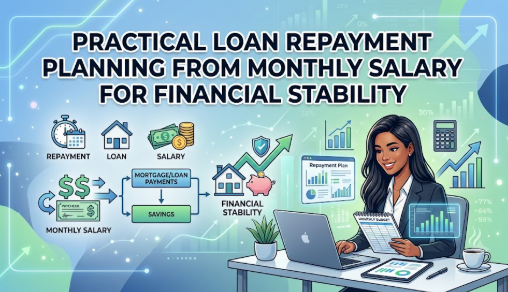
Loan repayment planning means deciding in advance how a fixed monthly income will be divided between EMIs, essential expenses, savings, financial goals, and personal spending.
It is more detailed than simply allowing the lender to deduct an EMI from a bank account. A proper plan answers several important questions:
- Can the salary comfortably support the EMI?
- How much money will remain after all compulsory expenses?
- Is there enough emergency money to handle an unexpected problem?
- Can any part of the loan be prepaid?
- Will the repayment plan affect other important financial goals?
- What will happen if income falls temporarily?
Financial planning generally involves managing current money in a way that supports future life goals. Loan repayment should therefore be treated as one part of a complete financial plan, not as a separate monthly burden.
Beginner-Friendly Example
Suppose a person receives a monthly take-home salary of ₹60,000 and pays an EMI of ₹15,000. The borrower should not automatically assume that the remaining ₹45,000 is available for spending.
The person must first calculate:
- Rent or housing expenses
- Food and groceries
- Transportation
- Utility bills
- Insurance
- Family responsibilities
- Medical costs
- Emergency savings
- Other loan or credit card payments
After these amounts are recorded, the actual monthly surplus becomes clear.
Common Misunderstanding
A common misunderstanding is that receiving loan approval means the borrower can comfortably repay the loan. Approval only shows that the lender has accepted the application based on its assessment. It does not guarantee that the EMI will fit comfortably into the borrower’s personal lifestyle, responsibilities, and future plans.
Practical Takeaway
Before accepting a loan, build a complete monthly salary plan using the proposed EMI. Continue only when the plan leaves enough money for essential living costs, emergency savings, and reasonable financial flexibility.
Why Loan Repayment Planning From Salary Is Important
Loan repayment planning directly affects financial stability because salary is often the main or only regular income source for an employee. When a large part of that income is committed to debt, even a small unexpected expense can disturb the entire monthly budget.
Protecting Monthly Savings
Without a repayment plan, borrowers may pay the EMI first and save only if money remains at the end of the month. In most cases, daily spending gradually uses that remaining amount.
A better approach is to include savings as a planned monthly allocation alongside the EMI.
Preventing Repeated Borrowing
Poor EMI management can force a borrower to use credit cards, salary advances, overdrafts, or new personal loans for basic expenses. This creates a borrowing cycle in which one debt is used to manage another.
A structured budget reduces this risk by keeping essential expenses and emergency funds separate.
Supporting Future Investments
Investing while carrying expensive debt requires careful judgment. A borrower should not ignore high-cost loan obligations merely to follow attractive investment ideas.
Loan repayment, emergency savings, insurance, and investing should be balanced according to risk, interest cost, and personal priorities.
Improving Financial Discipline
A regular repayment system encourages borrowers to:
- Track expenses
- Pay bills on time
- Maintain records
- Review financial goals
- Reduce unnecessary spending
- Avoid emotional purchases
Timely loan repayment is an important part of responsible borrowing and can support a healthier credit history.
Reducing Emotional Stress
Debt becomes emotionally difficult when borrowers are unsure whether they can manage the next EMI. A written plan cannot remove every financial problem, but it creates clarity about available income, upcoming payments, and required adjustments.
Practical Scenario
A salaried employee may receive a yearly bonus and immediately use it for travel or shopping. However, if the employee has a high-interest loan and no emergency fund, a better decision may be to divide the bonus between loan prepayment, emergency savings, and personal enjoyment.
This balanced approach improves financial stability without making the repayment plan unnecessarily restrictive.
The Real Problems Readers Face With Loan Repayment
Most loan repayment difficulties do not begin with one major mistake. They usually develop through several small planning failures.
Lack of Complete Financial Awareness
Some borrowers know their EMI but do not know the total outstanding balance, interest rate, remaining tenure, prepayment conditions, or total repayment cost.
Without these details, it is difficult to make an informed repayment decision.
Too Much Conflicting Advice
Online advice may tell borrowers to repay every loan immediately, invest instead of prepaying, choose the longest tenure, or select the smallest EMI.
None of these approaches is suitable for every person. The right decision depends on income stability, loan cost, emergency savings, family responsibilities, and financial goals.
Emotional Spending After Salary Credit
Salary credit can create a temporary feeling of financial comfort. Shopping, dining, travel bookings, and online purchases may happen before compulsory expenses are separated.
A better system allocates the EMI, bills, savings, and household expenses immediately after salary credit.
Unrealistic Repayment Targets
Some borrowers create aggressive prepayment goals but leave no money for healthcare, family expenses, repairs, or small personal needs. When the plan becomes too restrictive, they abandon it completely.
A sustainable plan is usually better than an extreme plan that cannot be maintained.
Ignoring Loan Documents
Borrowers may not review:
- Interest-rate type
- Processing fees
- Penal charges
- Prepayment conditions
- Foreclosure rules
- Insurance costs
- Repayment dates
- Rate-reset conditions
Not receiving or reviewing the loan agreement can create confusion and disputes. RBI guidance has treated failure to provide the borrower with a copy of the loan agreement and related documents as an unfair practice.
Depending Only on Social Media Advice
Repayment decisions should not be based solely on influencers, short videos, online comments, or unverified calculators. General advice may not consider the borrower’s complete financial position.
Not Knowing the Next Step
A borrower facing repayment pressure may delay action because of embarrassment or fear. Delaying communication can make the situation more difficult.
The better approach is to review the numbers early, reduce optional expenses, contact the lender through official channels, and seek qualified professional guidance where necessary.
How to Plan Loan Repayment From Monthly Salary Step by Step
Step 1: Calculate Your Actual Take-Home Salary
Begin with the amount that is regularly credited to your bank account after deductions, not the salary mentioned in the employment offer or cost-to-company figure. Include reliable monthly income such as fixed salary and regular allowances, but do not depend heavily on uncertain bonuses, incentives, overtime, or freelance earnings. This matters because an EMI must remain affordable even during an average month. For example, if your fixed take-home salary is ₹55,000 and incentives vary between ₹5,000 and ₹15,000, build the basic repayment plan around ₹55,000. A common mistake is using the highest recent income month to justify a larger EMI. The better approach is to use stable income for compulsory payments and use variable income for savings or controlled prepayment.
Step 2: Record Every Existing Debt Obligation
List all personal loans, home loans, education loans, vehicle loans, consumer loans, credit card balances, buy-now-pay-later commitments, and informal borrowings. Write down the EMI, due date, interest rate, outstanding balance, and remaining tenure for each account. This step matters because several small payments can create a much larger debt burden than one visible EMI. For example, an ₹8,000 personal-loan EMI, ₹4,000 consumer-loan EMI, and ₹5,000 credit card payment together require ₹17,000 every month. A common mistake is treating credit card minimum payments as ordinary monthly expenses. The better approach is to view all debt payments together and create one consolidated repayment picture.
Step 3: Separate Essential and Optional Expenses
Divide monthly spending into essential expenses and flexible expenses. Essential costs may include rent, groceries, basic transportation, utilities, school fees, insurance, medicine, and necessary family support. Optional costs may include frequent dining, entertainment subscriptions, impulse shopping, premium upgrades, and non-essential travel. This separation matters because repayment improvement usually comes from controlling flexible spending rather than cutting basic needs. For example, reducing online food orders from ₹5,000 to ₹2,000 creates ₹3,000 that can support an emergency fund or loan prepayment. A common mistake is labelling every existing expense as essential. The better approach is to ask whether the expense protects health, income, housing, safety, or a necessary responsibility.
Step 4: Fix a Safe Monthly EMI Allocation
Calculate how much of the salary is already committed to debt and how much remains after essential expenses. There is no single EMI percentage that is safe for every borrower. A person with low housing costs may manage a larger EMI more comfortably than someone supporting children, parents, medical needs, or irregular household expenses. Lenders may use their own assessment methods when determining repayment capacity, but personal affordability must be checked separately. RBI’s older consumer guidance notes that lenders may consider a portion of disposable or surplus income for repayment, illustrating why available surplus—not gross salary alone—matters. A common mistake is selecting the highest EMI the lender allows. The better approach is to choose an EMI that leaves a reasonable monthly buffer.
Step 5: Create an Automatic Salary-Day System
Arrange the salary so that important amounts are separated soon after it is credited. Maintain enough balance in the repayment account before the EMI date and automate essential payments where practical. You may divide the salary into separate accounts or tracked categories for EMIs, household expenses, emergency savings, goals, and personal spending. For example, a borrower can transfer the EMI amount and fixed bills into a payment account on salary day. A common mistake is keeping the entire salary in one account and spending from it freely. The better approach is to give every part of the salary a defined purpose before discretionary spending begins.
Step 6: Build a Repayment Emergency Buffer
An emergency fund protects the EMI plan when medical bills, job changes, repairs, or family emergencies occur. Start with a small target if building several months of expenses feels difficult. Even one EMI plus essential expenses can provide initial protection. Gradually increase the buffer according to job stability, family responsibilities, insurance coverage, and debt level. A common mistake is using every extra rupee for prepayment while keeping no liquid emergency money. The better approach is to balance debt reduction with accessible savings so that an emergency does not force fresh borrowing.
Step 7: Decide Whether Prepayment Is Suitable
Prepayment means paying an additional amount beyond the regular EMI to reduce the outstanding principal. It may reduce interest cost or loan tenure, depending on the loan structure and lender rules. Before prepaying, review the loan agreement, applicable charges, emergency savings, other high-cost debts, and future cash requirements. For example, using part of a bonus to reduce a high-interest personal loan may be useful, but using the full bonus while leaving no emergency reserve may create new risk. A common mistake is making prepayments without checking how the lender applies the amount. The better approach is to request written confirmation of the updated principal, tenure, EMI, and repayment schedule.
Step 8: Review the Plan Every Month
A repayment plan should change when salary, expenses, interest rates, family responsibilities, or financial goals change. Review bank statements, loan statements, unnecessary expenses, outstanding balances, and upcoming annual costs. Floating-rate loans may be affected by interest-rate resets, and regulated lenders have communication responsibilities concerning the possible impact of such resets on EMI or tenure. A common mistake is creating a budget once and assuming it will remain suitable for years. The better approach is to perform a short monthly review and a more detailed review whenever income or loan terms change.
Key Factors That Influence Loan Repayment Planning
Interest Rate
The interest rate represents the cost of borrowing. A higher interest rate can increase the EMI, total repayment cost, or repayment duration.
Borrowers should understand whether the rate is fixed, floating, or subject to lender-specific reset conditions. Comparing only the EMI may hide a more expensive loan.
EMI Amount
The EMI is the regular payment due to the lender. It normally contains principal and interest, although the exact structure depends on the product.
A low EMI may appear comfortable but can be connected with a longer tenure and greater total interest. A high EMI may reduce the tenure but create monthly cash-flow pressure.
Repayment Capacity
Repayment capacity is the amount a borrower can pay after meeting essential living expenses and maintaining reasonable financial protection.
It should be measured using take-home income and actual obligations, not optimistic assumptions.
Credit History and Credit Score
A credit score is a numerical summary based on information in a person’s credit history. Payment behaviour and reported borrowing accounts can influence how lenders assess future applications.
Borrowers can review their credit reports to check loan details and identify possible errors. RBI directions provide eligible individuals access to one free full credit report, including a credit score, from each credit information company once during a year.
Hidden and Additional Charges
Loan cost may include more than interest. Borrowers should review:
- Processing fees
- Documentation charges
- Insurance premiums
- Late-payment charges
- Penal charges
- Account-related fees
- Prepayment or foreclosure conditions
- Applicable taxes
The mistake is comparing loans only through the advertised interest rate. The better approach is to review the full cost and written terms.
Loan Tenure
A longer tenure generally spreads repayment across more months, which may reduce the EMI but can increase the total interest paid.
A shorter tenure may reduce total interest but must not create an unaffordable monthly commitment.
Existing Financial Responsibilities
Children’s education, rent, medical support, insurance, family obligations, and retirement contributions affect repayment capacity.
A person with the same salary and EMI as another borrower may have a completely different level of affordability.
Prepayment Rules
Some loans permit partial prepayment or foreclosure under specified conditions. Others may apply charges or require a minimum amount.
Borrowers should check the agreement and obtain updated statements after making additional payments.
Detailed Breakdown of Salary-Based Loan Repayment
When Borrowing May Make Financial Sense
Borrowing may be reasonable when it supports a necessary or productive purpose and the repayment fits comfortably within the borrower’s financial plan.
Examples may include:
- Purchasing a suitable home
- Funding education with realistic career value
- Buying a vehicle needed for employment
- Handling an essential medical requirement
- Financing a necessary business asset after careful analysis
The purpose alone does not make a loan affordable. The borrower must still review interest, tenure, total cost, risk, and repayment capacity.
When Borrowing Should Be Avoided
Borrowing should be reconsidered when it is mainly being used to maintain an unaffordable lifestyle, cover repeated budget shortages, invest in highly speculative activities, or repay another loan without a clear restructuring plan.
Loans should also be approached carefully when income is unstable, employment is uncertain, or the borrower has no emergency savings.
Build the Plan Around Net Income
Gross salary may include amounts that are not available for monthly spending. The repayment budget should therefore begin with net take-home income.
Variable income should be handled cautiously. A bonus can support prepayment, but it should not be necessary for paying the regular EMI unless the income pattern is predictable and the loan structure is designed accordingly.
Prioritise Compulsory Commitments
Create the repayment budget in this order:
- Basic housing and food
- Necessary utilities and transportation
- Insurance and healthcare
- Minimum contractual debt payments
- Emergency savings
- Important financial goals
- Optional lifestyle spending
- Additional loan prepayment
This order may change according to personal circumstances, but it prevents optional spending from receiving priority over basic security.
Managing Multiple Loans
When several loans exist, borrowers can use a structured repayment strategy.
One approach is to make required payments on every account and direct additional money towards the highest-cost debt. This may reduce interest more efficiently.
Another approach is to clear a smaller balance first to simplify the repayment system and build motivation. However, the total cost should still be reviewed.
The selected strategy should be written, measurable, and sustainable.
Managing Credit Card Debt
Credit card debt can become difficult when the borrower pays only a small amount while continuing to make new purchases.
The borrower should review the complete outstanding amount, applicable interest and charges, payment dates, and whether converting or consolidating the balance is genuinely beneficial.
New borrowing should not be used automatically. Any consolidation option must reduce cost or improve manageability without encouraging additional spending.
Planning for Annual and Irregular Expenses
Many repayment plans fail because they include monthly expenses but ignore annual costs such as:
- Insurance premiums
- School admissions
- Vehicle maintenance
- Festivals
- Medical check-ups
- Professional fees
- Travel to family events
- Home repairs
Divide expected annual expenses by twelve and save a monthly amount for them. This prevents irregular costs from disturbing EMI payments.
Loan Prepayment Versus Investing
There is no universal answer to whether extra money should be invested or used for prepayment.
Consider:
- Loan interest rate
- Investment risk
- Tax treatment
- Emergency savings
- Remaining loan tenure
- Liquidity needs
- Personal comfort with debt
- Certainty of expected returns
Prepaying debt creates a known reduction in future loan obligations, subject to the loan terms. Investment returns are uncertain and can fluctuate. Borrowers should compare these choices carefully rather than relying on simple online claims.
What to Do When Repayment Becomes Difficult
Do not ignore the problem or wait for repeated missed payments.
Take the following actions:
- Review the complete monthly budget
- Stop non-essential spending
- Avoid fresh high-cost borrowing
- Check available emergency savings
- Contact the lender through official channels
- Ask for written information about available options
- Understand charges and credit implications
- Seek qualified financial or legal guidance where required
Any restructuring, extension, settlement, or revised repayment arrangement may have financial and credit consequences. Understand those consequences before agreeing.
Common Mistakes Beginners Make With Loan Repayment
Choosing an EMI Based Only on Approval
A lender’s approval amount may be higher than the amount a borrower can comfortably manage.
Instead, calculate affordability using take-home income, existing debt, essential expenses, and emergency needs.
Ignoring the Total Repayment Cost
A small EMI can appear attractive, but a long tenure may significantly increase the total amount paid.
Compare the principal, EMI, tenure, charges, and estimated total repayment together.
Spending Before Separating the EMI
Using salary for shopping and lifestyle expenses before reserving the EMI can lead to insufficient account balance.
Separate compulsory payments immediately after salary credit.
Keeping No Emergency Fund
Without emergency savings, a medical bill or job interruption may force the borrower to miss payments or take another loan.
Build a basic buffer even while repaying debt.
Depending on Bonuses for Regular EMIs
Bonuses and incentives may change. Using them as a compulsory part of the EMI plan creates risk.
Base the EMI on reliable income and use bonuses for controlled prepayment or savings.
Paying Only the Minimum Credit Card Amount
A minimum payment may prevent immediate non-payment status under the issuer’s terms, but it does not necessarily clear the debt efficiently.
Review the full outstanding balance and stop adding unnecessary new transactions.
Making Emotional Prepayments
Borrowers sometimes use all savings to close part of a loan because they want to become debt-free quickly.
Prepayment should not leave the household unable to manage an emergency.
Ignoring Changes in Interest Rates
Floating-rate borrowers may continue paying without checking whether the EMI, tenure, or total cost has changed.
Review lender communication and request an updated repayment schedule when necessary.
Missing Due Dates Because of Poor Account Management
A borrower may have enough total money but keep it in the wrong account on the EMI date.
Maintain a repayment account and fund it before the due date.
Sharing Sensitive Financial Information
Loan scams may involve requests for one-time passwords, passwords, card details, remote access, or payments to personal accounts.
Use only official lender channels and protect personal information.
Depending Only on Social Media Advice
Online content cannot assess every borrower’s income, liabilities, goals, and legal position.
Use general content for education, but verify decisions through loan documents and qualified professionals.
Don’t Do This Checklist
- Do not borrow merely because an application is approved.
- Do not choose a loan by EMI alone.
- Do not ignore processing or foreclosure conditions.
- Do not use emergency money for unnecessary purchases.
- Do not invest borrowed money in highly speculative schemes.
- Do not take a new loan without reviewing existing debt.
- Do not miss payments intentionally while waiting for a better option.
- Do not share OTPs, passwords, or banking credentials.
- Do not trust guaranteed loan approval or debt-removal promises.
- Do not hide repayment difficulties until they become severe.
- Do not depend completely on uncertain bonuses or incentives.
- Do not sign a loan agreement without reading the important terms.
Practical Real-Life Examples of Loan Repayment Planning
Example 1: Salaried Employee With Month-End Shortages
Situation: Rohan earns ₹52,000 and pays a ₹13,000 EMI but regularly uses a credit card for groceries during the final week of the month.
Challenge: He treats the remaining salary as freely spendable after the EMI.
Better action: He separates household expenses, annual costs, and emergency savings on salary day.
Learning: Paying the EMI is not enough; the entire salary must be planned.
Example 2: Employee Receiving Variable Incentives
Situation: Meera’s fixed salary is ₹48,000, but monthly incentives can increase income to ₹65,000.
Mistake: She considers ₹65,000 her normal income and accepts a large EMI.
Better action: She builds the repayment plan using ₹48,000 and uses incentives for prepayment and savings.
Learning: Compulsory debt payments should rely mainly on stable income.
Example 3: Borrower With Multiple Small Loans
Situation: Arjun has three small consumer loans and believes none is individually difficult.
Challenge: Their combined payments consume a large part of his salary.
Better action: He lists all outstanding balances and directs extra money towards one selected loan while maintaining required payments on the others.
Learning: Multiple small debts must be reviewed as one total obligation.
Example 4: Borrower Using the Entire Bonus for Prepayment
Situation: Neha receives an annual bonus and wants to put all of it towards her personal loan.
Mistake: She has no emergency fund and an upcoming insurance premium.
Better action: She keeps money for the premium and emergency savings before making a partial prepayment.
Learning: Debt reduction should not remove essential financial protection.
Example 5: Employee Facing a Temporary Income Problem
Situation: Vikram’s company reduces incentives, making his monthly budget difficult.
Challenge: He considers taking another short-term loan without reviewing expenses.
Better action: He cuts optional spending, checks his emergency fund, and contacts the lender through official channels before missing payments.
Learning: Early action is safer than hiding or delaying a repayment problem.
Two Useful Tables for Better Understanding
Table 1: Illustrative Monthly Salary Repayment Plan
The following is an educational example, not a fixed rule. Actual allocations should reflect the borrower’s income, location, family needs, debt level, and financial responsibilities.
| Salary Category | Purpose | Illustrative Amount on ₹60,000 Salary |
|---|---|---|
| Loan EMI | Contractual monthly repayment | ₹14,000 |
| Housing and utilities | Rent, electricity, water, basic services | ₹15,000 |
| Food and household needs | Groceries and necessary supplies | ₹9,000 |
| Transport and communication | Travel, fuel, phone, internet | ₹5,000 |
| Insurance and healthcare | Premiums, medicine, medical reserve | ₹4,000 |
| Emergency and goal savings | Financial protection and future needs | ₹6,000 |
| Personal and flexible spending | Entertainment and non-essential spending | ₹4,000 |
| Monthly buffer | Irregular or unexpected expenses | ₹3,000 |
Table 2: Loan Repayment Mistakes and Better Approaches
| Common Mistake | Possible Problem | Better Approach |
|---|---|---|
| Selecting the longest tenure automatically | Lower EMI but potentially higher total interest | Compare EMI, tenure, and total cost together |
| Using gross salary for budgeting | Overestimating available income | Use regular take-home salary |
| Keeping no repayment buffer | One emergency can disturb the EMI | Build accessible emergency savings |
| Paying debt without reviewing statements | Missing rate, charge, or balance changes | Check loan statements regularly |
| Using bonuses for compulsory EMIs | Repayment depends on uncertain income | Base EMI on stable income |
| Making random prepayments | Poor use of available cash | Follow a written prepayment strategy |
| Ignoring several small loans | Combined debt becomes difficult | Consolidate all obligations in one list |
| Borrowing for repeated monthly shortages | Debt cycle becomes deeper | Correct the budget problem first |
| Paying late without contacting the lender | Charges and credit consequences may grow | Communicate early through official channels |
| Trusting unverified loan advice | Wrong or unsafe financial action | Verify documents and seek qualified guidance |
Tools, Methods, and Frameworks Readers Can Use
Monthly Budget Tracker
A budget tracker records income, essential expenses, discretionary expenses, savings, and debt payments.
Beginners can use a spreadsheet, notebook, or budgeting application. The purpose is not to record every rupee forever, but to identify patterns and control repeated spending leaks.
It helps avoid the mistake of assuming that money left in the bank is available for spending.
EMI Calculator
An EMI calculator estimates the monthly payment using the loan amount, interest rate, and tenure.
It is useful for comparing possible repayment structures before borrowing. However, calculator results should be checked against the lender’s official schedule because charges, rate conventions, and actual terms may differ.
It helps avoid selecting a loan based only on an advertised EMI.
Loan Repayment Planning Sheet
Create a sheet containing:
- Lender name
- Loan type
- Outstanding balance
- EMI
- Interest rate
- Due date
- Remaining tenure
- Prepayment conditions
- Account status
This gives the borrower one complete view of all debts.
Debt-to-Income Review
A debt-to-income review compares recurring debt payments with monthly income.
Rather than using one universal target, borrowers should examine whether enough money remains for essential expenses, savings, and financial emergencies.
It helps prevent over-borrowing.
Salary-Day Allocation Method
Under this method, the borrower divides the salary immediately after it is credited.
A basic sequence may be:
- Reserve EMI and bills
- Transfer emergency savings
- Set household spending limits
- Set aside annual-cost savings
- Keep a personal-spending amount
- Retain a buffer
This prevents unplanned spending during the first few days after salary credit.
Sinking-Fund Method
A sinking fund is money saved gradually for a known future expense.
Examples include vehicle insurance, school fees, festivals, annual subscriptions, maintenance, and planned travel.
Saving monthly for these costs prevents them from disturbing loan repayments.
Repayment Calendar
A repayment calendar records EMI dates, credit card due dates, annual fees, insurance premiums, and financial reviews.
It helps borrowers avoid late payments caused by forgetfulness rather than lack of money.
Credit Report Review
A credit report allows borrowers to review reported loan accounts, payment history, balances, and possible errors.
Check information carefully and use the official dispute process of the relevant credit information company when necessary.
Monthly Money Review System
Set one fixed date each month to review:
- Actual spending
- Next month’s bills
- Loan balances
- Savings progress
- Interest-rate changes
- Upcoming annual expenses
- Opportunities for prepayment
A short, regular review is more useful than waiting for a financial problem.
Expert Tips to Make Better Loan Repayment Decisions
1. Build the EMI Around Stable Income
Use regular take-home salary as the foundation of the repayment plan. This protects the borrower when bonuses, incentives, overtime, or freelance income fall.
Additional income can then be used for savings, planned prepayment, or important financial goals.
2. Keep the EMI Date Close to Salary Day
Where the lender permits a suitable repayment date, keeping the EMI shortly after salary credit can reduce accidental spending.
Always confirm any repayment-date change formally rather than assuming it has been approved.
3. Maintain More Than the Exact EMI Amount
Keep a small additional balance in the repayment account to manage minor timing differences, bank charges, or unexpected account deductions.
Do not rely on an exact balance that could become insufficient.
4. Review the Total Cost, Not Only the EMI
A comfortable EMI can hide a long tenure and larger interest cost.
Compare the loan amount, interest rate, EMI, tenure, charges, and total repayment before making a decision.
5. Build Emergency Savings Before Aggressive Prepayment
Becoming debt-free is an important goal, but using all available savings for prepayment can leave the borrower financially exposed.
Maintain accessible emergency money before increasing extra repayments.
6. Pay High-Cost Debt Carefully
When managing several loans, review which debt has the highest effective cost and which creates the greatest risk.
Continue required payments on all accounts while directing extra money according to a written strategy.
7. Increase Repayment After a Salary Increase
When salary rises, avoid allowing the entire increase to become lifestyle spending.
Use a defined part of the increment for prepayment, emergency savings, insurance, or long-term goals.
8. Avoid Taking New Debt During Repayment
A new loan can delay progress and increase monthly obligations.
Before borrowing again, identify whether the need is essential, whether savings can cover it, and how the new EMI will affect the existing plan.
9. Read Every Important Loan Communication
Do not ignore emails, messages, statements, or notices from the lender.
They may contain information about due dates, rate changes, charges, account status, or documentation requirements.
10. Keep Written Repayment Records
Store loan agreements, payment receipts, prepayment confirmations, account statements, and lender communication.
Written records help resolve errors and confirm the remaining obligation.
11. Protect Personal and Banking Data
Use official websites, applications, branches, and verified customer-service channels.
Never share an OTP, PIN, password, card verification code, or remote device access with a person claiming to offer loan help.
12. Ask for Help Before Missing Several Payments
Financial difficulty should be addressed early.
Contact the lender through official channels, request written information, understand the consequences of available options, and consult a qualified professional where necessary.
Case Studies: How Better Understanding Changes Loan Decisions
Case Study 1: Managing a Personal Loan on a Fixed Salary
Profile: Ankit is a 29-year-old employee earning a take-home salary of ₹58,000.
Situation: He pays a personal-loan EMI of ₹16,000 and lives in rented accommodation.
Problem: Although the EMI is paid on time, he regularly uses a credit card for groceries and travel during the final ten days of the month.
Wrong approach: Ankit believes the EMI is affordable because it is deducted successfully every month. He does not track rent, subscriptions, dining, fuel, and irregular family expenses.
Better approach: He reviews three months of bank and card statements, cancels unused subscriptions, creates a weekly spending limit, and starts saving a small emergency amount on salary day.
Result and learning: His EMI does not change, but the need for credit card borrowing falls because the remaining salary is organised more clearly.
Key takeaway: Repayment success depends on controlling the money left after the EMI, not only on paying the EMI itself.
Case Study 2: Choosing Between Prepayment and Emergency Savings
Profile: Priya earns ₹72,000 per month and has an outstanding vehicle loan.
Situation: She receives a ₹90,000 performance bonus and wants to use the entire amount for prepayment.
Problem: She has less than one month of essential expenses saved and expects a major vehicle-insurance payment soon.
Wrong approach: Priya focuses entirely on reducing interest and ignores liquidity.
Better approach: She keeps enough money for the insurance premium, places part of the bonus in an emergency fund, and uses the remaining amount for partial prepayment after checking the lender’s conditions.
Result and learning: The outstanding loan reduces, but she also remains financially prepared for unexpected expenses.
Key takeaway: A balanced decision can reduce debt without creating a new need to borrow.
Case Study 3: Managing Multiple EMIs After a Salary Change
Profile: Sameer supports his parents and has a personal loan, consumer loan, and credit card balance.
Situation: His employer changes the incentive structure, reducing his average monthly income.
Problem: His debt payments were originally planned using both fixed salary and incentives.
Wrong approach: Sameer considers taking another instant loan to maintain the previous lifestyle and payment pattern.
Better approach: He lists all debts, stops optional purchases, uses a limited part of his emergency savings, and contacts the lenders through official channels to understand available choices before missing payments.
Result and learning: He avoids adding a fourth debt and creates a stricter repayment plan based only on fixed salary.
Key takeaway: When income changes, the repayment plan must be revised immediately rather than supported by repeated borrowing.
Risk Awareness: What Borrowers Must Check First
Over-Borrowing Risk
Over-borrowing occurs when total debt payments leave too little money for basic needs and financial emergencies.
Reduce this risk by calculating all existing obligations before accepting a new loan.
Interest-Rate Risk
Floating interest rates may change over time, which can affect the EMI, tenure, or total repayment amount.
Review lender communication and updated repayment schedules.
Income Risk
Job loss, reduced incentives, illness, or career changes can reduce repayment capacity.
Maintain an emergency fund, suitable insurance, and a repayment plan based on stable income.
Credit Risk
Late or missed payments may affect the borrower’s credit history and future access to credit.
Fund the repayment account before the due date and act early if financial difficulty develops.
Fraud Risk
Fraudsters may offer guaranteed approval, immediate restructuring, or loan closure in exchange for fees or sensitive information.
Verify the lender, use official channels, and never share confidential banking credentials.
Data-Privacy Risk
Loan applications require personal and financial information. Sharing documents through unverified applications or individuals can create identity and fraud risks.
Check permissions, privacy practices, lender identity, and communication channels before submitting information.
Liquidity Risk
Using all savings for prepayment may leave no accessible cash for emergencies.
Balance debt reduction with adequate liquid savings.
Emotional Risk
Fear may cause borrowers to hide financial problems, while excitement may encourage unnecessary borrowing or aggressive prepayment.
Use written calculations and professional advice rather than making decisions under pressure.
Legal and Documentation Risk
Signing without reading the agreement can create confusion about interest, charges, collateral, repayment obligations, and default consequences.
Keep copies of all documents and seek qualified legal advice when terms are unclear.
Misinformation Risk
General online advice may not apply to a specific loan or borrower.
Verify information through the agreement, official lender communication, and qualified financial, tax, or legal professionals.
Checklist Before Taking Loan Repayment Action
- I know my actual monthly take-home salary.
- I have listed every loan and credit obligation.
- I know each EMI, due date, interest rate, and remaining tenure.
- I have separated essential and optional expenses.
- My EMI plan is based mainly on stable income.
- I have reviewed loan charges and prepayment conditions.
- I have kept emergency money separate.
- I have planned for annual and irregular expenses.
- I have compared repayment options carefully.
- I understand the possible effect of late payment.
- I have checked whether the interest rate is fixed or floating.
- I have reviewed the latest loan statement.
- I am not depending on guaranteed return or quick-money claims.
- I have protected my personal and banking information.
- I have prepared a written monthly repayment budget.
- I have avoided making the decision under fear or pressure.
- I have checked the tax or legal impact where relevant.
- I have considered qualified professional advice for major decisions.
Use this checklist before taking a new loan, changing an EMI, making a major prepayment, consolidating debt, or responding to repayment difficulties. Recheck it whenever income, expenses, interest rates, or family responsibilities change.
Strategic Insights for Better Debt Management
Understand Your Personal Debt-to-Income Position
A debt-to-income calculation is useful, but the percentage alone does not explain affordability.
Two people with the same ratio may have very different rent, family, healthcare, and education responsibilities. Use the ratio as a warning indicator, then examine actual cash flow.
Monitor the Total EMI Burden
Do not review each loan separately. Add every EMI, credit card obligation, and recurring repayment.
This total shows how much salary is already committed before daily living begins.
Use Salary Increases Strategically
Lifestyle inflation occurs when expenses rise automatically after income increases.
Decide in advance how a salary increment will be divided. For example, part may go towards prepayment, part towards savings, and part towards improved living standards.
Plan Prepayments Instead of Making Them Randomly
A planned prepayment strategy may include:
- A fixed amount every quarter
- A percentage of every bonus
- A part of annual salary increments
- Money saved after a loan ends
- Selected windfall income
Review loan terms before every payment and keep written confirmation.
Understand the Difference Between EMI Reduction and Tenure Reduction
After a prepayment, some borrowers prefer a lower EMI while others prefer a shorter tenure.
A lower EMI may improve monthly cash flow. A shorter tenure may reduce the repayment period and potentially the interest burden.
Ask the lender how the prepayment will be applied and request an updated schedule.
Keep Debt Repayment and Retirement Planning Connected
Borrowers should not automatically stop every long-term financial contribution while repaying debt.
The correct balance depends on loan cost, age, employer benefits, emergency savings, and retirement needs. High-cost debt may require stronger priority, but long-term goals should not be ignored without analysis.
Prepare for Temporary Income Interruptions
Consider how the EMI would be paid if salary were delayed or reduced for one or more months.
A suitable emergency fund, insurance protection, controlled fixed expenses, and early lender communication can reduce this risk.
Avoid Herd-Based Borrowing
Do not take a home, car, personal loan, or consumer loan simply because colleagues or relatives have done so.
The decision should fit your income, goals, responsibilities, and risk capacity.
Review Whether the Loan Still Serves Its Purpose
A loan may have been reasonable when taken, but financial circumstances can change.
Review whether the financed asset is still useful, whether unnecessary associated costs can be reduced, and whether restructuring or sale requires professional evaluation.
Key Loan Terms Explained for Beginners
- Principal: The principal is the original amount borrowed or the remaining loan amount before future interest is added.
- Interest Rate: The interest rate is the cost charged for borrowing money. It can influence both the EMI and total repayment cost.
- EMI: Equated Monthly Instalment is the regular amount paid towards a loan according to the repayment schedule.
- Loan Tenure: Loan tenure is the period over which the loan is scheduled to be repaid.
- Outstanding Balance: This is the amount that remains unpaid at a particular point in the loan.
- Fixed Interest Rate: A fixed rate remains unchanged for the agreed period according to the loan terms.
- Floating Interest Rate: A floating rate may change based on the applicable benchmark, lender policy, and contractual terms.
- Prepayment: Prepayment means paying an additional amount towards the loan before the scheduled completion date.
- Foreclosure: Foreclosure means closing the complete outstanding loan before the original end of the tenure, subject to applicable terms.
- Processing Fee: This is a charge that may be collected for processing the loan application or disbursal.
- Penal Charge: A penal charge may apply when contractual repayment conditions are not followed. Borrowers should check the agreement for details.
- Credit Report: A credit report contains information about reported credit accounts, balances, and repayment history.
- Credit Score: A credit score is a numerical summary based on information in the borrower’s credit record.
- Debt-to-Income Ratio: This compares recurring debt payments with income and helps assess the level of debt pressure.
- Emergency Fund: An emergency fund is accessible money kept for unexpected essential expenses or temporary income disruption.
Who Should Read This Blog
Beginners
Beginners can learn how loan repayment fits into a complete monthly financial plan.
Students and New Employees
Young earners can understand debt responsibilities before accepting education, vehicle, consumer, or personal loans.
Salaried Employees
Employees can use the salary-day allocation and monthly review methods to organise EMIs and living expenses.
Small Business Owners
Business owners who draw a regular monthly amount can adapt the repayment framework while keeping personal and business finances separate.
New Investors
Investors carrying debt can better compare loan prepayment with investment decisions.
Traders
Traders can understand why borrowed money and EMI funds should not be exposed to speculative market risks.
Loan Seekers
Applicants can calculate affordability before accepting a sanctioned amount.
People Managing Multiple Loans
Borrowers with several EMIs can create one complete repayment list and prioritise debts logically.
Crypto Learners
Crypto learners can understand why loan money and emergency savings should not be used for highly volatile or speculative activities.
Finance Bloggers
Finance writers can use the framework to create responsible, practical, and risk-aware educational content.
People Improving Financial Awareness
Anyone trying to improve budgeting, saving, credit management, and long-term financial discipline can benefit from the repayment process.
Frequently Asked Questions
1. What does it mean to plan loan repayment from monthly salary?
It means dividing take-home salary in advance between EMI payments, essential expenses, emergency savings, financial goals, and personal spending. The purpose is to ensure that debt is repaid without creating repeated month-end shortages.
2. How can I start planning loan repayment from monthly salary?
Begin by recording your net salary, every EMI, essential household expenses, annual costs, and current savings. Reserve the EMI and compulsory expenses on salary day before spending on optional activities.
3. How much of my salary should go towards loan EMIs?
There is no single suitable percentage for everyone. The safe amount depends on take-home income, existing debts, rent, family responsibilities, medical needs, job stability, insurance, and emergency savings.
4. Should I select a longer tenure to reduce the EMI?
A longer tenure may reduce the monthly EMI, but it can increase the total repayment cost. Compare the EMI, total interest, loan duration, and effect on your monthly budget before deciding.
5. Is prepayment always the best choice?
Not always. Review prepayment conditions, emergency savings, other high-cost debts, future expenses, and liquidity needs. Prepayment should reduce debt without leaving you financially unprotected.
6. Should I use my entire annual bonus to repay a loan?
Using part of a bonus for prepayment may be helpful, but first consider insurance premiums, emergency savings, taxes, essential purchases, and upcoming family responsibilities. A balanced allocation is often more sustainable.
7. How can I manage multiple loans from one salary?
List every outstanding loan, EMI, interest rate, due date, and remaining tenure. Continue required payments on all accounts and direct additional money towards one selected debt according to a written repayment strategy.
8. What is the biggest mistake in monthly EMI planning?
A major mistake is selecting an EMI based on lender approval without reviewing personal expenses and financial responsibilities. Approval does not automatically mean that the loan is comfortable for your household budget.
9. Can late EMI payments affect my credit history?
Payment information may be reported to credit information companies and can influence the borrower’s credit profile. Maintain sufficient balance before the due date and contact the lender early if repayment difficulty develops.
10. How often should I review my loan repayment budget?
Perform a basic review every month and a detailed review after salary changes, new expenses, interest-rate changes, prepayments, or additional borrowing. Regular reviews help identify problems before they become serious.
11. Should I invest while repaying a loan?
The decision depends on the loan’s interest cost, investment risk, emergency savings, insurance, time horizon, and financial goals. Avoid assuming that uncertain investment returns will always exceed the cost of debt.
12. What is the next step after learning how to plan loan repayment from monthly salary?
Prepare a written salary budget, review your latest loan statement, list all debts, build an emergency buffer, and set a monthly review date. Seek qualified professional guidance when the loan terms or repayment choices are unclear.
Conclusion
Planning loan repayment from monthly salary requires a clear budget, timely EMI payments, controlled spending, and regular financial review. Borrowers should understand their interest rate, loan tenure, charges, and repayment capacity before making decisions. Keeping emergency savings separate, avoiding unnecessary new debt, and using bonuses carefully can reduce financial pressure. A realistic repayment plan followed consistently can improve financial discipline, protect credit health, and support long-term stability.
