Introduction
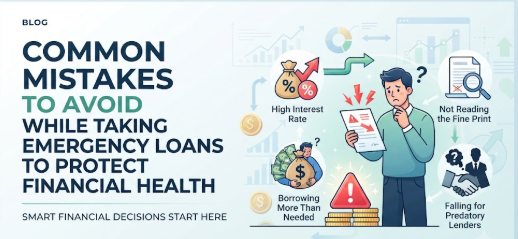
Month-end money pressure becomes stressful when urgent expenses arrive before salary. When a medical crisis, sudden vehicle breakdown, or an unplanned home repair hits, emotional stress rises rapidly. In these moments of panic, many beginners focus entirely on how fast they can get cash, completely ignoring the terms and conditions tied to the money. This clear lack of structural understanding opens the door to predatory lenders, high-interest traps, and hidden application fees that can destroy a household budget for years. Understanding the common mistakes to avoid while taking emergency loans is not just about saving money; it is about preserving your long-term financial survival. This comprehensive educational guide breaks down the hidden mechanics of urgent borrowing, helping you maintain clear control, make balanced choices under immense pressure, and secure necessary financing without causing self-inflicted damage to your underlying credit score.
What is Emergency Loans ?
An emergency loan is an unsecured personal loan designed to provide fast cash for sudden, unavoidable expenses. Unlike standard mortgages or car loans that require weeks of verification, these financing options emphasize rapid processing, often disbursing funds within hours.
People search for these options because they face immediate cash flow shortfalls and require instant relief. In real life, these loans are used for medical bills, critical appliance failures, or urgent travel. They connect deeply with personal finance because they carry much higher interest rates than standard structured loans due to the speed and elevated default risk borne by the lender.
- Beginner-Friendly Example: Imagine your laptop breaks down suddenly, and you cannot perform your remote job. You do not have cash saved up, so you apply for a rapid digital credit line to buy a replacement immediately.
- Common Misunderstanding: Many people mistakenly believe that because a loan app is available for download on an official app store, its interest rates and collection methods are automatically fair, legal, and government-regulated.
- Practical Takeaway: Speed always costs money. The faster a lender promises to give you cash without verification, the more expensive that loan will be over time.
Why Financial Awareness in Crisis Borrowing Is Important
When an urgent crisis hits, your financial awareness acts as your shield against exploitation. Unplanned debt directly cuts into your future savings, limits your ability to borrow for wealth-building assets like homes, and drastically reduces your monthly investing capacity. Making poor borrowing decisions under panic leads to a vicious cycle where a person takes out a second loan just to pay off the first one, breaking all sense of long-term financial discipline.
Consider a practical scenario: Two individuals face a sudden bill of ₹50,000. Individual A panics and uses a high-cost instant cash app with a 45% annual interest rate and heavy weekly processing fees. Individual B stops, evaluates their options, and chooses an overdraft facility against their existing salary account at 14% annual interest. Within six months, Individual A is struggling with aggressive collection calls, while Individual B has smoothly closed the debt with minimal total interest outflow.
The Real Problem Readers Face With Emergency Credit
The true issue is not the lack of money; it is the overwhelming presence of confusing, predatory advice online that preys directly on panic. When people are stressed, emotional decision-making overrides basic logic, causing them to skip reading terms and conditions entirely. Lenders exploit this vulnerability by highlighting “instant approval” in bold letters while hiding processing costs, compounding interest structures, and steep late penalties deep inside fine-print dropdown menus. Salaried workers and small business owners often find themselves trapped because they trust random social media advertisements, fail to compare alternative borrowing lines, and hold unrealistic expectations about how quickly they can pay the money back out of their regular cash flow.
How to Secure Urgent Funding Safely Step by Step
Step 1: Calculate the Exact Financial Shortfall
- What it means: Determining the absolute minimum amount of cash required to resolve the immediate problem.
- Why it matters: Borrowing even a little extra cash unnecessarily increases your core interest burden and monthly payment size.
- How to apply it: Review the actual crisis bill or invoice directly, and write down that exact number down to the last digit.
- Common mistake: Adding an extra ₹10,000 to the loan application just to have a soft buffer for minor lifestyle spending.
- Better approach: Borrow strictly what is needed to fix the crisis, and look for alternative ways to cut back on regular monthly items.
Step 2: Review Your Existing Banking Lines First
- What it means: Checking with your primary bank where your salary drops to see if you have pre-approved credit features.
- Why it matters: Established banks offer much lower interest rates to long-term account holders than unknown digital apps.
- How to apply it: Log into your primary mobile banking portal and check the pre-approved offers or personal overdraft tabs.
- Common mistake: Assuming your main bank will take too long and skipping straight to a risky, high-cost third-party platform.
- Better approach: Contact your relationship manager or check online apps for instant pre-approved cash options before looking elsewhere.
Step 3: Compare Annualized Costs Across Three Regulated Lenders
- What it means: Looking at the Annual Percentage Rate (APR) rather than just focusing on the basic monthly interest numbers.
- Why it matters: APR shows you the total comprehensive cost, combining the interest rate and upfront processing fees together.
- How to apply it: Ask every lender for a written key fact statement showing the absolute total repayment amount over the loan term.
- Common mistake: Falling for a low “1.5% per month” headline rate while missing a massive 10% upfront documentation fee.
- Better approach: Run the numbers through an independent tool to verify the true annual cost across all options.
Step 4: Audit the Complete Fee Schedule for Hidden Charges
- What it means: Scanning the agreement document specifically for operational, late, and early repayment penalties.
- Why it matters: Hidden charges can quickly double the cost of your debt if you miss a single payment date by accident.
- How to apply it: Read the terms section labeled “Fees and Penalties” line by line before clicking the final digit sign-off button.
- Common mistake: Skipping the text block because you assume all loan contracts contain the exact same standardized rules.
- Better approach: Explicitly ask the loan officer to detail all potential costs for late payments or closing the loan early.
Step 5: Match the Monthly EMI to Your True Surplus Income
- What it means: Ensuring the new Equated Monthly Installment (EMI) fits comfortably within what you have left after regular living costs.
- Why it matters: If the EMI is too high, you will default on your next cycle, which damages your credit score.
- How to apply it: Take your net monthly take-home salary, subtract all fixed rents and grocery bills, and see what is actually left.
- Common mistake: Committing to an EMI that takes up your entire extra income, leaving zero room for basic daily living.
- Better approach: Pick a slightly longer repayment term to lower the monthly EMI down to a safe, sustainable level.
Step 6: Confirm the Regulator Status of the Platform
- What it means: Verifying that the lender is explicitly licensed by the central banking authority as a bank or registered Non-Banking Financial Company (NBFC).
- Why it matters: Unregulated lending apps operate illegally, use abusive collection methods, and change terms arbitrarily.
- How to apply it: Look up the lender’s name directly on the official central bank portal list of approved financial institutions.
- Common mistake: Trusting an app simply because it has thousands of positive, potentially fake reviews on the app store.
- Better approach: Refuse to share data with any digital platform that does not openly display its registered NBFC partner details.
Step 7: Automate the Repayment Schedule Immediately
- What it means: Setting up a secure standing instruction or auto-debit feature on your main account for the payment dates.
- Why it matters: It removes human error, preventing forgotten deadlines, bounce charges, and sudden hits to your credit score.
- How to apply it: Fill out the official e-mandate form accurately during the final loan setup process.
- Common mistake: Relying on manual monthly reminders while dealing with the stress of an ongoing family emergency.
- Better approach: Schedule the auto-debit to execute exactly two days after your monthly salary hits your account.
Key Factors That Influence Urgent Borrowing Decisions
- Interest Rate Structure: Lenders use either reducing balance or flat rate systems. A flat rate applies interest to the original total loan amount throughout the term, making it significantly more expensive than a reducing rate system.
- Upfront Processing Fees: This is cash taken out before the money even hits your account. A high processing fee reduces the actual money you take home while keeping your total debt amount high.
- Loan Tenure Length: A short tenure means higher monthly payments but lower total interest paid. A long tenure reduces the monthly strain but increases the total cash spent over time.
- Credit Score Health: Your historical credit history dictates your bargaining power. A strong score unlocks lower rates, while a weak score forces you into high-cost, high-risk lending tiers.
- Prepayment Rules: Some lenders charge heavy penalties if you try to pay off the debt early using your monthly salary or bonus. Finding a lender with zero prepayment fees is crucial for emergency situations.
- Hidden Operational Charges: These include statement fees, loan cancellation costs, and digital platform access fees that slowly add up over time.
- Repayment Capacity Margin: This is your clear financial runway. Borrowing beyond 30% to 40% of your net income creates a severe threat to your basic household stability.
Detailed Breakdown of Emergency Credit Infrastructure
What an Emergency Loan Means Physically
An emergency loan is a high-speed capital tool used to bridge an unexpected cash gap. Because it is unsecured, the lender takes on higher risk, which they balance by charging higher interest rates and strict processing fees. Understanding this reality changes how you approach borrowing when you are under pressure.
When Borrowing Makes Structural Sense
Borrowing money makes sense only when the problem is an absolute necessity that cannot wait. A medical emergency, a major home repair that stops you from living safely, or fixing a vehicle you need to get to work are valid reasons. In these situations, the cost of not fixing the problem is higher than the interest on the loan.
When Borrowing Should Be Avoided Completely
Never use emergency credit for non-urgent wants or lifestyle items. Buying a new phone on credit, funding a vacation, or covering casual weekend spending are terrible reasons to take out a high-interest loan. Using fast credit lines to cover lifestyle choices is a primary cause of long-term personal bankruptcy.
The Hidden Cost Mechanics: Interest and Fees
Lenders frequently market their products based on speed, which draws focus away from the actual costs. Beyond the headline interest rate, you must check the processing fees, documentation charges, platform onboarding costs, and mandatory insurance riders. These upfront fees can quietly eat up 5% to 10% of the total approved loan value before it reaches your account.
Credit Score Impact and Long-Term Repayment
Every single emergency application triggers a hard credit inquiry on your profile. Making multiple applications across different apps within a few days signals panic to credit bureaus, causing your score to drop immediately. Additionally, if you miss a payment deadline, it damages your credit history, making future loans for homes or businesses far more expensive.
Common Mistakes Beginners Make With Urgent Debt
- Following Random Advice: Beginners often apply through links sent via SMS or social media videos, which often lead directly to illegal, data-stealing platforms.
- Ignoring Risk Factors: Assuming that you will easily pay the money back next month without checking if your salary surplus can actually handle the new expense.
- Not Comparing Options: Choosing the very first mobile app that pops up on a search page, missing out on far cheaper alternatives from traditional banks.
- Trusting Fake Approval Claims: Falling for platforms that promise “100% guaranteed approval with no credit check,” which are almost always advance-fee scams designed to steal your upfront processing money.
- Ignoring Hidden Fees: Focusing entirely on the monthly payment size while missing hefty admin fees and high compounding late fees.
- Making Emotional Decisions: Signing the agreement documents in a state of high stress without reading the legal obligations you are taking on.
DON'T DO THIS CHECKLIST:
- Don't apply for multiple loans simultaneously across different digital apps.
- Don't share your sensitive bank passwords or security PINs with any loan agent.
- Don't take a loan to invest in high-risk assets like cryptocurrency or trading.
- Don't borrow extra money beyond the immediate cost of the emergency.
- Don't ignore aggressive collection terms written into the fine print.
- Don't use unverified, non-licensed loan apps downloaded from third-party links.
Practical Real-Life Examples of Emergency Borrowing
- Situation 1: Salaried worker dealing with a sudden family medical bill.
- Mistake: Borrowing from an unverified digital app that charged 50% APR due to panic.
- Better Action: Requesting an advance from their company or using an official bank salary overdraft line.
- Learning: Traditional employers and primary banks often provide safer, cheaper emergency lifelines than instant online apps.
- Situation 2: A small business owner facing a sudden equipment breakdown.
- Mistake: Taking multiple instant consumer loans under their personal name, which hurt their credit score.
- Better Action: Applying for a formal merchant credit line backed by their business point-of-sale invoices.
- Learning: Matching the right type of debt to the situation keeps your personal and business credit profiles safe.
- Situation 3: An individual using credit cards for an emergency auto repair.
- Mistake: Leaving the large balance on their card, resulting in a 42% compounding interest charge.
- Better Action: Transferring the balance into a structured 12-month EMI plan at a much lower rate.
- Learning: Converting high-interest card debt into a fixed repayment plan saves thousands in interest costs.
- Situation 4: A beginner applying for an instant loan through a social media ad.
- Mistake: Allowing the app access to their full contact list just to speed up the approval process.
- Better Action: Closing the app and applying through a transparent, verified bank portal.
- Learning: Data privacy matters; never give up control of your phone’s personal data just for quick cash.
- Situation 5: A borrower trying to close their loan early after getting a work bonus.
- Mistake: Paying the balance without reading the contract, resulting in a surprise 6% prepayment fee.
- Better Action: Verifying the foreclosure terms first and timing the payment to minimize extra charges.
- Learning: Always check the exit costs of a loan before making early repayments.
Table 1: Lender Type vs Total Cost Matrix
| Lender Type | Average Interest Range (Annual) | Processing Fee Structure | Disbursal Speed | Risk Tier Level |
| Traditional Public Banks | 10% – 15% | Low (0.5% – 1%) | 2 to 5 Business Days | Very Low / Highly Regulated |
| Private Financial Institutions | 12% – 18% | Medium (1% – 2%) | 24 to 48 Hours | Low / Compliant |
| Licensed Digital NBFC Apps | 18% – 36% | High (2% – 5%) | 1 to 4 Hours | Medium / High Cost |
| Unregulated Instant Apps | 45% – 100%+ | Extreme (10% – 20%) | Under 15 Minutes | Critical Risk / Predatory |
Table 2: Common Mistakes vs Correct Financial Approach
| The Common Mistake | Immediate Negative Impact | The Correct Financial Approach | Long-Term Benefit Generated |
| Borrowing extra buffer cash | Increases total interest and monthly payment pressure | Borrow strictly the exact invoice amount | Saves money and prevents lifestyle inflation |
| Skipping the fee schedule print | Unexpected cash deductions at disbursal | Request a clear Key Fact Statement | Avoids surprise fees and hidden charges |
| Applying to multiple apps at once | Lowers credit score via hard inquiries | Use independent comparison portals | Protects credit history and options |
| Choosing the fastest processing | Pay the highest possible interest rates | Check your primary salary bank first | Secures the lowest available market rate |
Tools, Methods, and Frameworks Readers Can Use
- Online EMI Calculators: A digital tool that lets you plug in the principal amount, interest rate, and tenure to see your exact monthly payment before you apply. Using this helps you avoid taking on an unaffordable monthly debt burden.
- Debt-to-Income Framework (DTI): A simple math formula where you divide your total monthly debt payments by your gross monthly salary. Keeping this number below 35% ensures your household finances stay safe and balanced.
- Key Fact Statement (KFS) Audit Method: A systematic approach where you force the lender to provide a single, one-page summary listing all costs, fees, and interest parameters clearly. This simple check protects you from hidden charges hidden deep within long legal documents.
- Central Bank Portal Verification: A quick lookup process where you check the official regulatory database to confirm a lender is properly licensed. Using this simple step keeps you completely safe from illegal, predatory lending apps.
Expert Tips to Make Better Decisions
- Learn the Terms Before Acting: Spend 15 minutes understanding the difference between flat interest rates and reducing balance structures.
- Compare at Least Three Distinct Options: Never accept the first offer; look at alternative lenders to find the best market rate.
- Check the Total Annual Cost First: Focus entirely on the comprehensive APR rather than just looking at small monthly fee headlines.
- Keep Complete Digital Records: Save copies of all signed loan agreements, payment receipts, and closure certificates in a secure folder.
- Avoid Emotional, Panic-Driven Decisions: Step away from your phone for ten minutes to clear your mind before signing a binding financial contract.
- Review Your Household Budget Monthly: Adjust your regular spending plan immediately to account for the new loan payment.
- Start with the Smallest Needed Amount: Minimize your debt burden by borrowing only what is required to solve the immediate problem.
- Protect Your Personal Smartphone Data: Never grant a loan app permission to view your location, photos, or personal contact lists.
- Avoid Outrageous, Flashy Promises: Turn away from any platform that guarantees instant approval without verifying your basic credit data.
- Read the Early Closure Rules Carefully: Choose lenders that allow you to pay off the debt early without charging heavy penalties.
Case Studies: How Better Understanding Changes Decisions
Case Study 1: The Salaried Professional
- Profile: Rahul, a Senior Software Engineer based in a major city.
- Situation: Faced an unexpected medical bill of ₹1,20,000 not covered by his basic insurance plan.
- Wrong Approach: In a panic, Rahul clicked on a sponsored social media link promising instant cash approval within ten minutes. He uploaded his personal ID data without reading the fine print, which hid a high 48% annual compounding interest rate and an upfront 8% documentation fee.
- Better Approach: Rahul paused and logged into his primary bank app, where his monthly salary is deposited. He found a pre-approved personal overdraft feature with an annual interest rate of 13.5% and zero processing fees for long-term clients.
- Result: By taking the bank overdraft, Rahul saved over ₹40,000 in unnecessary interest and fees, avoiding aggressive collection calls.
- Key Takeaway: Checking your primary banking relationship first during a crisis can save you from high-interest debt traps.
Case Study 2: The Small Retail Business Owner
- Profile: Sunita, operator of a local neighborhood retail grocery store.
- Situation: Her main commercial delivery vehicle broke down, stopping daily business operations. She needed ₹80,000 for immediate repairs.
- Wrong Approach: Sunita applied for multiple instant personal loans across five different mobile apps simultaneously, hoping one would say yes quickly. This caused her credit score to drop by 45 points due to multiple hard inquiries hitting her profile at the same time.
- Better Approach: Sunita used a single online comparison portal to check options without triggering hard inquiries. She chose a reputable, licensed NBFC that offered business equipment lifelines specifically designed for local retailers.
- Result: Her repair was fully funded at a fair interest rate, and her credit profile remained stable for future business needs.
- Key Takeaway: Spreading multiple applications across random apps hurts your credit profile when you need it most.
Case Study 3: The Young Corporate Employee
- Profile: Priya, an account executive who recently entered the workforce.
- Situation: Needed ₹35,000 immediately to cover an unexpected security deposit for a sudden apartment move.
- Wrong Approach: Priya used a high-cost digital payday app without checking the exit terms. When she tried to pay off the full debt early using her next month’s salary bonus, she was hit with a surprise 10% early repayment penalty.
- Better Approach: Priya requested a transparent personal loan with zero foreclosure fees, allowing her to clear the debt early without penalties.
- Result: She paid off the loan cleanly in 45 days, paying only the exact interest for the weeks she used the money.
- Key Takeaway: Always check the exit and prepayment rules of a loan contract before signing.
Risk Awareness: What Readers Must Check First
- Interest Rate Escalation Risk: Certain digital credit lines use floating terms that increase your interest rate if the broader economy shifts. Always ensure your contract states a fixed, stable rate.
- Credit Profile Damage Risk: Missing a single monthly payment by even 24 hours can lower your credit score, making future loans for homes or cars far more expensive.
- Data Security and Privacy Exploitation: Rogue apps often download your personal photos and contact lists to use for aggressive collection harassment. Never give an app access to your phone’s storage.
- The Debt Trap Cycle: Taking out a high-cost loan can drain your monthly surplus, forcing you to borrow more money just to pay off the original debt.
- Unregulated Platform Fraud: Shady lenders often pose as official brands to steal your identity or demand upfront fees before disappearing without sending the loan money.
Checklist Before Taking Action
- Verify the lender is officially registered with the central banking authority.
- Check the exact Annual Percentage Rate (APR), including all hidden processing fees.
- Confirm the loan document has zero hidden charges or unexpected management fees.
- Make sure the monthly payment takes up less than 35% of your clear surplus monthly income.
- Read the exact rules regarding early repayment and loan foreclosure penalties.
- Ensure you have selected a fixed interest rate structure instead of an unpredictable flat rate.
- Keep your personal phone contacts, location data, and private photos completely protected.
- Read the full terms and conditions document line by line before signing.
Crucial Application Strategy: Do not check these boxes off casually. Use this list as a formal review tool before signing any contract to ensure you are protected against predatory terms.
Strategic Insights for Better Decision-Making
Understanding Your Debt-to-Income (DTI) Balance
Your financial health depends heavily on your overall debt ratio. A high debt load leaves you vulnerable to sudden shifts in the economy. By keeping your monthly loan payments well below your regular surplus income, you maintain a safety buffer that keeps you secure even during unexpected work transitions or health issues.
Managing the Total Cost of Credit Over Time
When choosing a loan, look beyond the simple monthly payment amount. A lower monthly payment spread over a long time can actually cost you far more in total interest. The smart path is to choose the shortest repayment period your monthly salary can comfortably handle, keeping your total interest costs as low as possible.
Building a Personal Emergency Reserve Plan
The ultimate protection against high-interest emergency debt is creating your own emergency savings fund. By automatically setting aside a small part of your monthly salary into a separate account, you build a financial cushion. Over time, this fund grows large enough to cover unexpected costs completely, freeing you from relying on expensive loans in the future.
Key Terms Explained for Beginners
- Annual Percentage Rate (APR): The total comprehensive cost of a loan expressed as a yearly percentage, combining the base interest rate and all upfront processing fees together.
- Reducing Balance Interest: A fair interest calculation method where the interest charge is based only on the remaining unpaid loan balance, rather than the original total borrowed amount.
- Processing Fee: A one-time administrative charge taken out by the lender upfront to cover the costs of checking and setting up your loan application.
- Foreclosure Fee: A penalty charge some lenders apply if you pay off the full balance of your loan before the official contract term ends.
- Hard Inquiry: A formal credit history check run by a lender that shows up on your profile and can temporarily lower your overall credit score.
- NBFC (Non-Banking Financial Company): A licensed financial institution that provides loan services but does not hold a full traditional banking license.
- Equated Monthly Installment (EMI): The fixed, regular monthly amount you pay to clear your loan, covering a mix of both the principal amount and interest costs.
- Predatory Lending: Unfair or deceptive practices used by lenders to trap borrowers in high-cost debt cycles through hidden fees and confusing terms.
- Credit Bureau: An independent organization that tracks your borrowing habits and calculates your overall financial credit score.
- Loan Default: A serious situation that happens when a borrower breaks the contract by missing their scheduled loan payments for multiple months.
Who Should Read This Blog
- Salaried Employees: Learn how to balance emergency loan payments with your regular monthly pay cycles safely.
- Small Business Owners: Discover how to navigate sudden cash flow gaps without hurting your business or personal credit profiles.
- Financial Beginners: Gain a clear, simple breakdown of credit terms to protect yourself from predatory digital apps.
- Finance Bloggers and Creators: Access reliable, expert insights to share accurate consumer safety tips with your own readers.
Frequently Asked Questions
What is the single biggest common mistake to avoid while taking emergency loans?
The single biggest error is focusing entirely on how fast the money is approved while completely ignoring the long-term annual interest rate and hidden processing fees. This oversight often traps people in expensive debt cycles that become very difficult to exit.
How do I verify if an instant online emergency loan platform is safe and legal?
Always check the official central banking database to ensure the app is directly partnered with a licensed bank or registered Non-Banking Financial Company (NBFC). Safe platforms will clearly display these official regulatory details on their main websites.
Will applying to multiple digital loan platforms simultaneously hurt my personal credit score?
Yes, every single formal application triggers a hard check on your profile. Making multiple applications within a short window signals financial distress to credit bureaus, which causes your credit score to drop quickly.
What is the difference between a flat interest rate and a reducing balance rate structure?
A flat rate calculates interest on your total original loan amount for the whole term, making it much more expensive. A reducing balance structure calculates interest only on what you still owe, which saves you money over time.
Can a lender legally access my private smartphone photos and personal contacts?
Legitimate, regulated platforms do not require access to your personal photos or contact lists to approve a loan. If an app demands these permissions as a requirement, close it immediately to protect your privacy.
What hidden fees should I look out for in an emergency loan contract?
Always review the fine print for upfront documentation fees, monthly account maintenance charges, early foreclosure penalties, and steep compounding late fees that apply if you miss a deadline.
Is it better to use a personal credit card or an emergency personal loan for a crisis?
If you can convert your credit card balance into a structured, low-interest installment plan, it can be a good option. However, leaving a large balance on a standard card can trigger high interest charges of over 40% annually.
How much of my monthly salary can safely go toward paying off loan EMIs?
As a safe rule, your total monthly debt payments should never take up more than 35% of your regular take-home salary. Exceeding this limit leaves your household budget highly vulnerable to unexpected expenses.
Can I pay off my emergency loan early if I receive a sudden work bonus?
Most regulated lenders allow early repayment, but some charge a foreclosure fee to make up for lost interest. Always check the early repayment rules in your contract before sending the extra cash.
What should I do immediately if I realize I cannot make my upcoming loan payment?
Contact your lender right away before the deadline passes. Most legitimate institutions are willing to adjust your payment schedule or offer a temporary extension if you reach out with honest communication.
Why are the interest rates on instant digital apps higher than traditional bank loans?
Instant apps process loans quickly with very little security or verification, taking on much higher default risk. They balance this risk by charging higher interest rates and processing fees to their users.
What is the best immediate step to take after successfully closing an emergency loan?
Request a formal No Dues Certificate (NDC) or Closure Letter from the lender. Check your official credit report a month later to confirm the debt is listed as fully paid and closed.
Conclusion
Navigating unexpected financial emergencies requires a calm mind and a careful look at your borrowing options. While the need for fast cash can make you want to skip the details, remembering the common mistakes to avoid while taking emergency loans is your best protection against deep financial trouble. Take the time to look past basic marketing taglines, verify the licensing of your chosen lender, and calculate the true total cost of the debt before signing any agreement. By staying informed and making balanced decisions under pressure, you protect both your short-term budget and your long-term credit health. Use the checklists and insights in this guide to build a secure, well-planned approach to managing debt responsibly.
