Introduction
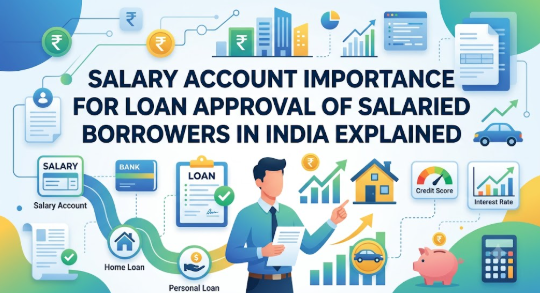
Many salaried people believe that receiving a regular monthly income is enough to qualify for a loan, but lenders usually look at several factors before making a decision. A salary account helps create a clear financial record showing salary credits, employer details, existing EMIs, monthly spending patterns, payment behaviour, and available repayment capacity. This makes income verification easier and gives lenders a better understanding of the applicant’s financial stability. However, having a salary account does not guarantee loan approval because credit history, employment stability, debt burden, documents, loan amount, and lender policies also matter. Understanding why salary account matters for loan approval helps beginners prepare properly, avoid repeated applications, compare offers carefully, and choose a loan amount that fits comfortably within their monthly income.
What is Salary Accounts ?
A salary account is a bank account into which an employer regularly deposits an employee’s monthly salary.
It may look similar to a normal savings account, but it is generally opened or designated under an arrangement between an employer and a bank. The exact features can vary depending on the bank, employer relationship, account category, and applicable terms.
For an employee, the account becomes the main point through which monthly income is received and used.
For a lender, it can become an important source of financial evidence.
How a Salary Account Works
The employer transfers the employee’s salary into the designated bank account on a regular salary date. The account holder may then use that money for household expenses, rent, investments, insurance premiums, EMIs, utility bills, card payments, and savings.
Over time, the account statement creates a financial record showing:
- Salary credit dates
- Salary amounts
- Employer narration or transfer details
- Monthly account balances
- Existing EMI deductions
- Credit card payments
- Cash withdrawals
- Returned transactions
- Overdraft usage, where applicable
- Other regular income or expenses
This transaction history helps lenders understand whether the income shown in the application is consistent with actual banking records.
Why People Search for Salary Account Loan Eligibility
Most people search for this topic when they are considering:
- A personal loan
- A home loan
- A vehicle loan
- An education-related loan
- A consumer durable loan
- A credit card
- An overdraft facility
- A salary-linked credit product
They usually want to know whether receiving salary in a particular bank improves their chances of approval.
The practical answer is that a clear salary record can support the application, but approval still depends on the lender’s complete assessment.
Beginner-Friendly Example
- Suppose Meera receives a monthly salary directly from her employer into the same bank account. Her statement shows regular salary credits, one manageable EMI, timely card payments, and a reasonable balance after monthly expenses.
- When she applies for a loan, the lender can verify her income more easily than if her salary were received irregularly in cash without supporting documents.
- This does not guarantee approval, but it gives the lender a clearer picture of her financial position.
Common Misunderstanding
A common misunderstanding is that a salary account itself is a form of loan security.
It is not.
The account provides evidence of income and financial activity. It does not protect the lender from default, job loss, excessive borrowing, inaccurate information, or poor repayment behaviour.
Practical Takeaway
Treat your salary account as a financial record, not merely a place where money arrives.
Regular income credits, disciplined transactions, timely payments, and controlled debt can make that record more useful when you need credit.
Why Salary Accounts Are Important for Loan Approval
A salary account can affect several parts of a loan assessment.
It Supports Income Verification
The lender needs to confirm that the income declared in the application is genuine and reasonably consistent.
A salary account may show:
- The salary amount
- The frequency of payment
- The employer’s name or transfer description
- Incentives or variable pay
- Irregular deductions
- Changes in monthly income
If the income credited into the account matches the salary slips and employment documents, verification becomes more straightforward.
It Shows Income Stability
- A single salary credit does not establish stability.
- Several months of regular salary deposits can help the lender see whether employment income is continuing consistently.
- Frequent gaps, major reductions, or unpredictable credits may require further explanation.
It Helps Estimate Repayment Capacity
Loan approval is not based only on gross salary.
The lender also considers how much income remains after:
- Existing EMIs
- Credit card obligations
- Rent or household expenses
- Insurance payments
- Recurring transfers
- Other fixed commitments
The account statement gives practical evidence of the applicant’s current financial burden.
It Shows Banking Behaviour
Regularly returned payments, cheque bounces, negative balances, excessive overdraft use, or repeated failed auto-debits may raise concerns.
A clean statement does not guarantee approval, but it can support the view that the applicant manages recurring obligations carefully.
It May Simplify Documentation
An existing relationship with the salary bank may reduce the amount of information that needs to be collected manually because the bank already holds account history and identity information.
However, updated documents or additional verification may still be required.
It May Create Eligibility for Pre-Assessed Offers
Some account holders may see pre-approved or pre-qualified loan offers based on their account activity, income pattern, and internal banking relationship.
Such offers remain subject to final terms, verification, eligibility checks, and lender policies.
It Affects Wider Financial Planning
The quality of your salary account activity can influence more than one loan application.
It can help you understand:
- How much you really save
- How much debt you already carry
- Whether another EMI is affordable
- Whether lifestyle spending is reducing eligibility
- Whether an emergency fund exists
- Whether your account is financially stable
Practical Scenario
- Rohit earns a reasonable monthly salary but has three active EMIs, frequent credit card payments, and very little balance left before the next salary date.
- Although his income appears strong, his available repayment capacity may be limited.
- His salary account helps the lender identify this pressure. A better approach for Rohit may be to reduce existing obligations before taking another loan.
The Real Problems Applicants Face With Salary Account-Based Loan Approval
The main difficulty is not opening or owning a salary account. The real challenge is understanding how lenders interpret the information inside it.
Lack of Awareness
Many applicants do not review their bank statements before applying.
They may overlook:
- Failed auto-debits
- Unpaid card balances
- Salary inconsistencies
- Existing EMI deductions
- Large unexplained transfers
- Low closing balances
- Frequent account overdrawing
These details may influence the lender’s assessment or create additional verification questions.
Confusing Online Advice
- Online content often oversimplifies the process by suggesting that salary account holders automatically receive loans.
- In reality, every lender may use its own internal eligibility criteria.
- Approval may depend on a combination of income, credit history, employment profile, age, debt burden, requested amount, tenure, documentation, and internal risk policies.
Emotional Decision-Making
People often apply during an urgent financial situation.
Pressure can make them:
- Apply for more than they can repay
- Accept the first available offer
- Ignore total borrowing cost
- Choose an unsuitable tenure
- Submit several applications quickly
- Hide existing financial obligations
Urgency should not replace affordability assessment.
Weak Comparison
A familiar salary bank may seem convenient, but convenience alone should not decide the loan.
Applicants should compare:
- Interest rates
- Processing fees
- Repayment tenure
- EMI amount
- Late payment charges
- Prepayment conditions
- Insurance or add-on costs
- Total repayment obligation
Unrealistic Expectations
- A regular salary does not eliminate risk.
- Job loss, medical expenses, family responsibilities, and other changes can affect repayment.
- Borrowers should assess how they would manage the EMI if income were interrupted temporarily.
Ignoring Terms and Conditions
- Applicants may focus only on the advertised interest rate.
- Important conditions can be hidden in or explained through the loan agreement, repayment schedule, sanction letter, or fee disclosure.
- Reading these documents is essential.
Depending Only on Social Media Advice
- General advice from social media cannot evaluate an individual’s income, liabilities, employment type, credit record, or financial goals.
- A borrowing decision should be based on verified documents and personal affordability, not popular opinions.
Not Knowing the Right Next Step
- Many people try to “improve approval chances” by submitting applications to several lenders.
- This may create repeated credit enquiries and unnecessary confusion.
- A better first step is to review eligibility, correct documentation gaps, understand existing debt, and apply selectively.
How Salary Account Assessment Works Step by Step
Step 1: The Lender Reviews the Loan Application
The application gives the lender basic information about your identity, employment, income, requested loan amount, purpose, existing obligations, and contact details. This matters because it creates the starting point for verification. You should enter information exactly as supported by your documents. For example, the salary amount in the application should reasonably match salary slips and bank credits. A common mistake is entering total annual compensation as monthly take-home income. The better approach is to distinguish gross salary, deductions, incentives, and net salary clearly.
Step 2: Identity and Employment Details Are Verified
The lender may verify your identity, address, employer, job role, employment duration, and current work status. This is important because a regular salary credit must be connected to a genuine and continuing source of employment. Applicants should keep current identity, address, and employment documents ready. A common mistake is submitting outdated employer information after changing jobs. The better approach is to disclose the current employer and explain any recent employment transition honestly.
Step 3: Salary Credits Are Matched With Income Documents
The lender may compare bank statement credits with salary slips, employment letters, tax records, or other permitted income documents. This step helps identify whether the declared income is regular and verifiable. For example, if a salary slip shows a certain net amount but the account regularly receives much less, the lender may seek clarification. A common mistake is treating reimbursements, bonuses, and one-time incentives as fixed monthly income. The better approach is to separate stable salary from variable earnings.
Step 4: Account Activity Is Examined
The lender may review the transaction history to understand how income is used. Regular EMI debits, credit card payments, failed transactions, overdraft usage, and closing balances can help reveal financial commitments. Applicants should review their statement before submission and prepare explanations for unusual entries. A common mistake is assuming that only salary credits matter. The better approach is to understand that the complete transaction pattern may contribute to the assessment.
Step 5: Existing Debt Obligations Are Calculated
Current EMIs and other regular debt payments are considered because they reduce the income available for a new loan. For example, an applicant earning ₹60,000 per month but already paying ₹30,000 toward debt may have limited capacity for another EMI. A common mistake is excluding a loan because it is being repaid from another account. The better approach is to disclose all active obligations and calculate the combined monthly burden.
Step 6: Credit History Is Checked
The salary account shows cash flow, while the credit report shows how previous and current credit obligations have been managed. Both can matter. Late payments, settlements, defaults, high credit utilisation, or many recent enquiries may affect the decision. A common mistake is assuming that a high salary can completely offset poor credit behaviour. The better approach is to review the credit report, correct genuine errors, and improve payment discipline before applying.
Step 7: The Requested Loan Is Tested Against Affordability
The lender evaluates whether the proposed EMI appears manageable after considering verified income and current commitments. The requested amount, interest rate, and tenure all affect affordability. Applicants should use an EMI calculator and prepare a realistic household budget. A common mistake is choosing the maximum available amount simply because it is offered. The better approach is to borrow only what is necessary and comfortably repayable.
Step 8: Final Risk Assessment and Decision Are Completed
The lender combines income evidence, employment stability, credit history, banking activity, debt burden, documentation, and internal eligibility rules. The application may be approved, declined, placed under review, or approved for a different amount or tenure. A common mistake is interpreting a decline as proof that every lender will reject the application. The better approach is to understand the reason where available, correct the underlying issue, and avoid immediately submitting multiple new applications.
Key Factors That Influence Salary Account Loan Eligibility
Regularity of Salary Credits
- Regular salary credits indicate continuity of income.
- Irregular salary payment does not always mean the applicant is unreliable. It may be caused by payroll practices, employment transitions, unpaid leave, or variable compensation.
- However, unexplained gaps can make income assessment more difficult.
- Better approach: Keep supporting documents ready for unusual salary months.
Net Monthly Income
- Lenders are generally interested in the income actually available for meeting monthly obligations.
- Gross salary may include components that do not enter the bank account directly.
- Common mistake: Using cost-to-company figures as usable monthly income.
- Better approach: Calculate affordability using net take-home salary.
Employment Stability
- A stable employment record may support confidence in continuing income.
- Frequent job changes, a recent employment transition, probation, contractual employment, or an approaching retirement date may affect assessment depending on lender policies.
- Better approach: Disclose employment status accurately and apply with realistic expectations.
Existing EMI Burden
- Every active EMI reduces the amount available for a new repayment.
- Even small loans can create pressure when several obligations operate together.
- Better approach: List all EMIs and card obligations before applying.
Credit Score and Credit History
- A credit score is one part of the credit profile, not the entire decision.
- Payment delays, settlements, defaults, credit utilisation, account age, and recent enquiries may also matter.
- Better approach: Review the complete credit report instead of focusing only on one number.
Bank Statement Quality
- A statement showing regular credits and controlled obligations may be easier to assess.
- Frequent failed deductions, negative balances, or unexplained large transactions may lead to additional questions.
- Better approach: Maintain sufficient balances for scheduled payments and keep records for unusual transactions.
Loan Amount and Tenure
- A larger loan creates a higher repayment obligation unless the tenure is extended.
- A longer tenure may reduce the monthly EMI but can increase the total amount paid over time.
- Better approach: Compare both EMI affordability and total borrowing cost.
Interest Rate
- Interest rate affects the EMI and total repayment.
- Applicants should understand whether the rate is fixed, floating, reducing-balance-based, or calculated through another permitted method.
- Better approach: Compare the effective repayment obligation, not only the headline rate.
Processing Fees and Other Charges
- Processing fees, documentation charges, insurance costs, taxes, late fees, and foreclosure conditions can influence total cost.
- Better approach: Read the fee schedule and sanction documents carefully.
Repayment Behaviour
- Past repayment discipline often helps lenders estimate future repayment risk.
- One accidental delay may not always define the entire profile, but repeated late payments can indicate financial stress.
- Better approach: Set reminders or auto-debits while maintaining enough balance.
Detailed Breakdown of Why Salary Account Matters for Loan Approval
What a Salary Account Tells the Lender
The salary account creates a picture of the applicant’s monthly financial cycle.
It may answer questions such as:
- Does salary arrive regularly?
- Is the credited amount stable?
- Are existing EMIs paid on time?
- Does the account frequently run out of funds?
- Are there failed auto-debits?
- Is there another major income source?
- Are there unusual transfers requiring explanation?
- Does the applicant retain any savings after expenses?
The statement does not tell the lender everything, but it provides practical evidence to support or challenge the information in the application.
When Borrowing May Make Sense
Borrowing may be reasonable when:
- The expense is necessary
- Repayment is affordable
- The loan serves a clear purpose
- Emergency savings are not enough
- The terms are understood
- Multiple offers have been compared
- The new EMI will not create excessive financial pressure
- A repayment backup plan exists
Examples may include necessary medical costs, essential home repairs, education, business equipment, or consolidating unsuitable debt under carefully reviewed terms.
Borrowing should still be evaluated case by case.
When Borrowing Should Be Avoided or Delayed
A loan may need to be avoided or postponed when:
- Income is uncertain
- Employment has recently ended
- Existing EMIs are already difficult to manage
- The loan is intended for unnecessary lifestyle spending
- The borrower does not understand the total cost
- Repayment depends on uncertain future income
- Emergency funds would be completely exhausted
- The applicant is borrowing to repay another loan without a proper restructuring plan
- The decision is being made under emotional pressure
Delaying an application can sometimes be more responsible than accepting unaffordable debt.
Salary Slips and Bank Credits Must Work Together
- Salary slips describe earnings and deductions.
- Bank statements show the actual money credited and how it moves afterward.
- A strong application generally requires consistency between these records.
Differences can occur because of:
- Reimbursements
- Incentives
- Tax deductions
- Unpaid leave
- Advance salary
- Bonus payments
- Payroll adjustments
- Employee benefit deductions
Applicants should be ready to explain legitimate differences.
How Employment Type Affects Assessment
- Permanent employees, probationary employees, contract workers, consultants, and commission-based earners may have different income patterns.
- A regular monthly deposit alone may not prove the same level of stability in every case.
- Lenders may request additional documents or apply different rules based on the employment arrangement.
- Better approach: Apply under the correct employment category and provide evidence that reflects your actual income structure.
Role of the Existing Salary Bank
Your existing salary bank may already have access to:
- Account history
- Salary frequency
- Average balances
- Payment patterns
- Existing products
- Identity records
- Internal customer history
- This may make assessment faster or support a pre-assessed offer.
- However, the existing bank is not automatically the best or cheapest option.
- Compare the full cost and conditions with other eligible lenders.
Importance of Income Continuity
- Lenders are interested not only in how much you earn today but also in the apparent continuity of that income.
- A very high salary received for only one month may provide less evidence than a moderate salary received regularly over a longer period.
- That does not mean recent employees cannot borrow. It means they may need to satisfy additional employment-duration or documentation requirements.
EMI and Repayment Planning
The EMI must fit within the applicant’s monthly budget after essential expenses and existing commitments.
A useful repayment review should include:
- Net salary
- Existing EMIs
- Rent
- Household expenses
- Insurance premiums
- Education expenses
- Medical costs
- Regular family support
- Savings contributions
- Emergency fund needs
The amount remaining after these obligations indicates whether a new EMI is realistic.
Hidden Charges and Total Borrowing Cost
The interest rate is only one part of the loan cost.
Applicants should review:
- Processing fees
- Applicable taxes on charges
- Documentation costs
- Insurance products
- Late payment charges
- Penal interest conditions
- Prepayment fees
- Foreclosure charges
- Bounce charges
- Account maintenance conditions, where relevant
A slightly lower interest rate may not always produce the lowest overall cost.
Credit Score Impact
- Applying for a loan may create a credit enquiry.
- Taking a loan creates a new repayment obligation.
- Timely repayments may support positive credit behaviour, while delays or defaults can damage the credit profile.
- Borrowers should not take a loan only to “build a score” unless the borrowing is needed, affordable, and responsibly planned.
Responsible Borrowing
Responsible borrowing means:
- Borrowing for a clear reason
- Choosing a manageable amount
- Understanding every charge
- Making payments on time
- Avoiding repeated applications
- Maintaining emergency savings
- Keeping personal information secure
- Contacting the lender early if repayment problems arise
The purpose is not merely to obtain approval. The purpose is to complete repayment without damaging financial stability.
Loan Comparison Basics
Applicants should compare offers using the same loan amount and similar tenure.
Review:
- EMI
- Interest structure
- Total repayment
- Processing fee
- Late payment rules
- Prepayment terms
- Insurance requirements
- Disbursal amount
- Customer support
- Agreement conditions
Avoid comparing one lender’s monthly rate with another lender’s annual rate without converting them to a comparable format.
Prepayment and Late Payment Impact
Prepayment can reduce interest cost in some situations, but charges or restrictions may apply.
Late payments can create fees, increase financial stress, and affect credit history.
Before signing, understand:
- Whether part-payment is allowed
- When prepayment can begin
- Whether charges apply
- How overdue payments are treated
- What happens after a failed auto-debit
- How payment allocation works
Common Mistakes Beginners Make With Salary Account Loan Applications
Assuming Regular Salary Guarantees Approval
- This happens because income is seen as the only eligibility factor.
- It is risky because lenders also examine debt burden, credit behaviour, employment status, documents, and internal policies.
- Do instead: Review the complete profile before applying.
Applying for the Maximum Offered Amount
- A pre-approved amount can feel like extra available income.
- The risk is that a larger loan creates a larger EMI and higher total repayment.
- Do instead: Borrow according to need and repayment comfort.
Ignoring Existing EMIs
- Applicants may consider each EMI separately and underestimate the combined burden.
- This can lead to monthly cash-flow pressure.
- Do instead: Add every debt payment together before taking another loan.
Treating Bonuses as Fixed Salary
- Variable bonuses may not be paid every month.
- Depending on them for EMI payments can create repayment problems.
- Do instead: Base the core repayment plan on stable income.
Emptying the Salary Account Every Month
- Moving money to another account is not automatically negative, but an account that always falls to almost zero may provide limited evidence of financial buffer.
- Do instead: Maintain a planned balance for upcoming debits and emergency needs.
Allowing Auto-Debits to Fail
- Failed deductions may occur because of insufficient balance or poor account management.
- Repeated failures can create charges and raise questions about repayment discipline.
- Do instead: Maintain enough money before scheduled debit dates.
Making Several Loan Applications Together
- This often happens when a borrower wants the fastest approval.
- Multiple enquiries can make the applicant appear credit-hungry and create confusion.
- Do instead: Compare eligibility first and apply selectively.
Ignoring Loan Agreement Terms
- Borrowers may focus only on the monthly EMI.
- Unexpected fees or prepayment restrictions can later create dissatisfaction.
- Do instead: Read the sanction letter, repayment schedule, fee disclosure, and agreement.
Sharing Sensitive Information With Unknown Agents
- Urgent borrowers can become vulnerable to fraud.
- Sharing account passwords, PINs, OTPs, or card credentials can lead to financial loss.
- Do instead: Use verified channels and never share confidential authentication details.
Hiding Existing Debt
- Applicants may fear that disclosing debt will reduce eligibility.
- Incomplete information can lead to verification problems and an unsuitable loan burden.
- Do instead: Provide accurate details and select an affordable amount.
Using Emergency Money for EMI Payments
- A loan that depends entirely on emergency savings may not be sustainable.
- Do instead: Build repayment capacity from regular income and preserve an emergency reserve.
Borrowing Under Panic or Social Pressure
Pressure from family, lifestyle expectations, or urgent sales offers can lead to poor decisions.
Do instead: Pause, compare, calculate, and review the purpose before borrowing.
Don’t Do This Checklist
- Do not assume a salary account guarantees approval.
- Do not submit false income or employment information.
- Do not hide existing loans or credit card debt.
- Do not apply to many lenders without a clear reason.
- Do not share OTPs, passwords, PINs, or card security details.
- Do not accept a loan without reviewing the total repayment.
- Do not depend entirely on bonuses for monthly EMIs.
- Do not use borrowed money for avoidable lifestyle pressure.
- Do not ignore failed auto-debits or overdue payments.
- Do not select a tenure based only on the lowest EMI.
- Do not sign incomplete forms or unread agreements.
- Do not borrow more simply because a higher amount is available.
Five Practical Real-Life Examples
Example 1: Salaried Employee With Stable Income
Situation: Ananya receives the same salary regularly and has no current EMI.
Challenge: She assumes she should take the maximum personal loan offered by her salary bank.
Better action: She calculates the amount actually needed, compares total costs, and selects a smaller loan with a manageable EMI.
Learning: Strong eligibility should not become a reason for unnecessary borrowing.
Example 2: Employee With Several Small EMIs
Situation: Karan earns a good salary but has a phone EMI, vehicle EMI, card instalment, and consumer loan.
Challenge: Each payment looks small, but the total monthly burden is high.
Better action: He postpones the new loan and clears two smaller obligations first.
Learning: Combined debt matters more than the size of any single EMI.
Example 3: Recent Job Changer
Situation: Sana recently joined a new company with a higher salary.
Challenge: Her account shows only two salary credits from the new employer.
Better action: She keeps her appointment letter, previous employment records, salary slips, and bank statements ready for verification.
Learning: Higher income helps, but continuity and documentation remain important.
Example 4: Applicant With Failed Auto-Debits
Situation: Ajay has sufficient monthly income but often transfers almost all his salary to another account.
Challenge: Two EMI auto-debits fail because he forgets to keep enough balance in the salary account.
Better action: He schedules transfers only after recurring payments and maintains a buffer.
Learning: Account management can be as important as income visibility.
Example 5: Borrower Comparing Salary Bank and Another Lender
Situation: Pooja receives a convenient offer from her salary bank.
Challenge: She is tempted to accept it without reviewing another eligible option.
Better action: She compares interest structure, processing fees, EMI, total repayment, and prepayment rules.
Learning: Existing banking relationships provide convenience, not automatic value.
Table 1: Salary Account Signals and Their Possible Meaning
| Salary account observation | What it may indicate | Better applicant approach |
|---|---|---|
| Regular salary credits | Stable and verifiable income | Keep salary slips and employment records consistent |
| Salary amount changes | Bonus, deduction, leave, or payroll adjustment | Maintain supporting documents and explanations |
| Several active EMI debits | Higher existing repayment burden | Calculate combined obligations before applying |
| Frequent failed auto-debits | Cash-flow or account-management problems | Keep a balance buffer before payment dates |
| Very low month-end balance | Limited monthly financial cushion | Review spending and strengthen emergency savings |
| Large unexplained transfers | Additional liabilities or unusual activity | Keep records showing the source and purpose |
| Regular savings transfers | Planned financial discipline | Ensure savings do not affect EMI affordability |
| Overdraft dependence | Possible recurring cash-flow pressure | Reduce reliance before taking new debt |
Table 2: Common Mistake Versus Responsible Approach
| Common mistake | Possible risk | Responsible approach |
|---|---|---|
| Borrowing the maximum offered | Unnecessary EMI pressure | Borrow only the required amount |
| Comparing only interest rates | Important charges may be missed | Compare total repayment and all fees |
| Ignoring current debt | Repayment capacity may be overstated | List every EMI and card obligation |
| Applying to many lenders | Multiple enquiries and confusion | Check eligibility and apply selectively |
| Depending on bonuses | Repayment may fail in low-income months | Use stable salary for affordability calculations |
| Hiding employment changes | Verification delays or rejection | Disclose current employment accurately |
| Sharing OTPs with agents | Fraud and unauthorised transactions | Use verified lender channels only |
| Choosing the longest tenure automatically | Higher total interest outflow | Balance EMI comfort with total cost |
Tools, Methods, and Frameworks Readers Can Use
EMI Calculator
- An EMI calculator estimates the monthly repayment based on loan amount, interest rate, and tenure.
- It helps beginners compare different repayment structures before applying.
- Use it to test whether the proposed EMI fits your household budget.
- It helps avoid choosing a loan based only on the amount available.
Repayment Planning Sheet
A repayment sheet lists:
- Net salary
- Fixed expenses
- Existing EMIs
- Card payments
- Proposed EMI
- Savings contribution
- Emergency fund balance
- Monthly surplus
This tool turns a borrowing decision into a clear cash-flow calculation.
It helps prevent the mistake of evaluating affordability from memory.
Credit Report Review
- A credit report review allows you to check active accounts, repayment history, enquiries, and possible reporting errors.
- Reviewing it before applying gives you time to dispute genuine inaccuracies through appropriate channels.
- It helps avoid surprises during lender assessment.
Salary Account Statement Review
Download or collect recent salary account statements and review:
- Salary dates
- Salary amounts
- Returned payments
- EMI debits
- Unusual transfers
- Cash withdrawals
- Closing balances
This method helps identify issues before the lender sees them.
Loan Comparison Checklist
Create a standard checklist covering:
- Loan amount
- Interest rate
- Interest type
- EMI
- Tenure
- Processing fee
- Total repayment
- Late charges
- Prepayment rules
- Insurance costs
- Net disbursal
- Customer support
Using the same checklist for every lender prevents incomplete comparisons.
Debt-to-Income Review Method
- This method compares monthly debt payments with monthly income.
- It helps you understand how much of your earnings already goes toward debt.
- Beginners should include all EMIs, not only the largest one.
- It helps prevent over-borrowing.
Monthly Money Review
Choose one day every month to review your salary account.
Check:
- Income received
- Bills paid
- Debt reduced
- Savings created
- Unexpected expenses
- Failed payments
- Upcoming obligations
This habit helps maintain loan readiness and improves general financial awareness.
Risk Checklist
Before borrowing, ask:
- Is the expense necessary?
- Can I pay the EMI during an emergency?
- Is my job income stable?
- Have I compared alternatives?
- Do I understand the total cost?
- Will this reduce my emergency savings?
- What happens if I miss a payment?
A written risk checklist reduces emotional decision-making.
Expert Tips to Make Better Loan Decisions
1. Base Affordability on Net Salary
- Use the amount that actually enters your account after deductions.
- This matters because gross salary may not be fully available for spending or repayment.
- Prepare your EMI budget using net take-home income and stable monthly earnings.
2. Borrow According to Need, Not Eligibility
- The maximum amount offered represents a lending limit, not a recommendation.
- Borrowing more than necessary increases total cost and monthly pressure.
- Write down the exact purpose and required amount before reviewing offers.
3. Add All Existing EMIs Together
- Small EMIs can create a large combined burden.
- Ignoring one card instalment or consumer loan can distort affordability.
- Review every bank account, card statement, and loan account before applying.
4. Maintain a Payment Buffer
- Keep enough money in the salary account for upcoming auto-debits.
- This prevents failed payments caused by timing differences or forgotten transfers.
- A practical approach is to separate bill money immediately after salary credit.
5. Compare Total Repayment
- A lower EMI does not always mean a cheaper loan.
- Longer tenure can reduce monthly pressure while increasing total interest paid.
- Compare the total repayment amount alongside EMI and tenure.
6. Avoid Repeated Applications
- Submitting many applications within a short period can create multiple enquiries.
- It may also make it harder to track offers and documents.
- Check broad eligibility and apply to a limited number of suitable lenders.
7. Keep Employment Documents Updated
- Recent salary slips, employment proof, identity documents, and current address information reduce avoidable delays.
- This is especially important after a promotion, transfer, or job change.
- Review all application details before submission.
8. Separate Fixed Salary From Variable Income
- Bonuses, incentives, reimbursements, and overtime may not occur regularly.
- Depending on them for mandatory EMI payments creates risk.
- Use fixed recurring salary for the main repayment plan and treat variable income as additional support.
9. Protect Personal Banking Information
- No legitimate process should require you to share your password, ATM PIN, card PIN, or one-time authentication code with an unknown person.
- Fraudsters often create urgency around loan approval.
- Use official channels and verify the identity of any representative.
10. Read Prepayment Conditions Early
- Many borrowers think about prepayment only after receiving extra money.
- Charges, lock-in periods, or restrictions may affect the benefit.
- Review part-payment and foreclosure terms before accepting the loan.
11. Preserve an Emergency Fund
- Do not use all available savings for initial charges or monthly repayments.
- Unexpected expenses can occur during the loan tenure.
- Maintain a separate emergency reserve appropriate to your circumstances.
12. Review the Account Before Applying
- Look for failed payments, unexplained credits, recent debt additions, or major balance fluctuations.
- This matters because the lender may ask for clarification.
- Preparing explanations and supporting records can reduce confusion.
13. Contact the Lender Before Missing Payments
- Financial difficulty should not be ignored.
- Early communication may provide more clarity about permitted options than waiting until several payments become overdue.
- Never assume that avoiding calls will solve repayment stress.
14. Avoid Borrowing for Social Pressure
- Weddings, gadgets, travel, and lifestyle upgrades can create emotional borrowing decisions.
- A loan continues after the excitement ends.
- Assess whether the expense can be postponed, reduced, or funded through savings.
15. Review Your Financial Position Every Month
- Income, expenses, and responsibilities change over time.
- A monthly review helps detect increasing debt before it becomes unmanageable.
- Track balances, EMIs, credit use, and progress toward savings goals.
Case Studies: How Better Understanding Changes Decisions
Case Study 1: The High-Income Applicant With Low Repayment Capacity
Profile: Vikram is a salaried technology professional earning a strong monthly income.
Situation: He applies for a personal loan to renovate his home.
Problem: His salary account shows a home loan EMI, vehicle loan EMI, two card instalments, and frequent large lifestyle expenses.
Wrong approach: Vikram focuses only on his gross salary and assumes the new loan will be approved easily.
Better approach: He prepares a repayment sheet, identifies unnecessary card instalments, reduces discretionary expenses, and postpones the application until two short-term obligations are cleared.
Result or learning: Vikram understands that income alone does not determine affordability. Reducing existing debt creates more monthly room and lowers financial pressure.
Key takeaway: A high salary cannot fully protect an applicant from excessive debt burden.
Case Study 2: The Recent Employee With Limited Salary History
Profile: Neha has moved from one established employer to another and received a salary increase.
Situation: She needs a vehicle loan shortly after joining.
Problem: Her current salary account shows only a limited number of salary credits from the new employer.
Wrong approach: She considers entering a longer employment duration on the application to appear more stable.
Better approach: She provides accurate joining details, previous salary statements, experience documents, current appointment proof, and available salary slips.
Result or learning: The application is assessed using genuine information. Even where additional verification is required, she avoids the risks created by false disclosure.
Key takeaway: Accurate documents are more valuable than trying to manipulate eligibility information.
Case Study 3: The Pre-Approved Offer That Was Not Automatically Suitable
Profile: Arjun is a salaried employee with regular account activity and a positive banking relationship.
Situation: He receives a pre-approved personal loan offer through his salary bank.
Problem: The offer is convenient, so he plans to accept it without comparing costs.
Wrong approach: He looks only at the offered loan amount and fast disbursal message.
Better approach: Arjun compares the EMI, tenure, processing fee, total repayment, prepayment conditions, and net amount received with another eligible offer.
Result or learning: He discovers that convenience and affordability are different considerations. He selects the option that better matches his repayment plan rather than acting immediately.
Key takeaway: A pre-approved offer should still be reviewed carefully before acceptance.
Risk Awareness: What Readers Must Check First
Over-Borrowing Risk
- Over-borrowing occurs when total debt becomes difficult to manage from regular income.
- It matters because one unexpected expense can disrupt several repayments.
- Reduce this risk by calculating all current and proposed EMIs before applying.
Interest Cost Risk
- Interest cost is the additional amount paid for using borrowed money.
- A longer tenure may lower the EMI but increase the total interest burden.
- Reduce this risk by comparing both monthly affordability and total repayment.
Employment Risk
- Salary-based repayment depends on continuing income.
- Job loss, delayed salary, unpaid leave, or reduced incentives can create repayment difficulty.
- Reduce this risk by maintaining emergency savings and avoiding an EMI that uses most of your monthly surplus.
Credit Risk
- Credit risk includes the possibility of damaging your credit history through late payments, defaults, or settlements.
- This can affect access to future borrowing.
- Reduce this risk by borrowing conservatively and making payments before the due date.
Fraud Risk
- Loan seekers may be targeted through fake approval messages, advance-fee demands, and fraudulent applications.
- Fraud can result in financial loss and identity misuse.
- Reduce this risk by using verified institutions and protecting passwords, PINs, OTPs, and identity documents.
Data Privacy Risk
- Loan applications require sensitive personal and financial data.
- Submitting documents through unknown websites or messaging accounts can expose that information.
- Reduce this risk by checking the legitimacy of the lender and using secure official submission methods.
Hidden Charge Risk
- Processing fees, bounce charges, late fees, insurance costs, and foreclosure charges can increase the effective cost.
- Reduce this risk by reviewing the complete fee disclosure and agreement.
Emotional Risk
- Urgency, fear, social pressure, or excitement can lead to unsuitable borrowing.
- Reduce this risk by taking time to compare, calculate, and discuss major decisions with a qualified professional where appropriate.
Misinformation Risk
- Online claims may promise guaranteed approval, no verification, or unrealistic benefits.
- Reduce this risk by relying on official documents and verified loan terms rather than promotional claims.
Legal and Documentation Risk
- False declarations, incorrect documents, or incomplete disclosures can create rejection, disputes, or other consequences.
- Reduce this risk by providing accurate information and keeping copies of every submitted document.
Refinancing and Debt-Cycle Risk
- Taking one loan to repay another without reducing the underlying debt problem can create a cycle of borrowing.
- Reduce this risk by analysing total cost, repayment duration, and whether consolidation genuinely improves affordability.
- Readers should verify all product-specific conditions directly and consult a qualified financial, tax, or legal professional where the situation requires personalised advice.
Checklist Before Applying for a Loan
- I understand why I need the loan.
- I have calculated the exact amount required.
- My salary credits are regular and properly documented.
- My salary slips match my bank credits.
- My employment information is current and accurate.
- I have reviewed my credit report.
- I have listed every existing EMI.
- I have included credit card instalments and minimum payments.
- I have calculated the proposed EMI.
- The EMI fits after essential household expenses.
- I have maintained emergency savings.
- I have compared more than one suitable offer.
- I have reviewed the interest structure.
- I have checked processing fees and other charges.
- I understand late payment consequences.
- I have checked prepayment and foreclosure rules.
- I know the total repayment amount.
- I have not depended on bonuses for the basic EMI plan.
- I have not applied to several lenders unnecessarily.
- I have verified the lender or platform.
- I will not share passwords, PINs, or OTPs.
- I have read the agreement and sanction documents.
- I have kept copies of all submitted documents.
- I have considered professional advice where needed.
- I am making the decision calmly rather than under pressure.
Use this checklist before submitting the application and again before accepting the final offer. Loan eligibility and loan suitability are different. An applicant may qualify for an amount that is still uncomfortable for the household budget. The final decision should be based on need, affordability, risk, and total repayment responsibility.
Strategic Insights for Better Loan Decision-Making
Debt-to-Income Awareness
- Debt-to-income analysis compares recurring debt payments with monthly income.
- The purpose is to understand how much income is already committed before adding another EMI.
- For example, two applicants with the same salary may have very different affordability if one has no debt and the other has several active loans.
- Beginners should calculate this using actual monthly payments rather than original loan amounts.
EMI Burden Planning
- An EMI should be judged alongside essential expenses and savings needs.
- A monthly instalment that appears manageable during a normal month may become difficult during a medical emergency, family event, or temporary income disruption.
- A better plan includes a financial buffer instead of using every remaining rupee for debt.
Credit Score Management
Credit management is a long-term activity.
Practical habits include:
- Paying on time
- Keeping card balances controlled
- Avoiding unnecessary credit enquiries
- Reviewing reports for errors
- Maintaining accurate contact information
- Closing or settling accounts through documented procedures
Do not take unnecessary loans only to chase a higher score.
Prepayment Planning
- Prepayment can help reduce outstanding debt, but borrowers should first review charges and maintain emergency savings.
- Using every available saving to close a loan may leave the borrower vulnerable to the next unexpected expense.
- A balanced approach may include partial prepayment while preserving liquidity.
Short-Term Versus Long-Term Debt Impact
- Shorter tenure can increase the EMI while reducing the total interest period.
- Longer tenure can lower monthly payments but keep the borrower in debt for longer.
- The correct choice depends on income stability, essential expenses, financial goals, and total cost.
Salary Growth Should Not Be Assumed
- Applicants sometimes justify a high EMI by expecting future increments.
- Salary growth is uncertain and may be affected by company performance, job changes, economic conditions, or personal circumstances.
- The loan should be affordable from current stable income rather than hoped-for income.
Lifestyle Inflation
- A salary increase can lead to higher spending on rent, subscriptions, gadgets, vehicles, and travel.
- This reduces the benefit of income growth and may weaken repayment capacity.
- Before taking a loan, review whether lifestyle expenses have increased faster than savings.
Emergency Fund Integration
- An emergency fund supports repayment stability during temporary disruptions.
- The appropriate amount varies by household, job stability, dependants, insurance coverage, and fixed obligations.
- The important principle is to avoid entering a long loan tenure with no financial buffer.
Account Consolidation for Clarity
Using too many bank accounts can make financial tracking difficult.
It may be useful to maintain a simple system:
- Salary account for income and fixed bills
- Separate account or allocation for savings
- Clear tracking of discretionary spending
- Central record of all EMIs
The goal is visibility, not merely account reduction.
Borrowing Purpose Evaluation
Classify the loan purpose as:
- Essential
- Productive
- Emergency-related
- Convenience-based
- Lifestyle-based
- Debt-repayment-related
This classification does not automatically determine whether borrowing is right, but it encourages a more thoughtful decision.
Key Terms Explained for Beginners
- Salary Account: A bank account used to receive regular salary payments from an employer. Its transaction history can support income verification during a loan application.
- Net Salary: The amount credited after deductions such as taxes, retirement contributions, insurance, or other payroll deductions. This is more useful for monthly repayment planning than gross salary.
- Gross Salary: Total salary before applicable deductions. It should not automatically be treated as fully available monthly income.
- Loan Eligibility: The lender’s assessment of whether an applicant meets its conditions for a particular credit product. Eligibility does not guarantee approval.
- Repayment Capacity: The applicant’s practical ability to pay the proposed EMI after existing obligations and essential expenses.
- EMI: Equated monthly instalment is the scheduled monthly payment made toward a loan. It generally contains principal and interest components.
- Interest Rate: The cost charged for borrowing money. The calculation method and tenure affect the total interest paid.
- Loan Tenure: The period over which the loan is repaid. A longer tenure may reduce EMI while increasing the repayment period and possible total cost.
- Processing Fee: A charge that may be collected for processing the application. Applicants should verify whether it is refundable and how it affects the disbursed amount.
- Credit Score: A numerical summary derived from credit history. It is one factor in loan assessment, not an approval guarantee.
- Credit Report: A record containing credit accounts, repayment history, enquiries, and other reported credit information.
- Pre-Approved Offer: An offer generated from available customer information or internal assessment. Final disbursal can still depend on verification, eligibility, and applicable conditions.
- Prepayment: Paying part or all of a loan before the scheduled completion date. Charges or conditions may apply.
- Foreclosure: Closing the entire outstanding loan before the original tenure ends. Borrowers should review the applicable process and charges.
- Debt-to-Income Ratio: A comparison between monthly debt payments and monthly income. It helps assess how heavily the applicant is already committed to debt.
Who Should Read This Blog
Beginners
Beginners can understand how lenders use salary account information and why regular income alone does not guarantee approval.
Students Entering Employment
New employees can learn how early banking habits may affect future credit readiness.
Salaried Employees
Employees can use the checklists and frameworks to review salary credits, expenses, EMIs, and loan affordability.
Small Business Owners With Salary Income
Business owners who also draw a salary can better understand why income classification and supporting records matter.
New Investors
Investors can avoid taking unaffordable loans to fund risky investments or market speculation.
Traders
Traders can understand why borrowed money should not be treated as risk capital and why repayment obligations continue regardless of market results.
Loan Seekers
Loan seekers can prepare documents, compare offers, calculate repayment capacity, and avoid common application mistakes.
Crypto Learners
Crypto beginners can recognise the danger of borrowing against salary income to invest in volatile or speculative assets.
Casino Content Creators
Casino content creators can understand responsible financial language and avoid presenting borrowing as a funding method for gambling.
Finance Bloggers
Finance writers can use the framework to explain salary-linked eligibility without making guaranteed approval claims.
People Improving Money Awareness
Readers trying to improve financial habits can use their salary account as a monthly income, expense, debt, and savings record.
People Trying to Avoid Financial Mistakes
The warning sections help readers identify over-borrowing, fraud, hidden charges, and emotional decision-making before these problems become serious.
Frequently Asked Questions
1. Why salary account matters for loan approval?
A salary account gives lenders a verifiable record of regular income and monthly banking activity. It can help with income assessment, but approval also depends on credit history, existing debt, employment stability, documentation, and lender rules.
2. Does having a salary account guarantee loan approval?
No. A salary account may support income verification, but it does not guarantee approval. The lender may also consider repayment capacity, credit behaviour, job stability, requested amount, and internal eligibility criteria.
3. Can I apply for a loan from a bank other than my salary bank?
Yes, subject to the other lender’s eligibility and documentation requirements. Compare the interest rate, fees, tenure, EMI, total repayment, and prepayment terms before deciding.
4. How many months of salary account statements may be required?
The required period varies by lender, product, applicant profile, and verification process. Applicants should check the specific document list and keep recent statements available in an official, readable format.
5. What happens when salary credits are irregular?
Irregular credits may lead to additional verification. Applicants can provide supporting documents explaining unpaid leave, bonuses, payroll adjustments, delayed salary, job changes, or other genuine reasons.
6. Why salary account matters for loan approval after changing jobs?
After a job change, the account shows when salary from the new employer began and whether the credited amount matches current employment documents. A limited history may require additional proof of previous and present employment.
7. Does transferring salary to another account affect eligibility?
Transferring money is not automatically a problem, but the lender may review whether scheduled EMIs are paid and whether sufficient funds remain for obligations. Clear transaction records and disciplined account management are helpful.
8. Can a high salary overcome a poor credit history?
A high salary may support repayment capacity, but it may not fully offset serious repayment problems, defaults, settlements, or excessive debt. Lenders generally evaluate the complete credit and income profile.
9. Should I accept a pre-approved loan from my salary bank?
Review it before accepting. Check the amount needed, EMI, total repayment, processing fee, interest structure, late charges, and prepayment terms. Pre-approved does not automatically mean suitable or cheapest.
10. What is the biggest mistake salaried borrowers make?
One major mistake is borrowing according to the maximum offered amount rather than actual need and repayment comfort. Eligibility should be treated as a limit, not as a recommendation to borrow more.
11. How can I improve salary account loan eligibility responsibly?
Maintain regular salary records, pay existing obligations on time, reduce excessive debt, review your credit report, avoid repeated applications, protect personal information, and choose a realistic loan amount.
12. What should I do after understanding why salary account matters for loan approval?
Review your salary statements, list current EMIs, check credit records, calculate an affordable EMI, compare suitable offers, and read all terms. Apply only when the loan has a clear purpose and manageable repayment plan.
Conclusion
Understanding why salary account matters for loan approval helps borrowers prepare more carefully before applying. A salary account gives lenders a clear view of regular income, existing EMIs, account activity, and repayment capacity. However, it does not guarantee approval because credit history, employment stability, debt burden, documents, interest rates, and lender policies also matter. Before applying, review your salary statements, calculate an affordable EMI, compare total repayment costs, and check all fees and conditions. Avoid repeated applications, protect your banking information, and keep emergency savings separate. Borrow only for a clear need and choose an amount that fits comfortably within your stable monthly income and long-term financial plan.
