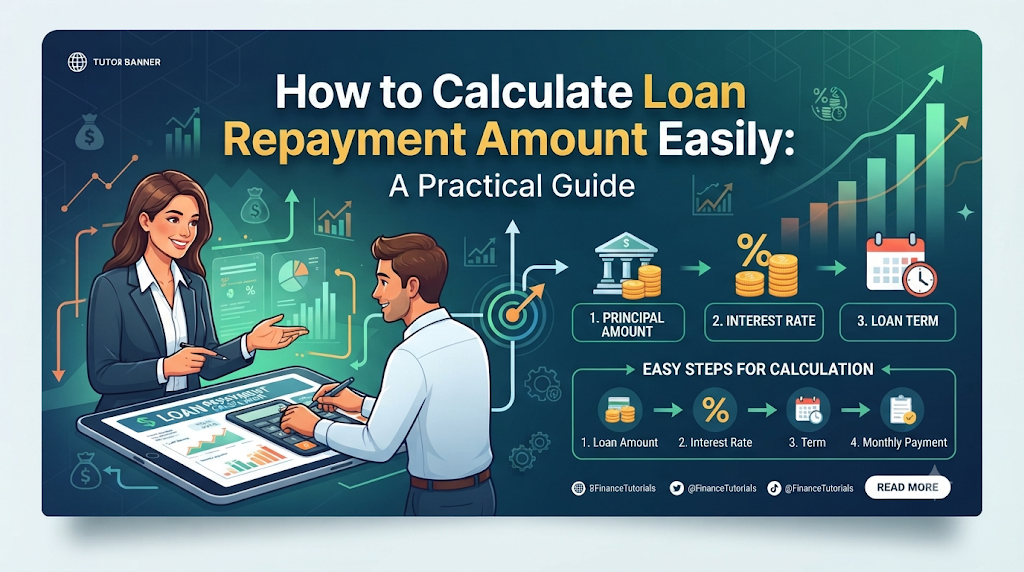
Introduction
Borrowing money is one of the most common financial decisions an individual or business owner will ever make. Whether you take out a mortgage to buy a home, finance a vehicle, or secure working capital for an enterprise, the central question remains the same: how much will this loan actually cost every month, and how much will leave your bank account by the end?
Many borrowers focus solely on whether a lender approves their application. Others look only at the advertised interest rate without realizing how repayment structures alter the real cost of debt. When you do not know how to calculate loan repayment amounts, you risk taking on debt that strains your monthly cash flow.
Understanding loan calculations gives you leverage. It allows you to spot misleading quotes, compare competing loan offers on equal terms, evaluate prepayment options, and protect your long-term financial health.
What Is a Loan Repayment Amount?
A loan repayment amount is the total sum of money you return to a lender over the life of a loan. It consists of two distinct components:
- Principal: The actual balance of money you borrowed.
- Interest: The fee the lender charges you for using their money over time.
In structured lending, repayments are usually divided into regular monthly installments known as Equated Monthly Installments (EMIs). Each EMI covers a portion of the interest due for that period alongside a portion of the original principal. By the time you make your final scheduled payment, both the principal and accrued interest drop to zero.
Beyond basic principal and interest, your full repayment cash outflow often includes mandatory administrative fees:
- Processing fees
- Documentation charges
- Loan insurance premiums
- Annual maintenance charges
- Prepayment or foreclosure penalties
Ignoring these additional fees means underestimating the true financial burden of the loan.
Flat Interest Rate vs. Reducing Balance Rate
The way a lender calculates interest determines whether a loan is affordable or surprisingly expensive. Borrowers most commonly encounter two calculation methods: flat rates and reducing-balance rates.
1. Flat Interest Rate
In a flat-rate loan, the lender calculates interest on the entire original principal for the entire loan duration, regardless of how much principal you have already repaid.
- How it works: If you borrow $10,000 at a 10% flat annual rate for 3 years, the lender calculates interest as $\$10,000 \times 10\% \times 3 = \$3,000$. Your total repayment is $13,000, divided into 36 monthly payments of approximately $361.11.
- The hidden cost: In year three, you still pay interest on the full $10,000, even though you have already repaid most of it. Because of this, an advertised 10% flat rate often equals an effective annual rate of 18% or higher on a reducing balance.
2. Reducing Balance (Diminishing Balance) Rate
In a reducing-balance loan, the lender calculates interest only on the principal amount that remains outstanding each month.
- How it works: As your monthly payments reduce the remaining principal balance, the interest charge drops alongside it. A larger share of your monthly payment goes toward clearing the principal balance as time goes on.
- The borrower benefit: This is the standard method used for mortgages, personal loans, and auto loans by regulated banks. It represents a fair, transparent calculation of borrowing costs.
How to Calculate Loan Repayment: The Mathematical Mechanics
To calculate a standard reducing-balance loan repayment manually or verify an online tool, you apply the amortization formula.
The Standard EMI Formula
$$\text{EMI} = \frac{P \times r \times (1 + r)^n}{(1 + r)^n – 1}$$
Where:
- $P$ (Principal): The total loan amount borrowed.
- $r$ (Monthly Interest Rate): The annual interest rate divided by 12, expressed as a decimal. If the annual rate is 12%, the monthly rate is $12 \div 12 = 1\%$, which equals $0.01$.
- $n$ (Tenure in Months): The total repayment period expressed in months. A 5-year loan equals $5 \times 12 = 60$ months.
Step-by-Step Calculation Example
Suppose you take an auto loan with the following terms:
- Principal ($P$): $20,000
- Annual Interest Rate: 9% (Monthly rate $r = 9\% \div 12 = 0.75\% = 0.0075$)
- Tenure ($n$): 3 years (36 months)
Step 1: Calculate $(1 + r)^n$
$$(1 + 0.0075)^{36} = (1.0075)^{36} \approx 1.308645$$
Step 2: Calculate the Numerator
$$P \times r \times (1 + r)^n = 20,000 \times 0.0075 \times 1.308645 = 196.2968$$
Step 3: Calculate the Denominator
$$(1 + r)^n – 1 = 1.308645 – 1 = 0.308645$$
Step 4: Divide Numerator by Denominator
$$\text{EMI} = \frac{196.2968}{0.308645} \approx \$636.00$$
Step 5: Determine Total Repayment and Total Interest
- Total Repayment Amount = $\text{EMI} \times n = \$636.00 \times 36 = \$22,896.00$
- Total Interest Cost = Total Repayment Amount – Principal = $\$22,896.00 – \$20,000.00 = \$2,896.00$
Understanding the Loan Amortization Schedule
An amortization schedule is an itemized table listing every single loan payment across the entire loan lifespan. It breaks down each payment into its interest component and its principal component, showing the declining balance after every installment.
In the initial stages of a long-term loan, your outstanding principal balance is at its highest. As a result, the monthly interest charge is also at its peak. The majority of your early EMI payments goes directly toward paying interest, with only a small slice chipping away at the principal.
Over time, as the principal balance decreases, the monthly interest charge shrinks. Consequently, an increasingly larger portion of each successive EMI goes toward paying off the principal. This structure explains why making extra principal prepayments during the first third of your loan tenure saves substantially more money than making prepayments near the end of the loan.
Practical Comparison: Short Tenure vs. Long Tenure
Borrowers often debate whether to pick a shorter repayment tenure with higher monthly installments or a longer tenure with smaller, more manageable payments. Both approaches present clear trade-offs.
| Feature / Factor | Short Tenure (e.g., 3 Years) | Long Tenure (e.g., 7 Years) |
| Monthly Payment (EMI) | Substantially higher | Considerably lower |
| Total Interest Expense | Minimal | Significantly higher |
| Monthly Cash Flow Risk | Higher risk if income drops | Low immediate budget strain |
| Pace of Equity Growth | Fast principal reduction | Slow initial principal reduction |
| Optimal Use Case | Stable, high disposable income | Strict monthly budget constraints |
Choosing a longer tenure reduces your monthly commitment, making the loan look more accessible. However, stretching repayment over extra years drastically drives up the total interest paid to the lender.
Common Mistakes Borrowers Make When Calculating Repayments
1. Confusing Flat Interest Rates with Reducing Rates
Borrowers frequently accept a personal or commercial vehicle loan advertised at an attractive “7% flat rate,” assuming it is cheaper than a competing bank’s “11% reducing rate.” In reality, a 7% flat rate on a multi-year loan can equal an effective reducing balance rate of 12.5% to 13.5%. Always ask the lender for the reducing-balance equivalent or the Annual Percentage Rate (APR).
2. Overlooking Upfront Processing and Administrative Fees
Calculating repayment based solely on the monthly EMI leaves out upfront deduction costs. If a lender charges a 2.5% processing fee on a $50,000 loan, you only receive $48,750 in your bank account, yet you pay interest on the full $50,000. These charges raise your true borrowing cost.
3. Choosing Loan Tenure Based Only on the Lowest EMI
Stretching a loan to the longest allowable duration makes the monthly payment fit into your budget, but it can double the total interest paid over time. Evaluate whether a modest increase in monthly savings allows you to handle a shorter tenure.
4. Ignoring Prepayment Penalties and Restrictions
Many fixed-rate loans carry prepayment or foreclosure penalties ranging from 2% to 5% of the remaining balance if you settle the debt early. If you plan to clear your loan using annual bonuses or asset sales, confirm whether the loan agreement allows penalty-free prepayments.
Practical Decision-Making Framework for Borrowers
Before committing to a loan agreement, follow this practical evaluation process:
- Calculate the Fixed Debt-to-Income Ratio: Ensure that your total monthly debt payments—including the new loan—do not exceed 35% to 40% of your verifiable net monthly income.
- Request an Amortization Schedule Upfront: Review the month-by-month breakdown of payments rather than relying solely on a verbal quote or headline interest rate.
- Compare Loans Using APR (Annual Percentage Rate): Use the APR instead of the nominal interest rate. The APR combines the interest rate, processing charges, insurance fees, and administrative costs into a single annualized percentage.
- Stress-Test Your Budget Against Floating Rates: If you select an adjustable or floating-rate loan, calculate what your monthly payment would become if benchmark interest rates rise by 1.5% to 2.0%.
- Review Prepayment and Foreclosure Terms: Select lenders that permit part-prepayments directly toward the principal balance without punitive administrative charges.
Step-by-Step Borrower Checklist
Before signing your loan agreement, verify each of the following items:
- Have you confirmed whether the quoted interest rate is flat or reducing?
- Did you calculate the total repayment amount across the entire term ($\text{EMI} \times \text{number of months}$)?
- Did you calculate the total interest cost by subtracting the principal from the total repayment amount?
- Have you itemized all upfront fees (processing, documentation, stamp duty, credit assessment fees)?
- Does the monthly EMI sit comfortably within 35% to 40% of your steady monthly take-home pay?
- Have you reviewed the foreclosure and prepayment terms for hidden penalties?
- If taking a floating-rate loan, can your monthly cash flow handle an interest rate increase?
Key Terms Explained
- Principal: The original amount of money borrowed from a financial institution, excluding fees and interest charges.
- Equated Monthly Installment (EMI): A set, recurring monthly payment made by a borrower to a lender on a specified date each month.
- Amortization: The systematic reduction of a debt balance over time through scheduled regular payments covering both interest and principal.
- Reducing Balance Rate: An interest calculation method where interest is charged solely on the remaining unpaid principal balance at each billing cycle.
- Flat Interest Rate: A calculation method where interest is assessed across the total original principal throughout the entire duration of the loan.
- Annual Percentage Rate (APR): The total annual cost of borrowing, reflecting both the interest rate and mandatory lender fees.
- Tenure: The agreed-upon duration or timeframe within which the borrower must fully repay the loan.
- Foreclosure / Early Settlement: Paying off the entire remaining loan balance in a single lump sum ahead of the contractual maturity date.
Frequently Asked Questions
What happens to my loan repayment amount if interest rates rise on a floating-rate loan?
When the benchmark rate increases on a floating-rate loan, lenders typically extend your loan tenure instead of immediately raising your monthly EMI. This keeps your monthly payment stable, but it increases the number of installments and substantially drives up the total interest cost. You can request your lender to increase your monthly EMI instead of extending the tenure to avoid higher lifetime interest.
Can I reduce my loan repayment amount after the loan has started?
Yes. You can lower your repayment obligation by making lump-sum part-prepayments directly against the principal balance. This reduces the outstanding balance, allowing you to either lower your future monthly EMI or shorten your remaining tenure. Alternatively, you can refinance the debt with another lender offering lower interest rates.
Why is the interest portion of my EMI higher in the first few years?
Interest is calculated on the outstanding balance. At the start of your loan, your outstanding principal balance is at its highest point, which produces larger monthly interest charges. As your payments gradually reduce the principal balance over time, the interest component decreases and more of your payment goes toward principal.
How does an online EMI calculator work?
An online EMI calculator uses the standard reducing-balance mathematical formula:
$$\text{EMI} = \frac{P \times r \times (1 + r)^n}{(1 + r)^n – 1}$$
It processes your principal, interest rate, and tenure inputs to compute the monthly payment, total interest payable, and amortization schedule.
Does a higher credit score change my repayment amount?
A higher credit score qualifies you for lower interest rates from lenders. Even a 0.5% or 1% reduction in your annual interest rate can lower your monthly EMI and save thousands of dollars in total interest over a long-term loan.
What is the difference between nominal interest rate and APR?
The nominal interest rate is the base percentage a lender charges to borrow money. The Annual Percentage Rate (APR) includes that nominal interest rate plus all mandatory closing costs, administrative fees, and processing charges. APR gives you a more realistic view of the total borrowing expense.
Is it better to choose a longer loan tenure to keep payments low?
A longer loan tenure makes your monthly payment more manageable, which protects your short-term budget. However, it increases the total interest you pay over the life of the loan. The ideal tenure balances an affordable monthly payment with the lowest total interest expense.
What should I check if a lender advertises zero-percent financing?
Zero-percent financing offers often make up for the lack of interest through higher administrative fees, inflated retail prices for the underlying asset, or shortened repayment windows that carry high default penalties. Check for upfront documentation charges, processing fees, and mandatory insurance requirements before proceeding.
Conclusion
Calculating your loan repayment amount is a straightforward mathematical process that protects your personal or business finances. By focusing on how interest is applied—specifically favoring reducing-balance calculations over deceptive flat-rate structures—you can accurately predict your monthly payment obligations and lifetime borrowing costs.
Before accepting any loan offer, check the numbers yourself. Obtain an official amortization schedule, calculate the total cash outflow across the entire tenure, factor in upfront processing fees, and confirm that your monthly installment fits safely within your cash flow. Taking a disciplined, analytical approach to debt ensures that borrowing remains a useful financial tool rather than a long-term burden.
