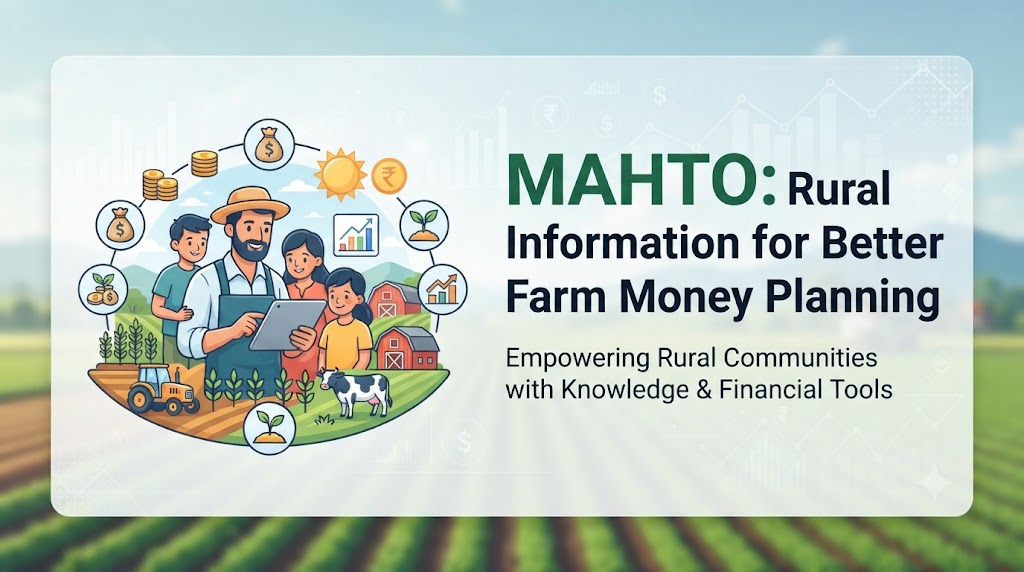
Farm money decisions are rarely simple. A family may need to buy seed before the crop earns anything, wait for a scheme payment, pay for animal feed every week, and still set aside funds for emergencies. Mistakes in planning often come from missing information rather than poor effort.
MAHTO is a Hindi-first rural knowledge platform for Indian farmers, agricultural families, rural entrepreneurs, and village communities. It covers agriculture, farmer schemes, livestock, mandi prices, weather-related farming guidance, and village business opportunities. This article looks at these subjects through one practical lens: how clear information helps rural families plan their money, their spending, and their risks.
What Is MAHTO?
MAHTO is an information platform built around village life and farm work. It explains topics in simple language so that readers do not have to struggle through official or technical wording.
Its subject areas include crop guidance, irrigation, soil testing, fertilizers, pest control, crop calendars, and organic farming. It also covers farmer schemes such as PM-Kisan, PM Fasal Bima Yojana, Kisan Credit Card, Soil Health Card, and state-level programmes. Other areas include livestock topics like dairy, poultry, fish, and goat farming, along with mandi-price information and ideas for extra rural income.
These topics sit together for a reason. A crop plan decides how much money is needed. A scheme may reduce a cost or bring support. A market price decides what the harvest earns. Animals and small businesses add to or change the household’s income. Understanding one area without the others gives only part of the picture.
Why Reliable Rural Information Matters
Rural households often carry seasonal cash flow. Money goes out at sowing time and comes in only after harvest and sale. If a family misjudges a cost, misses a scheme requirement, or sells at a poor moment, the gap can last for months.
Reliable information helps in a few clear ways:
- It shows the likely costs before money is spent.
- It explains what documents and conditions apply to a scheme.
- It makes price differences between markets easier to understand.
- It helps families see the risks in a new activity before investing.
There is a limit, though. Rules change, prices move, and every district has its own soil and weather. Any article should be treated as a starting point. The final check always belongs with official sources and local experts.
Understanding Agriculture Through Simple Guidance
Reading in one’s own language makes a real difference. Good farming information in Hindi helps readers follow how to pick a crop, prepare soil, plan irrigation, use fertilizer, handle pests, and prepare for harvest without getting lost in jargon.
A soil test is a useful example of money-saving knowledge. It reports the nutrient condition of a field, so a farmer can discuss fertilizer needs with an agricultural officer instead of buying by habit. Crop calendars help in a similar way. They show the usual sowing and harvest windows for a region, so labour, seed, and cash can be arranged ahead of time.
What works still depends on the variety, the soil, the rainfall, and local practice. General guidance is the starting point, and local advice should shape the final plan.
Understanding Farmer Welfare Schemes
Public programmes can support farmers through income help, crop insurance, credit, and soil care. Anyone reading about government schemes for farmers can use the same set of questions each time:
- Who is eligible, and who is not?
- What does the scheme actually offer?
- Which documents are needed?
- Where is the application made?
- How can the status be checked?
No farmer should assume he qualifies for every scheme. Land records, state rules, and other conditions can change the answer. The official portal or the nearest agriculture office gives the final word.
Verification Under PM-Kisan
PM-Kisan is an income-support scheme for eligible farmer families. In this context, eKYC is an identity verification step linked to a beneficiary’s record. Anyone looking for PM Kisan eKYC guidance should remember that methods and instructions can be updated, so only current official information should be followed.
A few habits help avoid trouble. Check that the name, Aadhaar details, and bank account information match across records. Use the official portal or a common service centre for the latest steps. Ask the local agriculture office if a mismatch cannot be fixed easily. Payment dates, deadlines, and eligibility changes should never be taken from forwarded messages.
Understanding Agricultural Credit
A Kisan Credit Card is meant to help eligible farmers obtain credit from banks for farming-related needs. Before applying, a farmer should ask the bank about current eligibility, required documents (commonly identity, address, and land records), interest conditions, repayment terms, and the branch that handles the process.
Approval and the amount are decided by the lender, so nobody can promise either in advance. It is also wise to know the total amount that will have to be repaid and by when, and to borrow only what the farm’s income can reasonably cover. Any form of borrowing should be compared on its full cost, not just its first look.
Understanding Mandi Prices
The time and place of sale can change what a harvest earns. For this reason, many farmers want to know how to check mandi prices. Government market-information portals, mandi boards, farmer information services, and the local market committee are the usual sources.
When comparing prices, look closely at these details:
- Crop and variety: Rates can differ even within one crop.
- Market: Nearby mandis may show different prices on the same day.
- Date: Prices shift daily, so old figures can mislead.
- Quality and grade: Moisture, cleanliness, and grade affect the rate.
- Unit: Prices may be quoted per quintal or per kilogram.
Prices vary because supply, demand, transport cost, and quality are not the same everywhere. A price from a social media post is not a safe basis for a decision unless it is dated and comes from a verified source.
Important Steps in Paddy Cultivation
Paddy is grown across many regions of India, and methods vary widely. Readers who want to learn how to grow paddy can think about it as a series of stages, each with its own cost:
- Variety: Choose one that suits the local climate, water supply, and season.
- Field preparation: Ploughing, levelling, and bunding help the field hold water evenly.
- Seed and nursery: Where transplanting is used, good seed and a well-managed nursery give seedlings a strong start.
- Planting: Seedlings are transplanted, or seed is sown directly, depending on the method.
- Water and nutrients: Water depth and fertilizer timing matter at different growth stages.
- Weeds and pests: Regular field visits help catch problems early.
- Harvest: Cutting at the right maturity and drying the grain well protect quality.
Because timing and practices depend on region, soil, and variety, no single method should be treated as right for every field.
Planning a Goat Farming Activity
Goat rearing can begin on a small scale, which is why many families consider it. Anyone studying how to start goat farming should settle several questions first. What is the purpose: meat, milk, breeding, or a mix? Which breed suits the local climate? Is there a dry, clean, airy shed? Can feed, fodder, and clean water be supplied daily? Is a veterinarian nearby for vaccination and treatment?
Simple records of births, health events, feed, and expenses make it easier to see whether the activity is working. The family should also list setup costs and running costs, and find out who buys goats locally. Income varies from farm to farm and cannot be guaranteed.
Understanding Organic Farming
Organic farming puts soil health first and reduces the use of synthetic inputs where that is suitable. People asking how to start organic farming should understand a few basics. Compost, farmyard manure, and green manure feed the soil. Crop rotation can help with pests and nutrients. Pest control depends on close observation and carefully chosen methods.
The change from conventional farming can take time, and yields may shift during that period. If produce will be sold as certified organic, the farmer must meet certification requirements, which should be confirmed with the proper authority. Organic farming is not automatically cheaper or more profitable, so a small trial plot with local guidance is a sensible beginning.
Understanding Livestock Management
Animals stay productive only when their basic needs are met. Reliable livestock farming information usually covers balanced feed and clean water, dry and hygienic housing, timely vaccination, planned breeding with simple records, and regular veterinary care. These points apply to dairy animals, poultry, fish, and goats, though details differ for each.
When an animal falls ill, a qualified veterinarian should be called. Home remedies and advice from unverified sources can make a condition worse and add to the family’s losses.
Rural Income Opportunities
Many families look for extra income beside farming. Common village business ideas include dairy activities, poultry, goat rearing, food processing, local services, and businesses that support agriculture, such as input supply or equipment hire.
Before starting any of these, a person should look at local demand, the money needed, the skills available, the resources at hand (space, water, power, labour, transport), and the regular costs and risks. A good habit is to start small, so that a wrong guess does not damage the family’s main income. Profit from a new business is never assured.
Turning Information Into Practical Decisions
Information helps most when it leads to better questions. A reader can use a knowledge platform to learn the basics, list what is unclear, and then take those questions to an agriculture officer, a bank, an extension worker, or a veterinarian. That keeps decisions rooted in local facts and not in a single article or video.
A Hypothetical Example
Suppose a family wants to add a few goats next year. They first read general guidance on breeds, shelter, and feed. They then write down expected costs: animals, shed repairs, feed, and medicines. They visit a nearby veterinarian to ask which breeds do well locally and what vaccinations are needed. They also find out where goats are sold. Only after this do they decide how many animals to buy, choosing a number small enough that an error would not put the household’s savings at risk.
A Simple Five-Step Approach
- Name the question. Decide whether it is about a crop, a scheme, an animal, or a business.
- Gather current information. Look for recent and clear explanations.
- Verify with official or local sources. Confirm rules and recommendations.
- Compare options, costs, and risks. Write them down before spending money.
- Get qualified advice. Speak to an agricultural, veterinary, or banking professional before a major decision.
Common Mistakes to Avoid
- Using outdated scheme details: Procedures change, so check the latest official source.
- Missing a document: One mismatched or missing paper can hold up an application.
- Believing unverified prices: Shared messages may carry old or wrong rates.
- Borrowing without a repayment plan: Know the total repayment and the date before taking any credit.
- Copying one method everywhere: What works in one region may fail in another.
- Starting livestock without a cost plan: Feed, shelter, and medicine expenses add up quickly.
- Expecting guaranteed profit: Every business carries risk.
- Treating animals without a vet: Wrong treatment can worsen an illness.
Frequently Asked Questions
What should be checked before applying to a scheme?
Check eligibility, benefits, documents, the application process, and the latest official instructions.
What does eKYC mean for PM-Kisan?
It is an identity verification step linked to a beneficiary’s record. The current method should be confirmed on the official portal.
Does a Kisan Credit Card guarantee a loan?
No. The bank decides on approval, limits, and terms.
Why do mandi prices differ?
Supply, demand, quality, transport costs, and local conditions change from market to market and day to day.
What should be planned before keeping goats?
Purpose, breed, shelter, feed, veterinary support, vaccination, costs, and local demand.
Is organic farming always cheaper?
Not necessarily. Costs, yields, and prices vary, and certification may be needed to sell produce as certified organic.
Conclusion
Crops, schemes, animals, and small businesses all depend on careful money decisions, and careful decisions depend on clear information. MAHTO brings these subjects together in simple language so rural readers can understand the basics and know what to ask next. The habit worth building is simple: learn the general idea, confirm current details through official or local sources, count the full cost, and seek qualified advice before acting.
