Introduction
Financial surprises happen when you least expect them. Your car engine might suddenly fail on the way to work, or a medical bill may arrive in the mail after a routine doctor visit.
When your savings account cannot cover these unexpected expenses, you might start searching for quick ways to borrow money. Two common options often appear during these stressful moments: emergency loans and payday loans.
At first glance, both products promise fast cash to solve your immediate problem. However, borrowing money without understanding the underlying mechanics can turn a temporary financial crunch into a long-term debt nightmare.
This guide explains the real differences between emergency loans and payday loans, how they work, the hidden risks involved, and how to choose the right option when you are short on cash.
What Is an Emergency Loan?
An emergency loan is a type of unsecured personal loan designed to help individuals cover unexpected, urgent expenses such as emergency home repairs, sudden medical bills, or critical travel.
How It Works
You apply through a bank, credit union, or online lender. The lender checks your credit score, income, and debt-to-income ratio to decide if you qualify. If approved, you receive a lump sum of money in your bank account, often within 24 to 48 hours.
You repay this money in fixed monthly installments over a set period, known as the loan term, which usually ranges from 12 to 60 months.
Why It Matters
Because emergency loans are traditional personal loans, they generally feature lower interest rates than alternative short-term credit products. They give you breathing room to spread out your repayments, making it easier to fit the debt into your monthly budget.
What Is a Payday Loan?
A payday loan is a small, short-term unsecured loan designed to bridge the financial gap until your next paycheck arrives.
How It Works
You visit a storefront lender or apply online, provide proof of income and a checking account, and write a post-dated check or grant electronic access to your bank account. The lender gives you cash immediately.
The loan term is extremely short—typically two to four weeks, aligning directly with your next payday. On that day, the lender expects you to pay back the borrowed amount plus a steep, flat fee.
Why It Matters
Payday loans require almost no credit check, making them accessible to people with poor credit histories. However, this convenience comes at a severe price. Because repayment terms are so short and fees are so high, many borrowers cannot afford to pay the full balance when due, forcing them to roll the loan over into a new cycle with even more fees.
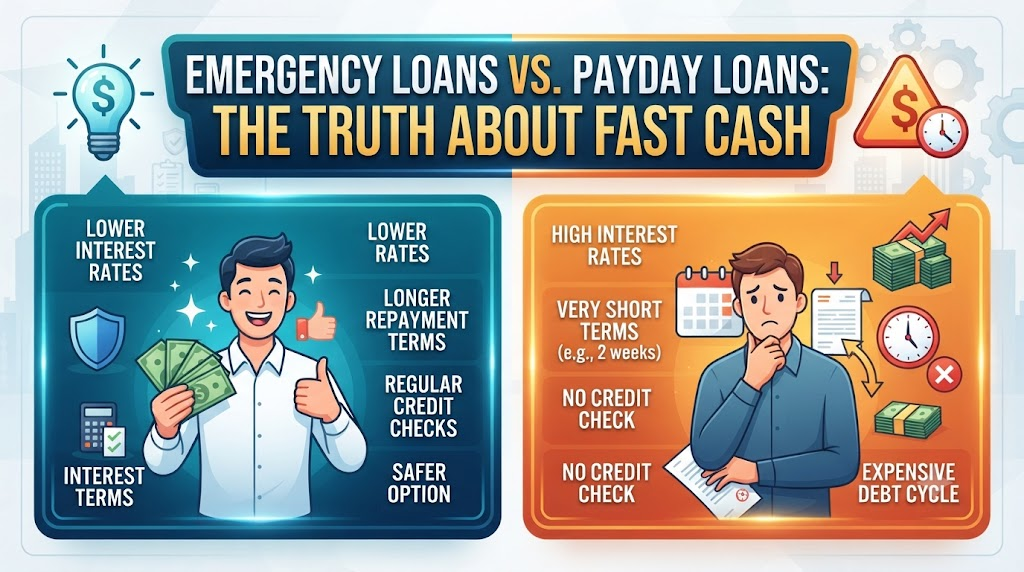
Key Differences Between Emergency Loans and Payday Loans
Understanding how these two borrowing methods compare helps you avoid predatory financial products.
| Feature | Emergency Loan | Payday Loan |
| Loan Amount | Higher (often $\$1,000$ to $\$10,000+$) | Lower (usually $\$100$ to $\$1,000$) |
| Repayment Term | Months to years (fixed monthly installments) | 2 to 4 weeks (single lump-sum payment) |
| Interest Rate (APR) | Moderate (typically $6\%$ to $36\%$) | Extremely High (often $400\%$ or more) |
| Credit Check | Required (income and credit history evaluated) | Minimal or none |
| Funding Speed | 1 to 3 business days | Immediate (minutes or hours) |
| Risk Level | Moderate (requires steady repayment discipline) | Extremely High (frequently leads to debt cycles) |
How Emergency Loans Work: A Closer Look
Emergency loans function just like standard personal installment loans.
When you apply, the lender evaluates your creditworthiness. If your credit score is strong, you secure a lower Annual Percentage Rate (APR), which represents the total yearly cost of borrowing, including interest and fees.
Key Factors in Emergency Loans
- Fixed Payments: Your monthly payment remains the same throughout the life of the loan, simplifying budgeting.
- Origination Fees: Some lenders deduct a small percentage upfront as an administrative fee.
- Prepayment Penalties: Reputable lenders do not charge extra if you pay off your loan early, saving you money on total interest.
Practical Example
Suppose your refrigerator breaks down completely, and you need $\$2,000$ to buy a replacement. You qualify for a 24-month emergency loan with a $12\%$ APR. Your monthly payment comes out to roughly $\$94$. While you pay interest over two years, the predictable monthly cost allows you to manage your cash flow without missing rent or utility payments.
How Payday Loans Work: The Debt Trap
Payday loans operate on an aggressive, short-term timeline that often exploits vulnerable financial situations.
The Cost Structure
Instead of charging an annual percentage rate, payday lenders typically charge a flat fee per $\$100$ borrowed. For example, a lender might charge a $\$15$ fee for every $\$100$ borrowed over a two-week period.
While $\$15$ sounds small, translating that fee into an annual percentage rate reveals an astronomical cost—often exceeding $400\%$ APR.
The Rollover Cycle
When your payday arrives two weeks later, you realize that paying back the full principal plus the fee leaves you with zero money for groceries, rent, or utilities until the following month.
To cope, you pay only the fee to “rollover” or renew the loan for another two weeks. You have now paid money for nothing, and you still owe the original principal, plus a brand-new fee. This cycle repeats, costing borrowers hundreds or thousands of dollars in fees for a small initial loan.
When to Use Which Option
Knowing when to consider—or strictly avoid—each option is vital for financial health.
When an Emergency Loan Makes Sense
- You face a genuine, unavoidable emergency that exceeds your emergency savings.
- You have a steady income and a realistic monthly budget to support fixed installment payments.
- Your credit score is decent enough to qualify for a reasonable interest rate.
When to Avoid Payday Loans Completely
- Always. For almost every financial situation, payday loans represent the most expensive form of borrowing available.
- If you cannot afford to pay off a payday loan in full on your very next payday, you should avoid it entirely to prevent falling into a chronic debt cycle.
Common Mistakes Borrowers Make
When panic sets in during a crisis, people often make rushed financial decisions. Avoid these common pitfalls:
- Failing to Read the Fine Print: Borrowers often focus only on how fast they get cash, missing hidden origination fees, late payment penalties, and restrictive repayment terms.
- Turning to Payday Lenders Out of Embarrassment: Some people avoid asking family members or visiting local credit unions because they feel embarrassed, choosing instead predatory online payday lenders that destroy their finances.
- Ignoring the Total Cost: Focusing only on the monthly payment or flat fee blinds borrowers to the total interest accumulated over the life of an installment loan or the compounding cost of a payday loan rollover.
- Borrowing More Than Necessary: Taking out a larger loan than required to cover cushion money simply increases your monthly obligation and total interest costs.
Safer Alternatives to Payday Loans
If you cannot qualify for a traditional emergency loan and want to steer clear of predatory payday lenders, consider these alternatives:
- Credit Union Small-Dollar Loans: Many credit unions offer Payday Alternative Loans (PALs) with low application fees and capped interest rates well below standard personal loans.
- Employer Cash Advance Apps: Apps like EarnIn or Brigit allow you to access earned wages before your official payday for minimal subscription fees instead of predatory interest.
- Borrowing From Family or Friends: A formal agreement with a trusted relative can secure interest-free or low-interest cash without credit checks or lender fees.
- Local Community Assistance Programs: Nonprofits, religious organizations, and local government agencies often provide emergency grants for utility bills, rent, or food assistance during hard times.
Key Terms
- APR (Annual Percentage Rate): The yearly cost of a loan, including interest and standard fees, expressed as a percentage.
- Unsecured Loan: A loan that does not require collateral, such as your house or car, to secure the borrowed funds.
- Installment Loan: A loan repaid over time with a set number of scheduled, regular payments.
- Rollover: Extending a payday loan due date by paying an additional fee, which triggers a compounding debt cycle.
- Principal: The original amount of money borrowed, separate from interest and fees.
Frequently Asked Questions
Can I get an emergency loan with bad credit?
Yes. Some online lenders specialize in bad-credit personal loans. However, expect higher interest rates and stricter eligibility terms compared to borrowers with strong credit scores.
Why are payday loans legal if they have such high interest rates?
Payday lending is regulated at the state level. While some states have banned the practice or capped interest rates strictly, other states permit high-fee structures under specific regulatory exemptions.
What happens if I default on an emergency loan?
Defaulting damages your credit score, triggers collection calls, and may result in the lender suing you or seizing funds if the loan agreement allows legal collection actions.
Are credit card cash advances better than payday loans?
While credit card cash advances carry high interest rates and immediate cash advance fees, they are still significantly cheaper and safer than payday loans because they offer revolving credit lines and standard billing cycles rather than immediate two-week lump-sum demands.
How much emergency savings should I keep to avoid these loans?
Financial experts generally recommend saving three to six months’ worth of essential living expenses in an easily accessible savings account to handle sudden financial emergencies.
Conclusion
Facing an unexpected financial emergency creates high stress, but choosing the wrong loan can multiply your problems.
Payday loans offer fast cash wrapped in a dangerous debt trap disguised as convenience. Emergency loans, while requiring credit checks and structured repayments, provide a manageable, predictable path to overcoming financial hurdles without sacrificing your long-term stability.
Always evaluate your actual repayment capacity, look for credit union alternatives, and steer clear of predatory lenders whenever you need cash in a hurry.
