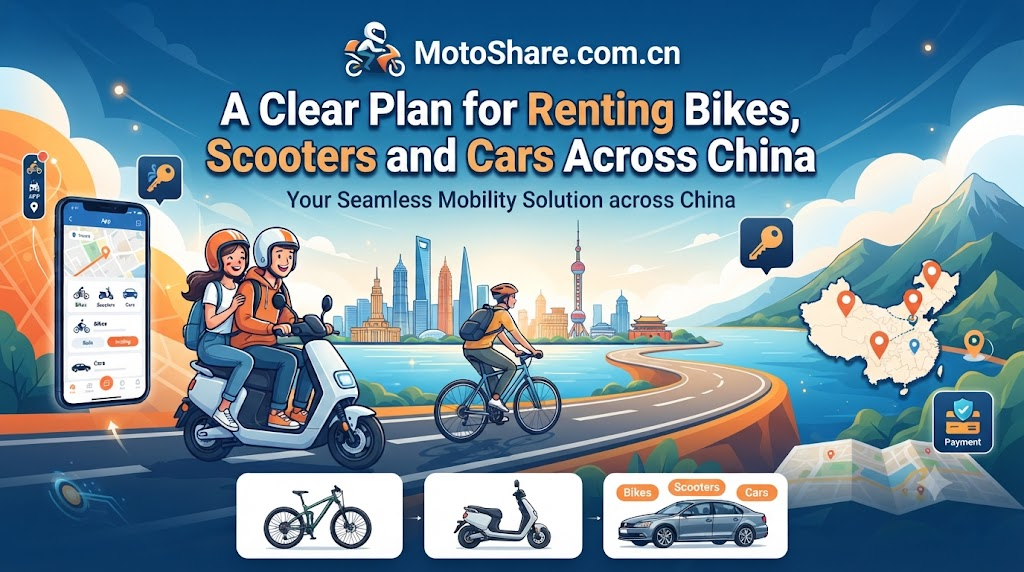
A vehicle rental that is booked in a hurry is often understood in a hurry, and that is when small problems turn into big ones. A missing document, a deposit nobody explained, or a bike that was too heavy for the rider can all be avoided with some early planning.
People rent vehicles in China for daily commuting, holidays, business visits and long journeys. Some want a bicycle for a quiet morning. Others need a car for a family or want a motorcycle for a week on the road. This article follows the order in which a careful traveller thinks: what the platform does, which vehicle fits, what the rules say, what the costs are and how to prepare. MotoShare, a vehicle-rental platform for China, is part of that story.
Understanding MotoShare and What It Does
MotoShare is a China-focused platform where people discover and book rental vehicles. Its description names visitors from abroad, local residents, commuters, road-trip fans and riders who want flexible transport as its audience.
The listings cover motorcycles, scooters, bicycles and cars. Rental periods can be short, such as a few hours, or long, such as several weeks. Because it works as a marketplace, the vehicles come from local rental providers. The description also mentions clear pricing, no extra booking fee from the platform itself, motorcycles from brands such as CFMOTO and Benelli, inventory in places like Beijing and Lanzhou, and city pages for locations such as Shanghai and Shangri-La.
Using a marketplace involves three different actions. Searching means seeing what exists in a place and for your dates. Comparing means reading prices, conditions and pickup details side by side. Confirming means agreeing to the final terms. Most regrets come from rushing the second action. Keep in mind too that no platform can promise every vehicle in every city on every date.
Why Travellers Choose Different Rental Vehicles
A visitor travelling with two children and large suitcases will probably look at cars. A commuter who wants to cross a busy city every day may prefer something small, light and cheap to park. A traveller on a short, slow outing may be perfectly happy with a bicycle. An experienced rider with several free days may start with a motorcycle in mind. Plenty of people compare two or three types before deciding.
What decides the answer is a mix of the journey, the budget, the rider’s experience, the local rules and what is free on the chosen dates. Starting the search early gives you time to weigh all five, instead of taking whatever is left.
Detailed Guide to Renting Vehicles in China
Getting to Know Different Motorcycle Types
Each motorcycle type has a purpose. These short notes show who each one tends to suit and what to watch for.
- Commuter motorcycles. Best for short trips and newer riders, since they are light and easy to handle. Watch for limited space for bags.
- Sports bikes. Best for confident riders who enjoy speed on good roads. Watch for the leaning seat position, which tires the body on long days.
- Touring motorcycles. Best for multi-day trips, with a comfortable seat and room for luggage. Watch for the extra weight at low speed.
- Premium models. Best for riders who want more power and features. Watch for the higher cost, and remember that more power is not the same as more safety.
- Adventure motorcycles. Best for mixed roads and longer journeys. Watch for the tall seat, which can be hard for shorter riders.
Your experience, your route, your comfort and your luggage should all weigh on the choice. The MotoShare description names CFMOTO and Benelli, but that does not confirm a specific model for your dates. The listing itself must show that.
Exploring Motorcycle Choices in Chinese Cities
Make a simple comparison sheet before you commit to anything. For each option, write the pickup place, the available dates, the model, the total price, the pickup arrangement and what the provider asks of the renter.
Fill in one sheet for motorcycle rental Beijing and a separate one for motorcycle rental Shanghai. The cities are different, and what is true in one may not be true in the other. Local traffic rules may limit where two-wheelers can travel, and registration rules can vary, so check them before relying on a listing.
A general search for motorcycle rental China can show you the range of what is out there, but the details of any one rental always depend on the city, the provider and the dates.
Choosing Among Bikes, Scooters and Cars
Think about four things: who is travelling, what they carry, how far they go and how confident the driver or rider is.
A bicycle is quiet and simple, but it is slow and carries almost nothing, so it suits short, easy outings. Searches for bike rental China options tend to come from people who want exactly that. A scooter covers more ground with less effort and often has an automatic gearbox. It is smaller and lighter than a motorcycle, which suits city streets, and scooter rental China searches usually come from people with short urban trips in mind. A motorcycle has more power and range, but it asks more skill and offers little shelter from rain.
A car protects you from weather and has room for passengers and bags, but it can be harder to park and costs more to run. People comparing car rental China options should remember that neither the cheapest vehicle nor the largest one is automatically right.
How Online Vehicle Discovery and Booking Works
A marketplace saves time because many options appear in one place. You pick a location and dates, and the choices appear. The listing, however, is only the beginning. The terms behind it decide how the rental will feel.
Group the terms by what they affect. Some involve money: the total price for your dates, the deposit and any cancellation charge. Some involve limits: the insurance cover, the mileage allowance and the fuel arrangement. The rest involve logistics: where you pick the vehicle up, where you return it and in what condition.
Providers may not all follow the same rules, so never assume that one listing works like another. Read the final terms before you confirm.
Renting a Car in China as a Visitor From Abroad
Two different things are easy to mix up. One is what the rental company needs to hand you the keys. The other is the legal permission you need to drive. They are separate, and having one does not give you the other. This difference sits at the centre of car rental China for foreigners.
Official Chinese government pages say that Chinese law does not recognise international driving licences, and that an international driving permit alone is not accepted. A visitor who wants to drive generally needs a Chinese temporary driving permit.
The usual documents, as listed by the Chongqing government, include a passport with a valid visa or entry stamp, the original foreign licence, an official Chinese translation of it and a white-background photo. Applicants also watch a short traffic-safety video. For short stays the permit is commonly valid for about three months, and the exact length can depend on visa status. Some airports offer help with the application. Procedures can differ by city, so confirm the details locally and start early.
The rental company will also have its own list, such as your passport, a deposit and its own insurance rules, so ask for it in advance.
Note one more point from the official Chongqing FAQ. For people renting vehicles in China, the temporary permit it describes covers only small automatic vehicles. A permit that works for a car should therefore not be assumed to work for a motorcycle. Ask the local authority and the provider which vehicle types your permit covers. Official guidance also says to keep the permit, your foreign licence with its translation and the rental contract with you while driving.
Understanding Self-Drive Options
Self-drive means that the customer rents the vehicle and drives it personally, within the law and the rental terms. A hired driver is not part of the deal.
People choose it for family holidays, business travel, sightseeing and any trip with heavy luggage. Interest in self drive car rental China options grows when travellers want to set their own timetable, stopping where they like and changing plans without asking anyone.
When comparing cars, start with seats and luggage, then compare the total cost, the insurance, the mileage rule, the fuel policy and the pickup and return arrangements. A smaller car can be easier to handle in a crowded city, so bigger is not always better.
Getting Ready for an Adventure Motorcycle Journey
Three simple questions can guide the whole preparation. Can I handle this bike calmly? Can it carry what I need? Can I reach help if something goes wrong?
For the first question, match the motorcycle to your experience, the distance, the weather and the road conditions. A very powerful bike is not always the safest or most suitable choice, and the best one is often the one that never makes you nervous. For the second, think about luggage, because bags change how a bike feels. For the third, plan your fuel stops, your rest breaks, your navigation and who you would call in an emergency.
Wear proper protective gear, and check tyres, brakes, lights and chain before you leave. Those who browse adventure motorcycle rental China options should also remember that not every road or destination is open to motorcycles, so confirm access first.
Planning a Motorcycle Journey Across China
One helpful way to plan a long ride is to work backwards from the end date. Decide when you must be back, then mark each day’s distance, weather risk, fuel stops and place to sleep. Leave a spare day, because plans change.
A motorcycle road trip China itinerary also needs a rules check. Look up local traffic rules, vehicle restrictions and whether the places on your route allow motorcycles. Find real distances, travel times and road conditions from reliable local sources instead of guessing. And confirm early that you are legally allowed to ride the type of bike you want, since that single fact can change the whole route.
Understanding Rental Costs and Conditions
The daily rate on a listing is rarely the full amount. It helps to sort every cost into four groups.
The first is the price you see, which is the rental itself. The second is money you hand over for a while, such as the deposit, which comes back later but is unavailable in the meantime. The third is money you might pay later, such as fuel, mileage fees, late return fees or charges for damage that insurance does not cover. The fourth is money you might lose if plans change, which depends on the cancellation terms.
Prices in China appear in Chinese yuan (RMB or CNY). Amounts and terms can differ by vehicle, city, provider and travel date, so add up every group for every option before comparing.
Preparing for a Smooth Rental
It helps to think in three moments. A week before, check your documents, read the rental agreement and confirm the pickup time and place. On pickup day, walk slowly around the vehicle and photograph any scratches, dents or worn tyres, and make sure the provider writes down existing damage. At return time, bring the vehicle back as the agreement says, and keep your photos in case a question comes up. These are general habits, not confirmed MotoShare procedures.
A Simple Rental Planning Process
- Pick the basics first. Choose the place, the dates and the type of vehicle, because every other decision depends on them.
- Compare more than one option. Set two or three listings side by side with their total costs, so one number does not fool you.
- Check the paperwork early. Confirm the licence rules, your identification and the provider’s requirements before you get attached to a vehicle.
- Read the details. Look at insurance, deposit, pickup arrangements and vehicle condition, which are where surprises usually appear.
- Confirm last. Book only when you understand the full agreement, and ask about anything unclear.
This is general advice and does not describe how any one platform’s booking works.
Common Rental Mistakes and How to Avoid Them
- Assuming a foreign licence is accepted. Check the official rules before you travel.
- Ignoring the permit. Start the application early and keep the documents together.
- Looking only at the headline price. Add every possible cost before you decide.
- Skipping insurance and deposit details. Read what is and is not covered, and how the deposit comes back.
- Choosing a bike that is too hard to handle. Pick one that matches your real experience.
- Forgetting pickup and return arrangements. Confirm the place, the time and the required condition.
- Assuming a vehicle is free on your dates. Check the exact dates on the listing.
- Planning a long trip without checking rules and roads. Research local restrictions and road conditions first.
A Realistic Hypothetical Example
Marta is organising a two-week holiday in China for four friends. She starts planning well ahead, because she knows paperwork can take time. Two people want to ride motorcycles, but the group will have a lot of luggage.
She compares three options on paper: two motorcycles, one large car and two small cars. The motorcycles cannot carry everyone’s bags. When she reads the official guidance, she learns that a visitor’s temporary permit may not cover every vehicle type, so she decides to ask the local authority before choosing anything with two wheels.
She then looks more closely at the cars. The two small cars would need two drivers with permits and would double some costs. One larger automatic car with a roomy boot looks simpler. She checks its seats, luggage space, insurance, deposit, mileage rule, fuel policy and pickup place, and she asks the provider which documents it needs.
Marta decides that one friend, with a translated licence and a temporary permit, will be the driver. They photograph the car at pickup and book only after reading the full agreement. The choice was not the most thrilling one, but it matched the group, the luggage and the rules.
Frequently Asked Questions
How far ahead should I start planning a rental in China?
As early as you can. Permits, translations and provider checks all take time, and starting early gives you more choice.
Which documents might I need to drive in mainland China?
Visitors generally need a Chinese temporary driving permit, usually applied for with a passport, the original foreign licence, an official Chinese translation and a photo. Check the current local requirements.
Does one permit cover every vehicle type?
Do not assume so. Official guidance says the permit it describes covers only small automatic vehicles for rentals, so ask about motorcycles separately.
How do I compare a scooter, a motorcycle and a car for one trip?
Compare passengers, luggage, distance, weather and your skill. Then compare the total cost of each.
What does a rental agreement usually cover?
Typically the price, deposit, insurance, mileage, fuel, pickup and return details and cancellation terms, though each provider’s agreement may differ.
Why read the cancellation terms early?
Because plans change, and the terms decide how much of your money you could lose if they do.
What should I do if I notice damage at pickup?
Photograph it, tell the provider right away and make sure it is recorded in writing before you drive off.
Closing Thoughts
A good rental begins long before pickup day. It starts when you decide what the trip needs, continues while you check the documents and read the terms, and ends when you hand the vehicle back as agreed. The pieces are simple, but they work best in order, and for visitors the first piece is the driving rules, since a licence from home does not settle the question on its own. MotoShare can help you search and compare options in one place, while the reading, the questions and the checking remain yours. Give those a little time up front, and the journey itself can go the way you pictured it.
