Introduction
In the past, the process of building software was often seen as a simple race to the finish line. Security was treated as a final check that was performed only after everything else was finished. However, it was frequently found that this method caused long delays and missed many hidden risks. Today, a much better way is followed. Security is now woven into the very beginning of the work. This shift in thinking is what led to the creation of the Certified DevSecOps Engineer path. This guide is written to show how this role helps in creating software that is both fast and safe.
What is a Certified DevSecOps Engineer?
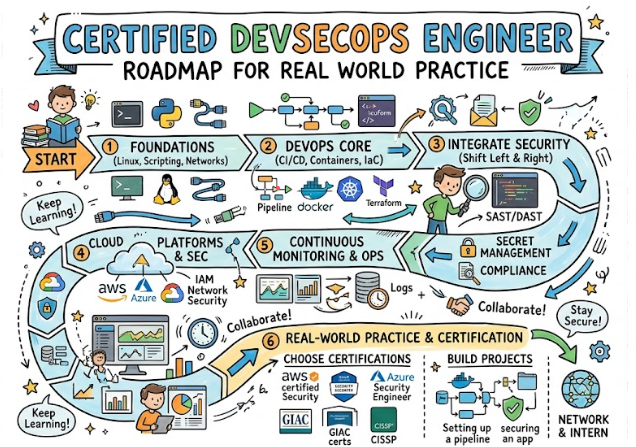
A Certified DevSecOps Engineer is understood to be a specialist who brings together the worlds of development, operations, and security. Instead of security being a separate team that works in isolation, it is made a part of the daily tasks of every engineer. Tools are used to check for mistakes automatically as the code is being written. This means that problems are caught and fixed before they can ever reach the user. A person in this role is expected to know how to set up these automated systems so that safety is maintained without slowing down the progress of the team.
Why is this needed in today’s world?
It is observed that the number of digital threats is growing every single day. Large companies and small startups alike are found to be targets of data theft and system failures. When a security mistake is found only after the software is being used by the public, the damage to a company’s reputation is seen to be very high. By making security a part of the DevOps process, these risks are lowered significantly. The “shift-left” approach is used, where security is moved to the left side of the project timeline. This ensures that every update is checked for quality and safety before it is ever sent out.
The value of holding a Certified DevSecOps Engineer credential
The importance of being certified is recognized by employers all over the world. A certification is not just a piece of paper; it is seen as proof that a professional has mastered a specific set of high-level skills. It is often found that people who are certified are given more responsibility and trust within their organizations. For the individual, the learning process provides a very clear and structured way to understand complex tools. Instead of trying to learn everything alone, a proven path is followed. This leads to a much deeper understanding of how to protect modern software systems.
Why Choose DevSecOpsSchool?
When a platform for technical growth is selected, the quality of the curriculum and the depth of hands-on practice are considered the most important factors. DevSecOpsSchool is recognized as a leader in this field for several reasons.
- Expert Instruction: Knowledge is shared by mentors who have spent decades managing security and operations for large-scale systems.
- Practical Learning: Access to advanced, cloud-based labs is provided. It is believed that skills are only truly acquired when they are practiced in a realistic environment.
- Comprehensive Material: Every aspect of the security lifecycle is covered, from the initial planning stages to the continuous monitoring of production systems.
- Career Guidance: Support is offered to help learners understand how these skills are applied in the job market and how to navigate career transitions.
- Global Community: A network of professionals is maintained, allowing for continuous knowledge sharing and networking across various industries.
A Deep Look at the Certification
What exactly is this certification?
The Certified DevSecOps Engineer program is a deep dive into the world of security automation. It is designed to teach how security checks can be made a natural part of the software pipeline. The integration of tools that scan code, check for old libraries, and protect cloud settings is taught in a very simple and direct way.
Who is this certification meant for?
Software developers who want to write safer code and DevOps engineers who want to add security to their pipelines are the primary audience. It is also found to be very helpful for system admins and security professionals who want to learn how automation is used in the modern world.
Detailed Certification Table
| Track | Level | Best For | Prerequisites | Skills Taught | Order |
| DevOps | Foundation | New Engineers | Basic Linux | CI/CD, Pipelines | 1 |
| DevSecOps | Intermediate | DevOps Teams | DevOps Skills | SAST, DAST, Vault | 2 |
| SRE | Advanced | System Admins | Linux Knowledge | Reliability, SLIs | 3 |
| AIOps/MLOps | Expert | Data Science | Python Skills | AI Automation | 4 |
| DataOps | Intermediate | Data Engineers | SQL Knowledge | Data Protection | 3 |
| FinOps | Foundation | All Staff | Cloud Basics | Cost Management | 2 |
Skills You Will Gain
- Code Scanning: The use of Static Application Security Testing (SAST) is learned to find errors in the source code.
- Runtime Checks: Dynamic Application Security Testing (DAST) is used to find flaws while the software is actually running.
- Library Safety: Tools are used to check if the third-party code being used has any known security holes.
- Container Security: Methods for keeping Docker and Kubernetes environments safe are practiced.
- Secrets Management: The right way to store passwords and API keys using tools like Vault is understood.
- Infrastructure Safety: The process of checking cloud settings for mistakes is automated.
Real projects you will be able to complete
- Secure Pipelines: A complete delivery system is built where security checks happen automatically with every update.
- Vulnerability Reports: Automated reports are generated to show exactly where a system might be weak.
- Hardened Environments: Cloud setups are configured so that they are resistant to common attacks.
- Access Controls: Systems are set up to make sure only the right people can see sensitive data.
Preparation Plan
The 14-Day Fast Track
The first two weeks are spent understanding the basic ideas of DevSecOps. The main tools are explored, and a simple pipeline is set up to see how everything works together.
The 30-Day Deep Dive
A full month is used to go through every lesson in detail. Daily practice in the labs is performed to make sure the tools are understood. Small projects are completed to build confidence.
The 60-Day Master Plan
Two months of study allow for a complete understanding of the topic. Advanced security scenarios are practiced, and mock exams are taken to ensure readiness for the final test.
Mistakes that are often made
- Ignoring the Culture: It is a mistake to think that only tools matter. The way people work together is just as important.
- Skipping Labs: Reading about a tool is not the same as using it. Hands-on practice is seen as the most important part of learning.
- Starting Too Fast: If the basics of DevOps are not understood first, the security part will be much harder to learn.
The next steps after certification
- In the same track: Advanced DevSecOps Expert.
- In a different track: Site Reliability Engineering (SRE).
- For leaders: Technical Management and Leadership.
Selecting the Right Path for You
The DevOps Journey
This is the path chosen by those who love automation and speed. It is focused on how software is moved from the developer to the customer without any manual work.
The DevSecOps Journey
This path is for those who want to be the guardians of the system. It is designed to teach how to keep everything safe while still maintaining a fast pace.
The SRE Journey
For those who enjoy making things stable and reliable, this is the best choice. It is focused on uptime and solving complex system problems.
The AIOps and MLOps Journey
This is a very modern path for those interested in artificial intelligence. It shows how AI can be used to manage and secure IT systems.
The DataOps Journey
Data is seen as a very valuable asset. This path is for people who want to manage how data is collected, stored, and protected across a company.
The FinOps Journey
This path is for those who want to help companies manage their cloud bills. It combines the worlds of finance and technology to save money.
Role to Certification Mapping
| Your Current Role | Recommended Certification |
| Software Developer | Certified DevOps Professional |
| DevOps Engineer | Certified DevSecOps Engineer |
| System Administrator | Certified SRE Practitioner |
| Cloud Architect | Certified Kubernetes Specialist |
| Security Analyst | Certified DevSecOps Engineer |
| Data Engineer | Certified DataOps Professional |
| IT Manager | Technical Leadership Certification |
| Finance Manager | Certified FinOps Associate |
What Should You Learn Next?
For the DevOps Professional:
- In the same track:: Certified GitOps Specialist.
- Different track: Certified DevSecOps Engineer.
- Leadership: Certified Engineering Manager.
For the Security Specialist:
- In the same track:: Advanced Cloud Security Expert.
- Different track: Certified SRE Practitioner.
- Leadership: Strategic Security Director.
Organizations That Provide Learning Support
DevOpsSchool
This organization is recognized for its very deep and practical training programs. A wide range of certifications is offered to help engineers at all levels. Long-term support and expert mentorship are provided to every student.
Cotocus
A focus on simple and effective learning is maintained by this institution. The courses are structured to help professionals gain new skills quickly and apply them to their jobs immediately. It is highly regarded for its technical depth.
ScmGalaxy
A massive amount of learning resources and community support is found here. It is used by thousands of people to stay updated on the latest trends in automation and configuration management.
BestDevOps
The highest standards of software engineering are taught at this platform. It is a great place for those who want to learn the best practices used by top companies around the world.
devsecopsschool.com
This is a specialized site that is dedicated entirely to the field of DevSecOps. It provides the most relevant and updated content for anyone looking to become a certified professional in this area.
sreschool.com
The core ideas of site reliability and system uptime are taught here. It is used by engineers who want to make sure their systems never fail.
aiopsschool.com
This platform is focused on the future of IT management. It shows how artificial intelligence and machine learning are being used to make operations smarter.
dataopsschool.com
The management and security of data pipelines are the main focus here. It is a key resource for data engineers and architects.
finopsschool.com
Helping companies save money on their cloud infrastructure is the goal of this site. It provides clear training on how to optimize costs without hurting performance.
FAQs Section
1. How is the return on investment (ROI) of this certification perceived by management? ?
The ROI is seen in the reduction of security breaches and the lower cost of fixing bugs early in the process. A certified professional is found to deliver more secure software with fewer delays.
2. Does this certification replace the need for a dedicated security team?
No, it is understood that this certification helps the engineering team take responsibility for security, allowing the dedicated security team to focus on high-level strategy and complex threats.
3. How is the “security silo” broken down after this training?
Collaboration is improved as developers and operations teams are taught to speak the same language as security professionals. Shared goals are established to ensure safety is everyone’s priority.
4. Is the focus placed on specific commercial tools or open-source solutions?
A balanced approach is taken, where the underlying principles are taught using both popular open-source tools and industry-standard enterprise solutions.
5. How is the impact on the development lifecycle measured?
Success is measured by the speed of delivery and the decrease in vulnerabilities found in production. The goal is to maintain a fast pace without increasing risk.
6. Are manual security audits completely replaced by automation?
Automation is used to handle repetitive and predictable tasks, but it is realized that manual audits are still needed for complex logic and architectural reviews.
7. How are legacy systems handled with these modern security skills?
Techniques are taught to wrap existing systems in modern security layers, ensuring that even older applications can be protected within a modern pipeline.
8. Is the certification enough to lead a security transformation within a company?
It provides the technical foundation needed to lead such a change. When combined with leadership skills, it is seen as a very powerful asset for any organization.
9. How is business risk managed through these technical skills?
Risk is managed by creating a transparent and automated system where every change is verified against security policies before it is approved.
10. Is coding knowledge a mandatory requirement for success?
A basic understanding of scripting and code structure is found to be necessary, as security is now written as code within the pipeline.
11. How does this training help in meeting global compliance standards?
The automation of compliance checks ensures that standards such as GDPR or HIPAA are met consistently without manual effort.
12. Is the training content adapted for global markets including India?
Yes, the curriculum is designed to reflect the standards and practices followed by global technology leaders in all markets.
Additional FAQs: Certified DevSecOps Engineer
1. How is the “Security as Code” concept practically applied?
Security rules are written in a format that can be stored in a version control system and executed by the automation server.
2. Are real-world attack scenarios simulated during the course?
Yes, labs are provided where common attacks are simulated so that students can learn how to detect and prevent them.
3. Is the knowledge of cloud-native security tools required?
The integration with tools provided by major cloud platforms is a core part of the advanced curriculum.
4. How is the vulnerability management lifecycle automated?
Tools are used to scan for flaws, report them to the development team, and verify the fix automatically.
5. Can this certification help in transitioning from a developer to a security role?
It is seen as the most effective path for such a transition, as it builds on existing coding skills while adding deep security expertise.
6. What is the role of secrets management in a secure pipeline?
It ensures that sensitive information like passwords is never stored in plain text and is only accessible to authorized systems.
7. How is container orchestration secured in this program?
Specific lessons are dedicated to the security of Kubernetes clusters, including network policies and image signing.
8. Is continuous monitoring part of the DevSecOps curriculum?
Yes, learning how to monitor systems for security events in real-time is a key component of the training.
Stories from the Field
Aarav
A much deeper understanding of how to protect the code was gained. The transition to a new role was made much easier because of the practical skills learned.
Priya
The labs were found to be the most helpful part of the journey. The confidence to lead a security project was built through daily practice.
John
A clear direction for the future was provided. The mentorship received helped in understanding which skills were most important for the industry.
Sana
The way the pipeline was managed was completely changed. Security is no longer a worry because it happens automatically now.
Arjun
The knowledge shared was very easy to understand and use. It is seen as a very worthwhile investment for anyone in the tech field.
Concluding Thoughts
The path to becoming a Certified DevSecOps Engineer is one that offers many long-term benefits. It is understood that the world will only become more digital, and the need for security will never go away. By choosing to learn these skills, a commitment to quality and safety is shown. It is seen that professionals who can bridge the gap between development and security are the ones who will lead the industry in the future. Strategic planning and a focus on continuous learning are encouraged for all. Taking the first step today is the best way to ensure a successful and resilient career for many years to come.
