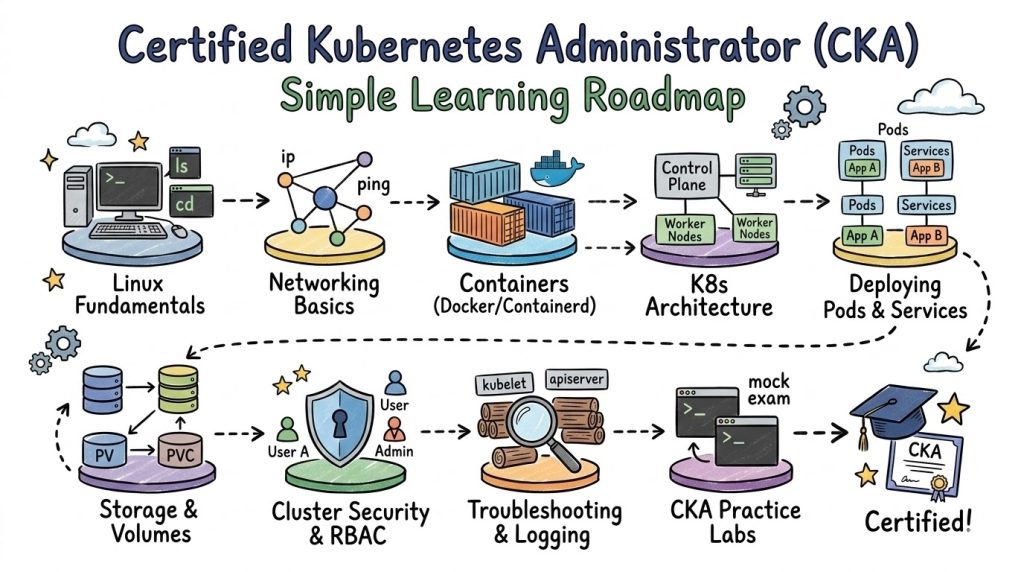
Introduction
In the current tech landscape, simply knowing how to use a tool is no longer enough. For those working in cloud environments, the ability to manage and fix systems under pressure is what separates a beginner from a veteran. The Certified Kubernetes Administrator (CKA) is the gold standard for proving you can handle the “brain” of modern software: Kubernetes.
This guide is written from a practical perspective. It moves away from the usual “how-to” and looks at what it actually takes to succeed as a professional in a world that relies on containers and automation.
What is Certified Kubernetes Administrator (CKA)?
Certified Kubernetes Administrator is a hands-on, performance-based exam. Unlike many tests that ask multiple-choice questions, CKA places you in a live command-line environment. You are tasked with solving real problems on actual clusters. It proves that you have the skills to install, configure, and manage production-grade Kubernetes.
Why it matters in today’s ecosystem
Modern software is no longer a single block of code. It is a collection of microservices running in the cloud. Kubernetes is the engine that keeps these services running, scaling, and communicating. If you cannot manage this engine, you cannot manage modern infrastructure. CKA ensures you are ready for this reality.
Why certifications are important
For engineers, certifications are a way to bypass the “guesswork” of learning. They provide a structured path. For managers, they act as a filter. When a manager sees a CKA holder, they know that person has spent hours in a terminal, not just reading a book.
Certification Overview Table
| Track | Level | Who it’s for | Prerequisites | Skills Covered | Recommended Order |
| Core Ops | Advanced | Engineers, Admins | Linux, Networking | Setup, Networking, Storage, Debugging | Start here for Ops |
Provider: DevOpsSchool
Why choose DevOpsSchool?
Expertise is built through practice, and DevOpsSchool understands this deeply. The training is focused on the “why” behind every command. You are provided with environments that mimic real-world failures. This helps you build the muscle memory needed for the exam and for your daily job.
Certification Deep-Dive: CKA
What is this certification?
It is a 2-hour exam that tests your ability to solve 15–20 hands-on tasks. It is less about theory and more about your ability to use kubectl and the official documentation to fix or build systems.
Who should take this certification?
- Software Engineers who want to understand where their code lives.
- DevOps Engineers tasked with automating deployments.
- SREs who need to ensure systems never go down.
- Managers who want to lead technical teams with authority.
Skills you will gain
- Mastering cluster installation using
kubeadm. - Configuring complex networking and security policies.
- Managing persistent storage for data-heavy apps.
- Troubleshooting broken nodes and control plane components.
Real-world projects you should be able to do
- Building a high-availability cluster for a banking app.
- Automating the backup and restore of cluster data.
- Hardening a cluster to protect sensitive user information.
Preparation plan
7–14 days plan
Focus entirely on the terminal. Practice the core 50 kubectl commands. Review the official Kubernetes documentation so you can find information quickly.
30 days plan
Spend the first two weeks on cluster setup and networking. Use the second two weeks to focus on troubleshooting and mock exams.
60 days plan
This is for those new to containers. Spend the first month learning Docker and Linux basics. Use the second month to deep-dive into Kubernetes objects and services.
Common mistakes to avoid
- Not using the correct “context” for each question.
- Over-complicating YAML files when a simple command would work.
- Spending too much time on a single, difficult task.
Best next certification after this
- Same track: Certified Kubernetes Security Specialist (CKS).
- Cross-track: AWS Certified Solutions Architect.
- Leadership: Certified Scrum Master (CSM).
Choose Your Learning Path
DevOps Path
Best for those who love automation. It focuses on the bridge between writing code and running it.
DevSecOps Path
Perfect for the security-minded. This path teaches you how to lock down your cluster from the start.
Site Reliability Engineering (SRE) Path
Ideal for those who value stability. It is about building systems that self-heal when things go wrong.
AIOps / MLOps Path
Designed for data science teams. It covers how to run heavy AI models on a shared cluster.
DataOps Path
Best for data engineers. It focuses on how to handle massive data pipelines within containers.
FinOps Path
Focused on the business side. It teaches you how to use resources efficiently to keep cloud bills low.
Role → Recommended Certifications Mapping
| Role | Primary Certs |
| DevOps Engineer | CKA, Terraform, Jenkins |
| SRE | CKA, Prometheus, Linux |
| Platform Engineer | CKA, Helm, Ansible |
| Security Engineer | CKA, CKS, Vault |
| Data Engineer | CKA, Spark, Airflow |
| Engineering Manager | CKA, Agile, PMP |
Next Certifications to Take
For the Senior Learner
- Same-track: Certified Kubernetes Application Developer (CKAD).
- Cross-track: Google Professional Cloud Devops Engineer.
- Leadership: Digital Transformation Specialist.
Training & Certification Support Institutions
DevOpsSchool
A wide range of hands-on labs is offered here. The instructors focus on real-world scenarios that you will face in the office.
Cotocus
High-level consulting and training are provided. They are known for helping large companies move to the cloud smoothly.
ScmGalaxy
A massive library of tutorials and guides is available. It is a great resource for anyone wanting to learn on their own.
BestDevOps
Practical training for teams is the main focus. They help groups of engineers get certified together.
devsecopsschool.com
Everything about security in the cloud is taught here. It is the best place to learn how to keep your code safe.
sreschool.com
Reliability is the core of their teaching. They show you how to build systems that are “always on.”
aiopsschool.com
The future of operations is shown through their AI courses. They teach how to automate IT tasks using machine learning.
dataopsschool.com
They focus on the speed and quality of data. It is perfect for those who manage big data on Kubernetes.
finopsschool.com
Managing cloud costs is made simple here. They teach how to get the most value out of every dollar spent on the cloud.
FAQs Section
- Is CKA harder than other certs?
Yes, because it is 100% practical. No guessing! - How long does it take to prepare?
Most working professionals need about 1 to 2 months. - What if I fail?
You usually get one free retake to try again. - Do I need a big computer?
No, the exam is taken in a browser on a remote machine. - What is the passing mark?
You need to score at least 66%. - Does it expire?
Yes, it is valid for three years. - Is it worth the money?
Most engineers see a significant salary increase after getting certified. - Can I use the internet?
You can only use the official Kubernetes documentation. - Should I do CKAD first?
If you are a developer, yes. If you are an admin, start with CKA. - How many questions are there?
Typically between 15 and 20 tasks. - Do I need to know coding?
You should be comfortable with YAML and basic Bash scripts. - What version of K8s is used?
The exam is updated every few months to match current releases.
CKA Specific FAQs
- Can I use aliases?
Yes, setting up an alias forkubectlis encouraged to save time. - Is there a lot of networking?
Yes, understanding how pods talk to each other is a big part of the test. - Are the labs timed?
You have exactly two hours to finish all tasks. - Can I skip a question?
Yes, you can flag it and come back to it later. - Is the environment laggy?
It can be, so having a good internet connection is vital. - Can I use an external monitor?
Yes, as long as your laptop screen is closed or not being used. - What is the hardest part?
Troubleshooting is usually the most difficult for many people. - Will I get my result immediately?
No, it usually takes about 24 hours to get your email.
Testimonials
Amit
“My daily tasks became so much easier after the training. I no longer feel lost when a pod crashes. The confidence I gained is the real value.”
Sarah
“I finally understood how to manage cluster security. This path gave me a clear way to improve my skills and show my boss I am ready for more.”
Rajesh
“The labs at DevOpsSchool were exactly what I needed. They pushed me to think like an expert. I passed the CKA on my first try.”
Deepika
“Getting certified gave me the clarity I was looking for. Now I lead our platform team with a deep understanding of how things work under the hood.”
Carlos
“I have been in IT for years, but this cert changed how I look at infrastructure. It is the most practical exam I have ever taken.”
Conclusion
The Certified Kubernetes Administrator (CKA) is more than just a title. It is proof of your hard work and technical skill. In a world where cloud-native is the norm, being a CKA holder puts you ahead of the curve. Long-term career growth is almost guaranteed for those who take the time to master these skills. Plan your journey today, and take the first step toward becoming a true expert.
