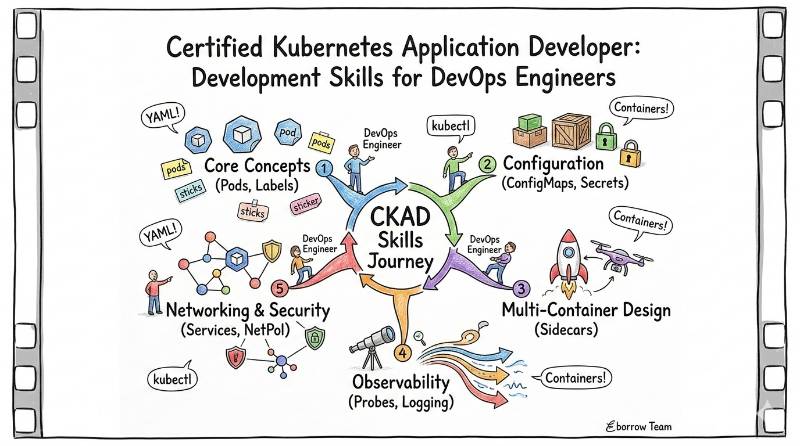
Introduction
Kubernetes has become the backbone of modern software development. As more companies move their workloads to the cloud, the need for skilled professionals who can build, configure, and expose applications on Kubernetes clusters has grown significantly. The Certified Kubernetes Application Developer (CKAD) program is designed to verify that an engineer can design, build, and deploy cloud-native applications effectively.
What is Certified Kubernetes Application Developer (CKAD)?
The CKAD is a performance-based certification exam that tests one’s ability to create, configure, and manage applications in a Kubernetes environment. Unlike traditional multiple-choice exams, this test requires solving real-world problems in a command-line interface. It is highly respected because it proves hands-on competence rather than just theoretical knowledge.
Why it matters in today’s software, cloud, and automation ecosystem
In the current landscape of DevOps and SRE, containerization is no longer optional. Kubernetes is the industry standard for managing these containers. For an engineer, being CKAD certified means being able to navigate the complexities of cloud-native architecture. It ensures that applications are scalable, resilient, and easily managed across different cloud providers.
Why certifications are important for engineers and managers
Certifications serve as a validated benchmark for skills. For engineers, it provides a structured learning path and a boost in professional credibility. For managers, having a certified team reduces the risks associated with cloud migrations and infrastructure management. It ensures that the team is following industry best practices, which leads to fewer production errors and faster deployment cycles.
Certification Overview Table
| Track | Level | Who it’s for | Prerequisites | Skills Covered | Recommended Order |
| Cloud Native | Intermediate | Developers, Engineers | Basic Linux & Docker | Pods, Deployments, Services | After CKA or directly |
Provider: DevOpsSchool
Why Choose DevOpsSchool?
DevOpsSchool is chosen by many professionals because of its deep focus on practical training. The courses are designed by experts who understand the pain points of real-world production environments. Beyond just passing the exam, the focus is kept on ensuring that the learner can handle actual project challenges. The support provided during the training helps in clearing doubts that documentation often leaves unanswered.
Certification Deep-Dive: CKAD
What is this certification?
The CKAD certification is a practical exam that focuses on the responsibilities of a cloud-native developer. It involves using Kubernetes primitives to build, monitor, and troubleshoot scalable applications and tools.
Who should take this certification?
- Software Developers who want to package their code for the cloud.
- DevOps Engineers focused on application delivery.
- Cloud Architects aiming to understand the developer’s perspective.
- System Administrators moving toward container orchestration.
Skills you will gain
- Designing and building container images.
- Creating and configuring Kubernetes Pods and Deployments.
- Implementing Multi-container design patterns.
- Configuring persistent volumes and claims for data storage.
- Managing application security and network policies.
- Troubleshooting application failures within a cluster.
Real-world projects you should be able to do after this certification
- Deploying a microservices-based web application.
- Setting up rolling updates and rollbacks for production apps.
- Configuring Liveness and Readiness probes to ensure app health.
- Managing sensitive data using Secrets and ConfigMaps.
- Scaling applications based on traffic demand.
Preparation Plan
7–14 Days Plan (The Intensive Sprint)
- Focus entirely on the official curriculum.
- Spend 4 hours daily on the command line (kubectl).
- Solve mock labs twice a day.
- Memorize key YAML structures for Pods and Services.
30 Days Plan (The Balanced Approach)
- Weeks 1-2: Understand core concepts like Pods, Labels, and Selectors.
- Week 3: Practice Networking, Storage, and Security.
- Week 4: Take multiple practice exams and improve speed.
60 Days Plan (The Foundation Builder)
- Month 1: Learn Docker and Linux basics alongside Kubernetes theory.
- Month 2: Deep dive into each CKAD domain with hands-on practice every weekend.
Common mistakes to avoid
- Spending too much time on a single difficult question.
- Neglecting the importance of the
kubectlimperative commands. - Not checking the current context/namespace before running commands.
- Copy-pasting YAML incorrectly from the documentation.
Best next certification after this
- Same track: Certified Kubernetes Administrator (CKA).
- Cross-track: Certified Kubernetes Security Specialist (CKS).
- Leadership / management: Cloud Digital Leader or Project Management certifications.
Choose Your Learning Path
1. DevOps Path
This path is best for those who want to bridge the gap between development and operations. It focuses on CI/CD pipelines and automated deployments.
2. DevSecOps Path
This is meant for engineers who want to integrate security into every stage of the development lifecycle. It prioritizes policy management and vulnerability scanning.
3. Site Reliability Engineering (SRE) Path
Best for those focused on system uptime and performance. It emphasizes monitoring, logging, and error budget management.
4. AIOps / MLOps Path
Designed for data scientists and engineers who need to deploy Machine Learning models at scale using Kubernetes clusters.
5. DataOps Path
This path is ideal for professionals managing large-scale data pipelines and ensuring data quality through automated workflows.
6. FinOps Path
Best for those who want to manage and optimize the costs of cloud resources while maintaining high performance.
Role → Recommended Certifications Mapping
- DevOps Engineer: CKAD, CKA, Jenkins Engineer.
- Site Reliability Engineer (SRE): CKAD, CKA, Prometheus Certified.
- Platform Engineer: CKAD, Terraform Associate, CKS.
- Cloud Engineer: CKAD, AWS/Azure Solutions Architect.
- Security Engineer: CKAD, CKS, Certified Ethical Hacker.
- Data Engineer: CKAD, Data Engineering on Cloud.
- FinOps Practitioner: CKAD, FinOps Certified Practitioner.
- Engineering Manager: CKAD (for technical context), PMP, Cloud Digital Leader.
Next Certifications to Take
Based on trends for software engineers, here are the recommendations for further growth:
- Same-track: Certified Kubernetes Administrator (CKA).
- Cross-track: HashiCorp Certified: Terraform Associate.
- Leadership-focused: Certified Scrum Master (CSM).
Training & Certification Support Institutions
DevOpsSchool
Comprehensive training programs are provided here for various cloud and DevOps tools. A focus is maintained on real-world scenarios and lab-based learning to ensure student success.
Cotocus
A boutique training firm that specializes in high-end technical consulting and training. It is known for its personalized approach and industry-aligned curriculum.
ScmGalaxy
A community-driven platform that offers extensive resources, tutorials, and certification guidance. It is widely recognized for its contributions to the DevOps community.
BestDevOps
Specialized training is offered here with a focus on fast-tracking professional careers. The courses are structured to be concise yet deep in technical content.
Other Schools
Specific domains are covered by devsecopsschool.com, sreschool.com, aiopsschool.com, dataopsschool.com, and finopsschool.com. Each platform provides specialized tracks for security, reliability, AI, data, and financial operations respectively.
FAQs Section
General FAQs
- Is the CKAD exam difficult?
It is considered moderate to difficult because it is 100% practical. - How much time is required to prepare?
Usually, 1 to 2 months of consistent practice is sufficient. - Are there any prerequisites?
No official prerequisites exist, but Linux knowledge is very helpful. - In what order should I take Kubernetes exams?
CKAD or CKA can be taken first, followed by CKS. - Does this certification help in getting a job?
Yes, it is highly valued by recruiters for technical roles. - How long is the certification valid?
It is typically valid for 3 years. - Can I use the official documentation during the exam?
Yes, one tab of official documentation is allowed. - What is the passing score?
The passing score is usually around 66%. - Is the exam online or offline?
The exam is proctored online and can be taken from home. - Does it cover Docker?
While it focuses on Kubernetes, understanding container concepts is vital. - Are retakes allowed?
Usually, one free retake is included with the exam purchase. - What is the format of the exam?
It consists of 15-20 performance-based tasks.
CKAD Specific FAQs
- Is CKAD only for developers?
It is geared toward developers, but DevOps engineers benefit greatly from it. - What version of Kubernetes is used?
The exam is updated regularly to reflect recent stable versions. - Are helm charts included in CKAD?
Basic knowledge of using Helm is part of the curriculum. - How is speed managed during the exam?
Aliases and imperative commands are used to save time. - Can I use a notepad during the exam?
An internal digital notepad is provided within the exam browser. - Is network policy part of CKAD?
Yes, configuring basic network policies is a core skill. - Are volumes and storage tested?
Yes, persistent volumes and claims are frequently tested. - Is CKAD easier than CKA?
Many find CKAD slightly easier as it focuses on application-level resources rather than cluster administration.
Testimonials
- Arjun (DevOps Engineer): “The CKAD training helped me understand how to properly structure my deployments. My confidence in managing production clusters has grown significantly.”
- Sita (SRE): “Real-world application was the focus of my learning. I can now troubleshoot complex pod issues much faster than before.”
- Rohan (Cloud Engineer): “Career clarity was achieved after this certification. It helped me move from a general sysadmin role into a specialized cloud role.”
- Priya (Security Engineer): “Skill improvement in container security was my main goal. Learning how to manage secrets and policies in CKAD was a game changer.”
- Amit (Engineering Manager): “Confidence growth in my team was visible after they got certified. We now speak the same technical language and follow better standards.”
Conclusion
The Certified Kubernetes Application Developer (CKAD) certification is a vital milestone for anyone working in the cloud-native space. By focusing on hands-on skills, it ensures that an engineer is ready to handle the demands of modern application delivery. Long-term career benefits include higher salary potential, better job security, and the ability to lead complex technical projects. Strategic learning and planning are encouraged for every professional who wants to remain relevant in the evolving tech industry.
