Introduction
The landscape of software development has been transformed by the shift toward distributed systems and microservices. In the past, monitoring a single server was a straightforward task, but today’s environments are composed of hundreds or even thousands of interconnected components. When a failure occurs, the source of the problem is often hidden behind layers of complexity. This is where the concept of observability becomes essential. It is no longer enough to simply know that a system is “up” or “down.” Instead, deep insights into the internal state of applications must be gathered through the analysis of traces, metrics, and logs.
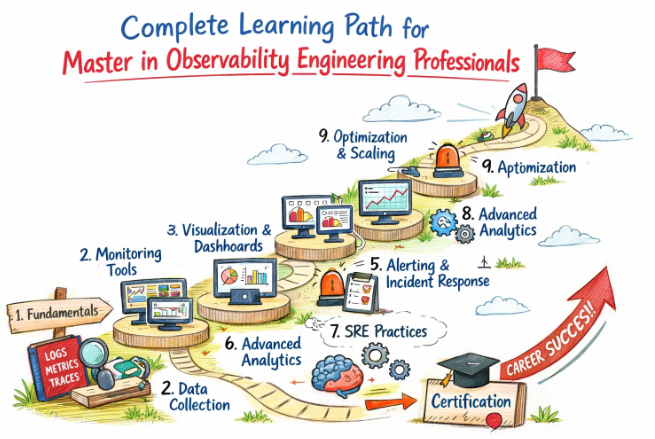
The Master in Observability Engineering (MOE) is designed to address these modern challenges. It is a comprehensive program created for those who wish to move beyond traditional monitoring and embrace a proactive approach to system health. By focusing on the “why” behind system behavior rather than just the “what,” engineers are empowered to build more resilient and reliable software. This guide is prepared to help professionals understand how this certification can serve as a cornerstone for a successful career in the evolving tech ecosystem.
Understanding the Master in Observability Engineering (MOE)
The Master in Observability Engineering (MOE) is a professional certification program that focuses on the tools, mindsets, and methodologies required to gain full visibility into complex software systems. It is not merely a course on tools; it is a deep dive into the philosophy of building systems that are inherently observable. The core objective is to ensure that performance bottlenecks and errors are identified and resolved before they impact the end-user experience.
Why Observability is Vital in Today’s Ecosystem
In the current era of cloud computing and rapid automation, the speed of delivery has increased significantly. However, this speed often introduces new risks. Traditional monitoring tools frequently fail to keep up with the dynamic nature of containerized environments and serverless architectures. Observability matters because it provides a granular view of every request as it travels through a system. This level of detail is necessary for maintaining High Availability (HA) and meeting strict Service Level Agreements (SLAs).
Furthermore, as organizations adopt AIOps and MLOps, the data generated by observability tools becomes the foundation for automated decision-making. Without high-quality data, automation cannot be effectively implemented. Therefore, mastering these skills is seen as a prerequisite for anyone working in advanced DevOps or Site Reliability Engineering roles.
The Value of Certifications for Professionals and Leaders
For engineers, certifications like the MOE provide a structured way to validate expertise in a specialized niche. It serves as a signal to employers that an individual possesses a standardized level of knowledge and is committed to continuous learning. In a competitive job market, having a verified credential can be the deciding factor during the hiring process.
For managers, certifications ensure that their teams are speaking the same technical language. When a team is trained under a unified framework, collaboration is improved, and the time taken to resolve incidents is significantly reduced. It also helps leadership in identifying skill gaps within the organization and planning for future technological shifts.
Why Choose DevOpsSchool?
When selecting a training partner, the quality of the curriculum and the experience of the instructors are the most important factors. DevOpsSchool is chosen by many because the programs are designed by industry veterans who have faced real-world production issues. The focus is placed heavily on hands-on labs rather than just theoretical lectures.
At DevOpsSchool, learners are provided with a supportive environment where complex concepts are broken down into manageable steps. The community aspect allows for networking with other professionals, while the certification itself is recognized globally by top-tier technology firms. The goal of the institution is to ensure that every student leaves with practical skills that can be immediately applied to their workplace.
Master in Observability Engineering (MOE): A Deep-Dive
What is this certification?
This certification is an advanced program that teaches the principles of telemetry, including logs, metrics, and distributed tracing. It is designed to help engineers build and manage highly visible and reliable cloud-native infrastructures.
Who should take this certification?
This path is ideal for Software Engineers, SREs, and DevOps professionals who are responsible for the uptime and performance of large-scale applications. It is also highly beneficial for Engineering Managers who oversee platform teams and need to understand the technical requirements of modern monitoring.
Certification Overview Table
| Track | Level | Who it’s for | Prerequisites | Skills Covered | Recommended Order |
| DevOps | Intermediate | Systems Engineers | Basic Linux/Git | CI/CD, Infrastructure as Code | 1 |
| DevSecOps | Advanced | Security Analysts | DevOps basics | Automated Security, Compliance | 2 |
| SRE | Expert | Reliability Engineers | MOE or DevOps | Error Budgets, Incident Response | 3 |
| AIOps/MLOps | Specialized | Data/Ops Engineers | Python/Cloud | Model Deployment, Monitoring | 4 |
| DataOps | Specialized | Data Engineers | SQL/Big Data | Pipeline Reliability, Data Quality | 5 |
| FinOps | Management | FinOps Analysts | Cloud Billing | Cost Optimization, Forecasting | 6 |
Skills You Will Gain
- The ability to implement distributed tracing across microservices.
- Mastery over log aggregation and analysis tools.
- Proficiency in creating meaningful dashboards and alerting systems.
- Understanding of Service Level Objectives (SLOs) and Service Level Indicators (SLIs).
- Expertise in identifying performance bottlenecks in high-traffic environments.
Real-World Projects Post-Certification
- A full-stack observability suite is built for a Kubernetes cluster.
- A centralized logging system is established for a multi-cloud environment.
- Custom exporters are developed to monitor specialized application metrics.
- An automated incident response workflow is triggered by observability data.
Preparation Plan
7–14 Days Plan (The Intensive Review):
In this short window, focus is placed on reviewing core definitions and the primary toolsets. Documentation for Prometheus, Grafana, and ELK stack is studied. Practice exams are taken to identify weak areas.
30 Days Plan (The Balanced Approach):
Theoretical concepts are covered in the first two weeks. The remaining two weeks are dedicated to setting up local lab environments. Hands-on exercises involving trace injection and log parsing are performed daily.
60 Days Plan (The Master Mastery):
The first month is spent understanding the architectural patterns of observability. The second month focuses on advanced troubleshooting and real-world case studies. Deep dives into OpenTelemetry and its integration with various languages are conducted.
Common Mistakes to Avoid
- Relying too much on default dashboards without understanding the underlying data.
- Collecting too much data (noise) without a clear strategy for analysis.
- Ignoring the cultural aspect of observability and focusing only on tools.
- Failing to correlate logs with traces during a debugging session.
Best Next Certification After This
- Same Track: Advanced Site Reliability Engineering (SRE) Masterclass.
- Cross-Track: Master in DevSecOps for integrated security observability.
- Leadership / Management: FinOps Certified Professional for cost-aware engineering.
Choose Your Learning Path
1. DevOps Path
This path is best for those who want to automate the delivery of software. The focus is on integrating observability into the CI/CD pipeline so that performance issues are caught during the testing phase.
2. DevSecOps Path
Best for security-minded engineers. Here, observability is used to detect unusual patterns that might indicate a security breach. It combines system health with security posture.
3. Site Reliability Engineering (SRE) Path
Designed for those who prioritize system uptime. This path uses observability data to manage error budgets and ensure that the system remains within its defined reliability limits.
4. AIOps / MLOps Path
Ideal for data scientists and engineers. It focuses on monitoring machine learning models in production to ensure that data drift and performance degradation are addressed immediately.
5. DataOps Path
This is for professionals managing large data pipelines. Observability ensures that data is flowing correctly and that the quality of the data remains high throughout the lifecycle.
6. FinOps Path
Tailored for those managing cloud budgets. Observability tools are leveraged to track resource usage and link technical performance to cloud spending.
Role → Recommended Certifications Mapping
| Role | Primary Recommended Certification | Secondary Goal | Leadership Path |
| DevOps Engineer | Master in DevOps | MOE Certification | Engineering Manager |
| SRE | MOE Certification | DevSecOps Master | Director of Reliability |
| Platform Engineer | Cloud Architecture | MOE Certification | Platform Lead |
| Cloud Engineer | Multi-Cloud Expert | FinOps Practitioner | Cloud Operations Manager |
| Security Engineer | DevSecOps Master | MOE Certification | CISO |
| Data Engineer | DataOps Master | AIOps Specialist | Data Architect |
| FinOps Practitioner | FinOps Certified | Cloud Economics | Financial Operations Director |
| Engineering Manager | MOE Certification | Agile Leadership | VP of Engineering |
Next Certifications to Take
For those who have completed the MOE, the journey continues.
- Same-Track: It is recommended that the SRE Masterclass be pursued to apply observability in a reliability framework.
- Cross-Track: The DevSecOps Certification is a great choice to learn how to monitor security threats.
- Leadership: An Agile Engineering Management course should be considered for those moving into people leadership roles.
Training & Certification Support Institutions
DevOpsSchool
This institution is recognized for its comprehensive curriculum and expert-led training. A wide range of certifications in DevOps, SRE, and Observability are offered here with a focus on career growth.
Cotocus
A global provider of technical training that specializes in emerging technologies. Specialized tracks for cloud-native engineering and platform reliability are delivered by this organization.
ScmGalaxy
A well-known resource for community learning and professional certification support. Deep technical insights and vast repositories of knowledge regarding software configuration management are shared here.
BestDevOps
Practical, result-oriented training is the hallmark of this institution. The programs are tailored to help professionals transition into high-paying DevOps and SRE roles through rigorous coaching.
devsecopsschool.com
A dedicated platform for those looking to master the intersection of security and operations. Automated security testing and compliance-as-code are the core focus areas here.
sreschool.com
This institution focuses exclusively on the principles of Site Reliability Engineering. Concepts such as toil reduction and incident management are taught with a hands-on approach.
aiopsschool.com
Modern operations require the use of artificial intelligence. This school provides the skills needed to implement AI and ML in IT operations to achieve self-healing systems.
dataopsschool.com
Reliability in data pipelines is the specialty of this platform. It provides training for data engineers who need to ensure the integrity and availability of big data systems.
finopsschool.com
Cloud cost management is addressed here. It teaches engineers and managers how to balance technical performance with financial responsibility in the cloud.
FAQs Section
- What is the difficulty level of the MOE certification?
The level is considered advanced. A solid understanding of cloud infrastructure and basic monitoring concepts is required to succeed. - How much time is required to complete the program?
Usually, between 4 to 8 weeks are needed, depending on the previous experience of the learner and the time dedicated daily. - Are there any prerequisites for taking this exam?
While not mandatory, a basic knowledge of Linux, containers, and at least one programming language is highly recommended. - In what sequence should these certifications be taken?
It is often suggested that a general DevOps certification be completed before specializing in MOE or SRE tracks. - What is the career value of becoming an Observability Engineer?
This role is in high demand, often commanding higher salaries due to the specialized nature of the skills involved. - Which job roles benefit most from this certification?
SREs, Cloud Architects, and DevOps Leads find the most immediate benefit in their daily tasks. - Is this certification recognized globally?
Yes, the credentials provided are valued by international organizations across various sectors, including finance and healthcare. - Can an Engineering Manager benefit from this?
Absolutely. It provides the technical context needed to lead teams that are building complex, high-scale applications. - What tools are covered in the training?
Industry-standard tools such as Prometheus, Grafana, Jaeger, and ELK are typically included in the curriculum. - Does this certification help in getting a promotion?
Validation of these advanced skills often leads to senior-level roles and increased responsibilities within an organization. - How long is the certification valid?
Most technical certifications are valid for two to three years, after which a renewal or advanced level is encouraged. - Is there any community support after the certification?
Graduates are usually given access to alumni networks and forums where ongoing learning and job opportunities are shared.
Additional FAQs for Master in Observability Engineering (MOE)
- How does MOE differ from traditional monitoring?
While monitoring tells you when something is wrong, MOE provides the data to understand why it is wrong through deep system introspection. - Is coding required for MOE?
A basic ability to read and write scripts or application code is necessary to instrument applications for better visibility. - Does MOE cover cloud-native environments like Kubernetes?
Yes, a large portion of the curriculum is dedicated to observing containerized workloads and microservices. - Can I take the exam online?
Yes, online proctored exams are available, making it accessible to professionals worldwide. - What is the passing score for the MOE certification?
Usually, a score of 70% or higher is required to be granted the master-level credential. - Are there hands-on labs in the exam?
The certification process often involves practical scenarios where candidates must demonstrate their ability to troubleshoot real issues. - How does MOE support AIOps?
The high-quality telemetry data produced through observability practices is the essential input for AI-driven operational tools. - Will this certification help me with distributed tracing?
Distributed tracing is a core pillar of the MOE program, and mastery of it is a primary outcome.
Professional Testimonials
Aarav
The depth of knowledge gained through this program is incredible. Complex debugging tasks that used to take hours are now resolved in minutes due to the new perspective on system visibility.
Priya
The transition into a senior role was made much smoother after completing this certification. The focus on real-world application rather than just theory provided the confidence needed to lead a team.
Ethan
A clear understanding of how metrics and logs correlate was missing from my workflow. This program bridged that gap, and the improvement in system reliability was noticed immediately by the leadership.
Sanya
The career clarity provided by this path is unmatched. It is now clear how observability fits into the larger picture of SRE and DevOps, making strategic planning much easier.
Marcus
The hands-on labs were the most valuable part of the experience. Being able to practice in a safe environment before applying the skills to production systems was a huge benefit for my professional growth.
Final Thoughts
The Master in Observability Engineering (MOE) certification is a powerful tool for any professional looking to excel in the modern tech landscape. As systems grow more complex, the ability to see and understand what is happening under the hood becomes a rare and valuable skill. By pursuing this certification, an investment is made in a future where data-driven decisions lead to more stable and efficient software.
Strategic learning and careful planning are encouraged for those who wish to reach the top of their field. Whether the goal is to become a specialized SRE or a more effective Engineering Manager, the principles of observability will remain a vital part of the journey. The path forward is clear: master the data, and the systems will follow.
