Introduction
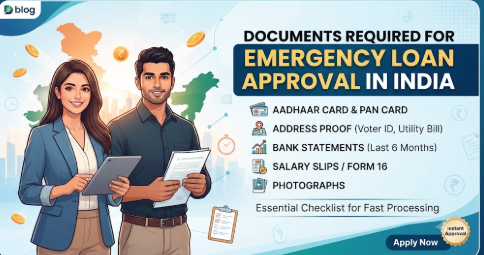
An urgent medical bill, household repair, education expense or temporary income gap can create immediate financial pressure, especially when savings are limited and payment cannot be postponed. During such situations, borrowers may begin an emergency loan application without first checking the documents required for verification. This often creates unnecessary delays, rejected uploads, mismatched information or repeated calls from the lender. Proper documentation helps a lender confirm the applicant’s identity, address, income, employment and repayment capacity, but documents alone do not guarantee approval. The lender may also consider credit history, existing debt, banking behaviour and internal eligibility rules. Understanding the documents required for emergency loan approval allows applicants to organise their records, avoid inaccurate information, protect sensitive data and compare borrowing terms before accepting an offer. This guide provides a practical, India-focused explanation for salaried people, self-employed professionals, pensioners and small business owners who need to approach urgent borrowing carefully.
Understanding Documents Required for Emergency Loan Approval in Simple Words
Emergency loan documents are records used by a bank, non-banking financial company or another authorised lender to verify the information given in a loan application.
They help answer five basic questions:
- Is the applicant a genuine person?
- Does the applicant live at the stated address?
- Does the applicant earn enough to repay the loan?
- Is the bank account controlled by the applicant?
- Does the application satisfy the lender’s eligibility and risk rules?
Know Your Customer, commonly called KYC, is the process through which regulated financial entities verify a customer’s identity and address. RBI guidance explains that regulated entities obtain and verify customer identity and address information as part of KYC requirements.
A Beginner-Friendly Example
Suppose a salaried employee applies for an emergency personal loan to pay an urgent hospital bill. The lender may request:
- PAN details
- Proof of identity
- Proof of current address
- Recent salary slips
- Recent bank statements
- Employment information
- A photograph or live selfie
- Consent for credit assessment
The lender reviews these records together. A salary slip may show monthly income, while a bank statement helps confirm whether the salary is actually credited and whether existing repayment obligations appear manageable.
A Common Misunderstanding
Many applicants believe that uploading Aadhaar and PAN automatically produces loan approval. In reality, these documents mainly support identity and compliance verification. Approval may still depend on income stability, credit profile, repayment capacity, employer or business details, existing loans and lender policy.
Practical Takeaway
Prepare documents before beginning the application, but also review the loan’s total cost, monthly obligation, tenure and conditions. Fast processing should never replace careful borrowing.
Why Proper Emergency Loan Documentation Is Important
Loan documentation is important because lending involves both financial risk and regulatory responsibility.
It Confirms Identity
Identity verification helps a lender reduce impersonation, fraud and the misuse of another person’s financial information.
Depending on the lender’s accepted process, identification may involve Aadhaar-based verification or another officially accepted document. UIDAI describes Aadhaar as a proof of identity and address for residents, although the specific document and authentication process accepted for a loan can vary by lender and applicable rules.
It Supports Address Verification
A current address helps the lender maintain correct customer records and communicate important notices. A mismatch between the application, Aadhaar, bank statement and other records may lead to additional verification.
It Demonstrates Income
Income proof helps the lender estimate whether the borrower can manage the proposed EMI along with rent, household expenses and existing debts.
It Supports Credit Assessment
Bank statements, employment records and credit information may help the lender understand financial behaviour. A lender may consider regular income credits, existing EMIs, returned payments, irregular balances or recent borrowing activity.
It Protects the Applicant
Accurate documents can protect borrowers from incorrect loan records, unsuitable offers and fraudulent applications made in their names.
Practical Scenario
A person needs ₹60,000 for an urgent medical expense. Instead of applying to several unknown applications, the person first collects salary slips, bank statements and KYC records, estimates an affordable EMI and compares the Key Fact Statement provided by regulated lenders. This approach may not guarantee approval, but it improves preparedness and reduces the risk of accepting an unclear or unaffordable loan.
RBI’s digital lending guidance requires important charges and other applicable information to be disclosed through the Key Fact Statement before the borrower enters the loan contract.
The Real Problems Readers Face With Emergency Loan Documents
People searching for emergency loans are usually under pressure. That pressure can reduce their ability to compare options carefully.
Lack of Document Awareness
Applicants may not know whether they need salary slips, bank statements, income-tax returns or business documents. They may begin an application and discover missing requirements halfway through the process.
Different Lender Requirements
There is no single document list that applies identically to every lender and applicant. Requirements can change according to:
- Employment type
- Loan amount
- Credit profile
- Existing relationship with the lender
- Verification method
- Applicant location
- Internal underwriting policy
Mismatched Personal Information
Differences in name, address, date of birth, initials or mobile numbers can create verification problems.
For example:
- PAN shows the full name.
- Aadhaar uses initials.
- Bank account uses an older surname.
- Salary slip contains a spelling error.
Even a genuine applicant may face delays until the mismatch is explained or corrected.
Poor-Quality Uploads
Blurred images, cropped documents, password-protected files and incomplete bank statements are common reasons lenders ask for resubmission.
Unrealistic Expectations
The term “emergency loan” may create an expectation of immediate approval. However, the lender must still complete identity, credit and risk checks.
Weak Loan Comparison
Applicants may focus only on the amount offered and ignore:
- Annual percentage rate
- Processing fee
- Taxes
- Late-payment charges
- Penal charges
- Insurance or add-on services
- Prepayment conditions
- Total repayment amount
Unsafe Sharing of Personal Data
Financial urgency makes borrowers vulnerable to fraud. Some people share PAN, Aadhaar, OTPs, bank passwords or card details with unknown agents claiming they can guarantee approval.
No legitimate loan process requires an applicant to disclose internet-banking passwords, ATM PINs or card PINs.
Depending Only on Social Media Advice
Social media posts may simplify lending into claims such as “no documents,” “approval for everyone” or “money in minutes.” Such statements may omit eligibility conditions, high charges or privacy risks.
Not Knowing the Right Next Step
The better sequence is:
- Confirm the actual need.
- Calculate the amount required.
- Check repayment capacity.
- organise documents.
- Verify the lender.
- compare the Key Fact Statement.
- apply through an official channel.
- retain all records.
How Emergency Loan Documentation Works Step by Step
Step 1: Identify the Exact Financial Need
Begin by calculating how much money is genuinely required and whether part of the expense can be covered through savings, insurance, employer support or a payment arrangement. This matters because borrowing more than necessary increases interest and EMI pressure. For example, when a hospital deposit is ₹35,000, applying for ₹1 lakh simply because it is offered may create avoidable debt. A common mistake is treating the maximum eligible amount as the correct amount. The better approach is to borrow only the verified shortfall.
Step 2: Choose an Appropriate and Verifiable Lender
Check whether the loan is being offered by a regulated bank or NBFC, or through a platform working transparently with a clearly identified regulated lender. The lender’s legal name, customer support details, privacy policy, grievance process and loan terms should be visible. A common mistake is trusting an application merely because it appears in an app store or advertisement. The better approach is to confirm who is actually providing the loan before sharing documents.
Step 3: Review Eligibility Before Uploading Documents
Read the lender’s basic criteria regarding age, location, employment type, minimum income, business vintage and other conditions. This prevents unnecessary sharing of personal documents with a lender whose criteria the applicant clearly does not meet. For example, a self-employed applicant should not submit only salary-style documents when the lender requires business income records. The common mistake is applying first and reading conditions later. The better approach is to complete an eligibility check before document submission.
Step 4: Prepare Identity and Address Records
Collect clear and current KYC documents. Verify that the name, date of birth and address are consistent across the application and supporting records. PAN is a ten-character alphanumeric identifier issued by the Income Tax Department and is used for tax and specified financial purposes. A common mistake is uploading an expired, cropped or mismatched record. The better approach is to review every field and correct material discrepancies where necessary.
Step 5: Prepare Income and Employment Evidence
Salaried applicants may need recent salary slips, salary-credit bank statements and employment details. Self-employed applicants may need income-tax returns, bank statements, business registration records or financial statements. The lender uses these documents to understand income regularity rather than relying only on the income typed in the application. A common mistake is modifying a document or hiding pages. The better approach is to provide complete and genuine information.
Step 6: Submit Bank Account Information Carefully
The loan may be disbursed only into a verified bank account belonging to the borrower. The lender may request bank statements, a cancelled cheque or electronic account verification. Applicants should ensure the account holder’s name and account details match the application. A common mistake is submitting another person’s account or an inactive account. The better approach is to use a personal, active account and confirm all details before submission.
Step 7: Complete Digital Verification Securely
Some lenders use OTP verification, live photographs, video KYC, electronic signatures or account-verification services. Complete these steps only inside the lender’s official website or application. Never share an OTP with a caller, agent or messaging account. A common mistake is allowing a remote agent to control the phone or install screen-sharing software. The better approach is to perform verification personally through a secure connection.
Step 8: Review the Offer Before Accepting It
Document approval is not the final decision point. Read the Key Fact Statement and loan agreement before giving consent. Check the annual percentage rate, interest calculation, net disbursal, EMI, tenure, processing fee, late charges, penal charges and total repayment. A common mistake is accepting because the application displays “approved.” The better approach is to judge affordability and total cost before signing.
Key Factors That Influence Emergency Loan Approval
Submitting complete documents improves processing, but the lender may consider several other factors.
Identity Consistency
Names, dates of birth, addresses, phone numbers and bank information should be accurate and consistent.
Income Stability
Regular income can be more important than a high but irregular income. The lender may assess whether earnings are stable enough to support monthly repayment.
Repayment Capacity
Repayment capacity is the amount an applicant can reasonably pay after normal living expenses and existing commitments.
Existing EMI Burden
A borrower already paying several EMIs may have limited room for another loan, even with sufficient gross income.
Credit History
Past repayment behaviour may influence approval, pricing and the loan amount. Delayed payments, settled accounts or repeated enquiries may affect a lender’s risk assessment.
Employment or Business Stability
A lender may check how long the applicant has worked for the present employer or operated the current business.
Bank Account Behaviour
Regular salary or business receipts may support the stated income. Returned payments, frequent negative balances or unexplained high-value activity may trigger additional review.
Loan Amount and Tenure
A larger loan or shorter tenure can create a higher EMI. The lender may adjust the amount or tenure based on affordability.
Accuracy of the Application
False, incomplete or contradictory information can cause rejection and may create serious compliance concerns.
Lender-Specific Policy
Two lenders can evaluate the same applicant differently because their internal credit policies, risk appetite and customer segments may differ.
Detailed Breakdown of Documents Required for Emergency Loan Approval
The exact requirements vary, but the following categories are commonly relevant.
1. PAN Details
PAN helps establish the applicant’s tax and financial identity. It may be used for:
- Identity matching
- Credit-bureau checks
- Tax-related reporting requirements
- Detecting duplicate applications
- Linking financial records
Applicants should check that the PAN name matches the loan application.
Common Mistake
Uploading an unclear PAN image or typing the number incorrectly.
Better Approach
Use a clear copy and verify each character before submission.
2. Proof of Identity
Depending on the lender and permitted KYC process, identity verification may use documents such as:
- Aadhaar
- Passport
- Voter identity card
- Driving licence
- Other officially accepted documentation
RBI KYC guidance recognises specified officially valid documents for customer verification, while the exact process followed by a lender depends on applicable rules and its verification method.
Common Mistake
Assuming every identity document is accepted by every lender.
Better Approach
Check the lender’s current approved-document list before uploading.
3. Proof of Current Address
A lender may use one or more of the following, subject to its policy:
- Aadhaar containing the current address
- Passport
- Voter identity card
- Driving licence
- Utility bill
- Bank statement
- Registered rent or lease record
- Other accepted address evidence
The address document should generally be current and readable.
Common Mistake
Submitting Aadhaar with an old address while entering a different current address without explanation.
Better Approach
Declare both permanent and current addresses correctly and provide supporting records when requested.
4. Recent Photograph or Live Selfie
Digital applications often request a live selfie or facial verification to confirm that the person applying matches the identity record.
Common Mistake
Using a photograph of a printed photo or completing verification in poor lighting.
Better Approach
Use a well-lit setting, follow the on-screen instructions and avoid filters or edited images.
5. Salary Slips
Salaried applicants may be asked for recent salary slips showing:
- Employee name
- Employer name
- Pay period
- Gross salary
- Deductions
- Net salary
- Employee identification details
Common Mistake
Submitting only one slip when the lender requests several months.
Better Approach
Provide the complete requested period and ensure the slips are genuine and readable.
6. Salary-Credit Bank Statements
Bank statements may help verify:
- Regular salary deposits
- Income frequency
- Existing EMI deductions
- Returned payments
- General cash-flow stability
- Bank account ownership
Common Mistake
Uploading screenshots showing only selected transactions.
Better Approach
Download the official statement for the complete requested period from the bank.
7. Employment Proof
Depending on the lender, employment proof may include:
- Employee identity card
- Offer or appointment letter
- Employment confirmation
- Official email verification
- Employer details
- Form 16, where applicable
Common Mistake
Providing outdated employer information after changing jobs.
Better Approach
Use current employment information and explain a recent job change honestly.
8. Income-Tax Records
Income-tax returns or Form 16 may be requested when the lender requires stronger income verification.
These records may be especially relevant for:
- Self-employed professionals
- Business owners
- Commission-based workers
- Applicants with multiple income sources
- Higher loan amounts
Common Mistake
Entering income that is materially different from declared tax records without a valid explanation.
Better Approach
Use accurate income information and keep supporting records ready.
9. Business Registration or Professional Records
Self-employed applicants may be asked for documents such as:
- GST registration, where applicable
- Business registration
- Shop and establishment record
- Professional licence
- Partnership deed
- Company incorporation documents
- Business address proof
Common Mistake
Using personal income claims without evidence of business activity.
Better Approach
Maintain clear separation between personal and business records wherever practical.
10. Business Bank Statements
Business statements may show:
- Sales receipts
- Customer payments
- Operating expenses
- Loan obligations
- Cash-flow consistency
- Seasonal variations
Common Mistake
Submitting only the strongest month while omitting the complete requested period.
Better Approach
Provide full statements and explain seasonal or one-time fluctuations when asked.
11. Financial Statements
For some business borrowers, the lender may request:
- Profit and loss statement
- Balance sheet
- Cash-flow statement
- Audited or certified accounts
- Sales summaries
These may not be required for every small emergency loan, but they can become relevant for business-purpose borrowing or higher amounts.
12. Cancelled Cheque or Bank Verification
A cancelled cheque can help verify:
- Account holder’s name
- Bank name
- Account number
- IFSC
- Account ownership
Some lenders replace this with secure electronic verification.
Common Mistake
Submitting a cheque from a joint, business or family account when the loan requires an individual account.
Better Approach
Confirm the acceptable account type before submission.
13. Existing Loan Information
The applicant may need to declare:
- Active personal loans
- Home or vehicle loans
- Credit-card balances
- Buy-now-pay-later obligations
- Informal or employer loans
- Monthly EMI commitments
RBI guidance has addressed the importance of obtaining information regarding borrowers’ existing loans as an input into credit evaluation.
Common Mistake
Hiding obligations that appear later in a credit report or bank statement.
Better Approach
Provide complete and honest information.
14. Purpose-Related Records
Some lenders may request evidence of the emergency, particularly for a specific-purpose product.
Examples include:
- Hospital estimate
- Medical invoice
- Education fee notice
- Repair estimate
- Insurance claim record
- Vendor quotation
A standard unsecured personal loan may not always require purpose evidence, but applicants should follow the lender’s stated requirements.
15. Co-Applicant or Guarantor Documents
Where a co-applicant or guarantor is involved, that person may also need to submit:
- KYC documents
- Income records
- Bank statements
- Employment information
- Consent for credit assessment
A person should never agree to become a guarantor without understanding the legal and financial consequences.
Documents for Different Types of Applicants
Salaried Employees
A salaried applicant may commonly require:
- PAN
- Identity and address proof
- Recent salary slips
- Salary-credit bank statements
- Employment details
- Employee identification
- Form 16 or other income record, when requested
- Photograph or live verification
- Bank account verification
Self-Employed Professionals
A self-employed doctor, consultant, designer or freelancer may need:
- PAN
- Identity and address proof
- Bank statements
- Income-tax returns
- Professional registration, where relevant
- Invoices or income summaries
- Business or professional address proof
- Financial statements for certain applications
Small Business Owners
Documents may include:
- Applicant and business PAN details
- KYC records
- Business registration
- GST-related records, where applicable
- Current-account statements
- Income-tax returns
- Financial statements
- Business-address proof
- Ownership or partnership records
Pensioners
A pensioner may need:
- PAN
- Identity and address proof
- Pension-payment order or pension statement
- Bank statements showing pension credits
- Age-related records
- Nominee, co-applicant or security information where required
Gig Workers and Freelancers
Income may be irregular, so documentation can include:
- Bank statements
- Platform payment reports
- Invoices
- Contracts
- Income-tax returns
- Client payment records
- Professional registration, if applicable
The common mistake is presenting only one high-income month. A better approach is to show a reasonable period of consistent earnings.
Common Mistakes Beginners Make With Emergency Loan Documents
Applying Without Checking Eligibility
This leads to unnecessary applications and credit enquiries.
Better approach: Review basic eligibility and required documents before submitting.
Uploading Blurred or Cropped Files
Important fields may be unreadable, causing resubmission or rejection.
Better approach: Scan the full document in good lighting and check every page.
Entering Different Information Across Records
Conflicting income, address or employment details can trigger verification.
Better approach: Complete the application using information supported by genuine documents.
Editing Financial Documents
Altering salary slips, bank statements or tax records is dishonest and may create legal consequences.
Better approach: Submit authentic records and explain genuine irregularities.
Hiding Existing Loans
Existing obligations may appear through credit checks and bank transactions.
Better approach: Declare all debts accurately.
Applying to Many Lenders at Once
Multiple applications may create confusion, duplicate document sharing and repeated credit enquiries.
Better approach: Compare lenders first and apply selectively.
Ignoring Fees and Net Disbursal
A sanctioned amount and the amount actually credited may differ after permitted deductions.
Better approach: Check the net amount, APR, fee breakdown and total repayment before accepting.
Sharing Documents with Unknown Agents
Personal documents can be misused for fraud.
Better approach: Submit records only through a verified official channel.
Sharing OTPs, PINs or Passwords
These details can provide access to bank accounts or identity systems.
Better approach: Never disclose confidential authentication credentials.
Borrowing Under Emotional Pressure
Urgency can lead to unaffordable repayment commitments.
Better approach: Calculate EMI capacity before accepting an offer.
Ignoring the Loan Agreement
Applicants may miss late charges, debit instructions, collection practices or prepayment conditions.
Better approach: Read and save the complete agreement and Key Fact Statement.
Depending on Guaranteed-Approval Claims
No responsible lender can approve every applicant regardless of eligibility.
Better approach: Treat guaranteed-approval claims as a warning sign.
Don’t Do This Checklist
- Do not upload altered bank statements.
- Do not provide false income information.
- Do not pay an unknown person for guaranteed approval.
- Do not share ATM PINs or internet-banking passwords.
- Do not share an OTP over a phone call or chat.
- Do not install remote-access software for loan verification.
- Do not borrow more merely because a higher amount is offered.
- Do not accept without checking total repayment.
- Do not ignore existing EMI obligations.
- Do not submit documents through unofficial messaging accounts.
- Do not sign a blank form.
- Do not use another person’s identity or bank account.
Practical Real-Life Examples of Emergency Loan Documentation
Example 1: Salaried Person Facing a Medical Expense
A salaried employee needed funds for an urgent medical deposit but uploaded only PAN and Aadhaar. The lender later requested salary slips and complete bank statements, delaying verification. The better action was to prepare all income and banking records before starting. The learning is that KYC proves identity but does not necessarily prove repayment capacity.
Example 2: Employee With an Address Mismatch
An applicant’s Aadhaar showed a permanent village address, while the application contained a rented city address. The applicant initially left the difference unexplained. A current bank statement and accepted address record were later provided. The learning is to disclose permanent and current addresses accurately rather than forcing every document to show the same address.
Example 3: Freelancer With Irregular Income
A freelance designer submitted only one invoice from a large project. The lender could not assess normal monthly income. The freelancer then provided several months of bank statements, invoices and tax records. The learning is that a longer income history can be more useful than one unusually strong payment.
Example 4: Small Business Owner With Mixed Accounts
A shop owner received business payments into several personal accounts. This made income difficult to understand. The owner organised business statements, sales records and registration documents before applying again. The learning is that organised financial records support clearer assessment.
Example 5: Applicant Targeted by a Fake Agent
A borrower received a message promising approval after payment of an advance “verification charge.” The agent also requested an OTP. The borrower stopped communication and used only the official lender channel. The learning is that urgency should never override privacy and fraud checks.
Table 1: Emergency Loan Document Categories
| Document category | Common examples | What it may help verify | Common problem |
|---|---|---|---|
| Identity | Aadhaar, passport, voter ID, driving licence | Applicant identity | Name or date-of-birth mismatch |
| Tax identity | PAN | Financial identity and credit checks | Incorrect PAN entry |
| Address | Accepted KYC record, bank statement or utility record | Current or permanent residence | Old or unsupported address |
| Income | Salary slips, ITR, invoices or financial statements | Earning capacity | Incomplete income history |
| Banking | Bank statements, cancelled cheque or account verification | Account ownership and cash flow | Cropped statements or another person’s account |
| Employment | Employee ID, appointment record or employer confirmation | Job status and stability | Outdated employer details |
| Business | Registration, GST records or business statements | Business existence and activity | Mixing personal and business records |
| Loan obligations | Credit report, statements or borrower declaration | Existing debt burden | Undisclosed EMIs |
Table 2: Documentation Mistake Versus Better Approach
| Documentation mistake | Possible effect | Better approach |
|---|---|---|
| Blurred document upload | Verification failure | Scan the full record clearly |
| Name mismatch | Additional verification | Use consistent legal details or explain differences |
| Incomplete bank statement | Delayed income review | Submit the complete requested period |
| Inflated income claim | Rejection or compliance concern | Enter genuine, supportable income |
| Hidden existing loans | Reduced trust and affordability concern | Declare all obligations honestly |
| Old address record | Address verification delay | Provide an accepted current record |
| Unofficial document submission | Privacy or fraud risk | Use only verified lender channels |
| Ignoring the Key Fact Statement | Unexpected charges | Review APR, fees and total repayment |
| Multiple rushed applications | Repeated enquiries and data exposure | Compare first and apply selectively |
| Password or OTP sharing | Account takeover or fraud | Keep authentication details private |
Tools, Methods and Frameworks Readers Can Use
Emergency Loan Document Folder
Create one secure folder containing updated KYC, income and bank records.
Use clear file names such as:
- PAN.pdf
- Address-Proof.pdf
- Salary-Slip-Month-1.pdf
- Bank-Statement.pdf
- Employment-Proof.pdf
This reduces rushed uploads and prevents submission of the wrong file.
Document Consistency Checklist
Compare the following before applying:
- Full name
- Date of birth
- Current address
- Permanent address
- Mobile number
- Email address
- Employer or business name
- Bank account holder’s name
- PAN details
This method helps identify mismatches early.
EMI Calculator
An EMI calculator estimates the monthly payment using the loan amount, interest rate and tenure.
Beginners should calculate several scenarios rather than relying only on the lender’s displayed EMI. A longer tenure may reduce the monthly amount but can increase total interest.
Repayment Planning Sheet
Create a simple sheet containing:
- Monthly take-home income
- Essential household expenses
- Existing EMIs
- Insurance premiums
- Emergency savings
- Proposed new EMI
- Remaining monthly balance
This helps determine whether the loan fits the household budget.
Loan Comparison Checklist
Compare at least:
- Lender’s legal name
- Loan amount
- Net disbursal
- Interest rate
- APR
- Processing fee
- Tenure
- EMI
- Total repayment
- Late and penal charges
- Prepayment conditions
- Customer support and grievance process
Credit Report Review
Reviewing one’s credit report can help identify:
- Unknown accounts
- Incorrect late payments
- Closed loans still marked active
- High outstanding balances
- Possible identity misuse
A credit report is only one part of a loan decision, but correcting genuine errors before applying may prevent confusion.
Data-Sharing Safety Check
Before uploading a document, confirm:
- The lender is identified.
- The website or application is official.
- The connection is secure.
- The requested document is relevant.
- The privacy policy is available.
- No password, PIN or OTP is being requested by an agent.
Key Fact Statement Review Method
Read the Key Fact Statement in three stages:
- Cost: APR, interest, fees and charges.
- Commitment: EMI, tenure, repayment dates and debit instructions.
- Consequences: late charges, penal charges, credit impact and recovery process.
Do not accept the loan until all three are understood.
Expert Tips to Make Better Emergency Loan Decisions
1. Prepare Before the Emergency Becomes Critical
Keep current KYC and income records securely organised. This reduces panic and prevents poor-quality submissions when funds are urgently required.
2. Correct the Primary Details First
Ensure that your name, phone number, address, PAN and bank-account information are accurate. Small mistakes can create repeated verification steps.
3. Borrow Only the Actual Shortfall
Calculate the expense and subtract available savings, insurance reimbursements or other confirmed support. Borrowing the exact gap reduces interest and EMI pressure.
4. Compare APR, Not Only the Interest Rate
The annual percentage rate is designed to reflect the broader annualised cost of borrowing, subject to the applicable calculation and disclosure framework. It can provide a more complete comparison than the headline rate alone.
5. Check the Net Disbursal
A loan may be sanctioned for one amount but credited at a lower amount after disclosed fees or deductions. Confirm whether the amount reaching the bank account is enough for the emergency.
6. Review Existing EMIs Honestly
List every loan, credit-card payment and other fixed obligation. A new EMI should not leave the household unable to manage food, rent, utilities or medicine.
7. Use Genuine Documents Only
Never modify a statement or salary slip to improve eligibility. False records can produce rejection, account restrictions or legal consequences.
8. Apply Selectively
Do not send documents to every lender advertising fast money. Compare a small number of credible options and proceed only after checking suitability.
9. Protect Aadhaar, PAN and Bank Information
Mask or share information only according to the lender’s legitimate process and applicable requirements. Avoid sending records to personal messaging numbers or unknown email addresses.
10. Never Share Authentication Credentials
OTPs, passwords, UPI PINs, card PINs and internet-banking credentials are not documents. They must remain confidential.
11. Save Every Loan Record
Keep copies of:
- Application
- Key Fact Statement
- Sanction communication
- Loan agreement
- Repayment schedule
- Receipts
- Closure or no-dues confirmation
Written records help resolve disputes and track obligations.
12. Read the Repayment Date Carefully
A loan disbursed close to the first repayment date can create immediate pressure. Confirm when the first EMI will be deducted and maintain sufficient balance.
13. Avoid Optional Products You Do Not Understand
Insurance, membership programmes or other services may be offered with a loan. Determine whether they are optional, what they cost and whether they provide useful value.
14. Ask Questions Before Accepting
Seek written clarification when any fee, interest calculation or condition is unclear. Do not rely entirely on verbal assurances from an agent.
15. Seek Professional Support for Serious Debt Stress
When existing debt is already unmanageable, another emergency loan may postpone rather than solve the problem. A qualified financial adviser, accountant or legal professional may help assess alternatives.
Case Studies: How Better Documentation Changes Decisions
Case Study 1: A Salaried Employee With Multiple EMIs
Profile: Rohan is a salaried employee with stable monthly income.
Situation: He needed funds for an urgent family medical expense.
Problem: He already had a vehicle loan and two credit-card balances.
Wrong approach: Rohan initially considered declaring only the vehicle EMI because he believed credit-card payments were unimportant.
Better approach: He listed all obligations, downloaded complete bank statements and calculated the new EMI against his actual disposable income. He also reduced the loan request by using part of his emergency savings.
Result or learning: The revised amount created a more manageable repayment plan. The lesson was not that documentation guaranteed approval, but that honest records helped him avoid taking an unaffordable amount.
Key takeaway: Repayment planning should include every recurring debt, not only formal term-loan EMIs.
Case Study 2: A Freelancer With Inconsistent Monthly Earnings
Profile: Meera works independently as a content and design consultant.
Situation: She needed funds to replace a laptop required for client work.
Problem: Her income varied significantly each month.
Wrong approach: She planned to submit only two large invoices and describe them as normal monthly income.
Better approach: Meera prepared a broader record containing bank statements, several invoices, client contracts and income-tax records. She calculated affordability using her average conservative income rather than her best month.
Result or learning: She gained a more realistic understanding of the EMI she could handle during slower months.
Key takeaway: Variable-income applicants should plan repayment around sustainable average cash flow.
Case Study 3: A Shop Owner Approached by an Unverified App
Profile: Arvind operates a small neighbourhood retail shop.
Situation: He required short-term funds for urgent equipment repairs.
Problem: An unknown application offered a large loan without clear lender information.
Wrong approach: He almost uploaded PAN, Aadhaar, contact permissions and bank credentials because the advertisement promised guaranteed approval.
Better approach: Arvind stopped the application, verified alternative lenders, prepared business statements and reviewed the written loan terms before proceeding.
Result or learning: He avoided exposing sensitive data to an unclear platform and selected a borrowing option with transparent repayment information.
Key takeaway: Verifying the lender is more important than the speed promised in an advertisement.
Risk Awareness: What Readers Must Check First
Over-Borrowing Risk
What it means: Taking more debt than income can support.
Why it matters: Excessive EMIs can disrupt essential expenses and lead to repeated borrowing.
Risk reduction: Borrow only the required amount and complete a realistic cash-flow review.
Interest and Cost Risk
What it means: The total borrowing cost may be higher than expected after considering fees and other charges.
Why it matters: A manageable principal amount can still become expensive.
Risk reduction: Compare APR, net disbursal, EMI and total repayment.
Credit Risk
What it means: Missing or delaying payments can affect credit history.
Why it matters: Future borrowing may become more difficult or expensive.
Risk reduction: Choose an affordable EMI and maintain funds before the due date.
Fraud Risk
What it means: Criminals may use fake lending offers to collect money or documents.
Why it matters: Applicants can lose funds or suffer identity misuse.
Risk reduction: Verify the lender, avoid advance payments to unknown agents and never share OTPs or passwords.
Data Privacy Risk
What it means: Loan documents contain highly sensitive identity and financial information.
Why it matters: Misused records can support impersonation, phishing or unauthorised borrowing.
Risk reduction: Upload documents only through secure, official channels and limit unnecessary permissions.
Bank Account Risk
What it means: Incorrect electronic mandates or unauthorised access may affect the applicant’s bank account.
Why it matters: Unexpected debits can disrupt household finances.
Risk reduction: Review debit mandates carefully and never provide login credentials.
Misinformation Risk
What it means: Applicants may rely on incomplete claims made by advertisements, influencers or agents.
Why it matters: Important costs and eligibility conditions may remain hidden.
Risk reduction: Base decisions on formal documents issued by the lender.
Legal and Compliance Risk
What it means: False declarations or altered records may violate legal or contractual obligations.
Why it matters: The application may be rejected or investigated.
Risk reduction: Submit genuine records and seek professional advice when uncertain.
Emotional Risk
What it means: Fear and urgency can weaken judgement.
Why it matters: Applicants may borrow too much, ignore fees or trust fraudulent promises.
Risk reduction: Pause long enough to use a written checklist before accepting.
Collection and Default Risk
What it means: Failure to repay can lead to recovery activity according to the loan contract and applicable rules.
Why it matters: Default can create financial, emotional and credit consequences.
Risk reduction: Contact the lender early when genuine repayment difficulty begins instead of ignoring communications.
Readers should verify current requirements directly with the relevant lender and consult a qualified financial, tax or legal professional when the amount, agreement or financial consequences are significant.
Checklist Before Applying for an Emergency Loan
Need and Affordability
- The emergency expense has been verified.
- The exact funding shortfall has been calculated.
- Available savings or insurance support has been considered.
- The proposed EMI fits the monthly budget.
- Existing EMIs and credit-card obligations have been included.
- Essential household expenses will remain affordable.
- A repayment backup plan has been considered.
Lender Verification
- The actual lending bank or NBFC is clearly identified.
- The lender’s official contact details are available.
- The grievance process has been reviewed.
- The application is being completed through an official channel.
- No agent has promised guaranteed approval.
- No unexplained advance payment has been requested.
Document Preparation
- PAN details are accurate.
- Identity proof is clear and accepted.
- Current and permanent addresses are declared correctly.
- Income proof covers the requested period.
- Bank statements are complete and unedited.
- Employment or business information is current.
- Existing loans are disclosed.
- Bank account details match the applicant.
- All uploaded pages are readable.
Privacy Protection
- No OTP is being shared with another person.
- No ATM, card or UPI PIN is being disclosed.
- No internet-banking password is being provided.
- No remote-access software has been installed.
- Unnecessary phone permissions have been avoided.
- Copies of submitted records are stored securely.
Loan-Term Review
- The Key Fact Statement has been read.
- Interest rate and APR have been checked.
- Processing fees and taxes have been reviewed.
- Net disbursal is sufficient for the need.
- EMI and repayment dates are understood.
- Total repayment has been calculated.
- Late and penal charges have been reviewed.
- Prepayment conditions are understood.
- Optional add-on products have been identified.
- The loan agreement has been saved.
Use this checklist before submitting the application and again before accepting the final offer. The second review is important because the approved amount, cost or tenure may differ from what was initially expected.
Strategic Insights for Better Emergency Loan Decisions
Debt-to-Income Review
Debt-to-income review compares recurring debt payments with regular income.
A simple personal calculation is:
Total monthly debt payments ÷ monthly income
Different lenders may calculate affordability differently, so a personal ratio should not be treated as an approval rule. Its main value is helping the applicant recognise whether debt is already consuming too much income.
EMI Burden Versus Total Cost
A smaller EMI is not always a cheaper loan. Extending the tenure may reduce the monthly payment but increase total interest.
Applicants should consider both:
- Can I pay this EMI each month?
- How much will I repay in total?
Short-Term Versus Long-Term Debt Impact
A short tenure may reduce total interest but create a high EMI. A long tenure may improve monthly cash flow but keep the borrower in debt for longer.
The better choice depends on:
- Income stability
- Existing obligations
- Emergency-fund level
- Possibility of income disruption
- Prepayment conditions
Credit Score Management
A credit score is not improved by taking unnecessary loans. Responsible practices usually include:
- Paying obligations on time
- Keeping borrowing manageable
- Reviewing credit records
- Correcting genuine reporting errors
- Avoiding repeated applications without purpose
Prepayment Planning
Applicants expecting a bonus, insurance reimbursement or business receipt may consider prepayment, but they should first check:
- Whether part-prepayment is allowed
- Whether a minimum amount applies
- Whether charges apply
- Whether interest is reduced as expected
- How the repayment schedule changes
Emergency Fund Rebuilding
After the emergency is managed, rebuild savings gradually. Even a small monthly transfer can reduce dependence on future high-cost borrowing.
Using Insurance Before Debt
For medical, vehicle, property or other insured events, check the insurance process before borrowing the full expense. However, do not assume reimbursement will occur until eligibility and timing are confirmed.
Avoiding Debt Rotation
Using one loan to repay another can create a cycle where fees and interest continue accumulating. Consolidation or refinancing may sometimes help, but only when the total cost, tenure and repayment behaviour genuinely improve.
Document Discipline
Maintain updated digital and physical records. Good documentation supports not only loan applications but also taxation, insurance claims, employment verification and financial planning.
Early Communication During Repayment Stress
When income falls or an emergency continues, contact the lender before missing multiple payments. Ask for written information about available options. Do not depend on informal promises from collection agents or third parties.
Key Terms Explained for Beginners
- Emergency Loan: A loan sought to meet an urgent financial requirement. It is not automatically a special regulated category, and terms vary by lender and product.
- KYC: Know Your Customer is the process used by regulated financial institutions to verify a customer’s identity and address.
- PAN: Permanent Account Number is an alphanumeric tax identifier used for tax administration and specified financial transactions.
- Proof of Identity: A document or approved verification method that confirms who the applicant is.
- Proof of Address: A document that supports the applicant’s residential address.
- Income Proof: Records such as salary slips, tax returns, invoices or financial statements used to support declared earnings.
- Bank Statement: A record of account transactions during a specified period. Lenders may use it to review income, EMIs and cash flow.
- Credit Report: A record containing credit accounts and repayment information reported by lenders and other eligible institutions.
- Credit Score: A numerical representation derived from credit information. It is one factor that may be considered during lending decisions.
- EMI: Equated Monthly Instalment is the regular amount payable according to the loan schedule.
- Interest Rate: The rate charged on the borrowed amount according to the loan’s terms.
- APR: Annual Percentage Rate is an annualised measure intended to communicate the broader cost of borrowing, subject to the applicable calculation framework.
- Processing Fee: A charge for processing the loan application or facility. Applicants should check whether it is deducted before disbursal.
- Net Disbursal: The amount actually credited after applicable and disclosed deductions.
- Loan Tenure: The agreed period over which the loan is scheduled to be repaid.
Who Should Read This Blog
Beginners
This guide explains loan documents without assuming prior financial knowledge.
Students and Young Professionals
It helps new borrowers understand why identity and income verification are required before taking debt.
Salaried Employees
They can use the salary-slip, employment and bank-statement checklists to prepare an organised application.
Small Business Owners
The guide explains why business registration, cash-flow and tax records may be relevant.
Freelancers and Gig Workers
They can learn how to demonstrate income when earnings are not fixed every month.
Pensioners
The guide identifies pension and bank-credit records that may support income verification.
Loan Seekers
It provides a complete framework for checking documents, affordability and lender credibility.
New Investors and Traders
It reinforces the importance of keeping investment capital separate from borrowed emergency funds.
Crypto Learners
It explains why emergency loans should not be used for speculative or highly volatile activities.
Finance Bloggers
They can use the article to understand responsible language around loan approval, documentation and risks.
People Improving Money Awareness
The checklists support better record keeping, privacy protection and repayment planning.
People Trying to Avoid Financial Mistakes
The guide highlights fraud signals, hidden-cost concerns and emotional borrowing risks.
Frequently Asked Questions
1. What are the main documents required for emergency loan approval?
Common requirements include PAN, accepted identity and address proof, recent bank statements, income records and bank-account verification. Salaried and self-employed applicants may receive different document requests. The lender can also ask for additional information based on its policy.
2. Do complete documents guarantee emergency loan approval?
No. Complete documents support verification but do not guarantee approval. The lender may also review income stability, credit history, existing debt, repayment capacity, employment or business profile and internal credit rules.
3. Are Aadhaar and PAN enough for an emergency loan?
They may support identity and compliance checks, but many applications also require income and banking evidence. The exact documents required for emergency loan approval depend on the lender, loan amount, applicant profile and verification process.
4. Why does a lender ask for bank statements?
Bank statements may help confirm income credits, account ownership, existing EMIs and general cash-flow behaviour. Applicants should submit complete, genuine statements for the requested period rather than screenshots of selected transactions.
5. How many salary slips may be required?
The number varies by lender. Applicants may be asked for recent salary slips covering a specified period. Always follow the current document list shown by the lender rather than assuming one salary slip will be sufficient.
6. What documents can a self-employed person submit?
A self-employed applicant may need PAN, KYC records, bank statements, income-tax returns, business registration, invoices, professional records or financial statements. Requirements depend on the business type and loan product.
7. Can I apply when the address on Aadhaar is old?
You should disclose your current and permanent addresses accurately. The lender may request an additional accepted current-address record or further verification. Do not enter an incorrect address merely to match an old document.
8. Why was my document rejected even though it was genuine?
The file may have been blurred, cropped, expired, incomplete or inconsistent with the application. Check whether every page is readable and whether names, addresses and dates match the information submitted.
9. Is it safe to send loan documents through a messaging application?
Use only the lender’s verified official channel and confirm its document-submission process. Avoid sending sensitive records to unknown agents or personal numbers. Never share OTPs, banking passwords, card PINs or UPI PINs.
10. What should I check after my emergency loan is approved?
Review the Key Fact Statement, APR, interest rate, processing fee, net disbursal, EMI, tenure, late charges, prepayment rules and total repayment. Approval does not mean the offer is automatically affordable or suitable.
11. Can emergency loan documents be submitted online?
Many lenders support digital submission and electronic verification. Applicants should use the official website or application, maintain a secure internet connection and follow the lender’s instructions. Do not allow another person to control the verification process.
12. What is the best next step after preparing the documents required for emergency loan approval?
Calculate an affordable loan amount, verify the lender and compare written offers. Apply selectively, provide accurate information and read the complete agreement before accepting. Keep copies of all documents and repayment records.
Conclusion
The documents required for emergency loan approval usually cover five essential areas: identity, address, income, employment or business activity, and banking information. PAN, accepted KYC records, salary slips, bank statements, tax documents and account-verification records help lenders assess whether an application is genuine and whether repayment appears manageable. However, submitting every requested document does not create a right to approval, nor does an approval message automatically mean that the loan is suitable. Applicants must examine the borrowing need, existing EMI burden, net disbursal, annual percentage rate, processing fee, repayment tenure and total amount payable. They should also verify the actual lender, avoid guaranteed-approval claims and protect PAN, Aadhaar, bank records and authentication details from unknown agents.
