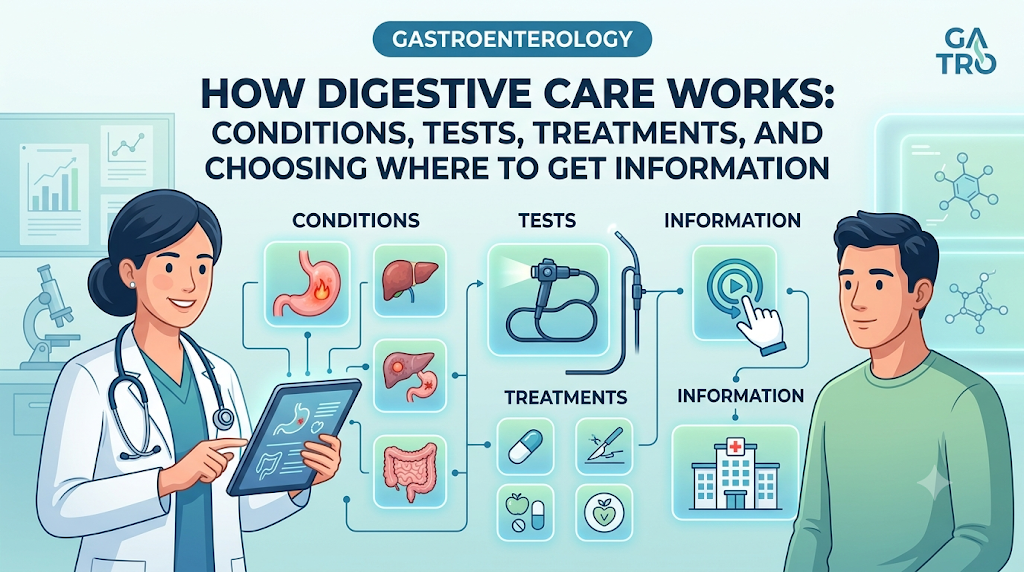
Most of us never think about digestion until it causes a problem. Then it becomes hard to ignore. Pain after meals, acid that won’t settle, sudden bowel changes, or a liver test that comes back abnormal can turn an ordinary week upside down.
Gastroenterology is the branch of medicine built for these situations. It covers the full digestive tract and the organs that work beside it. People often reach this subject while worried, with plenty of questions and very little background. Clear explanations can make that experience far less stressful.
GastroHospitals is a digestive-health platform that brings hospital information, specialist topics, condition guides, and procedure details together for patients and families. This article follows the same ground. It explains how the specialty is organized, how common conditions are understood, how doctors look for answers, and how families can research care with a clear head.
Gastroenterology in Everyday Terms
Imagine a long route that food travels after it is swallowed. Gastroenterology looks after that entire route, plus the organs that help along the way.
The food pipe, called the esophagus, moves each bite down to the stomach. The stomach churns the food with acid until it becomes a thick liquid. Next comes the intestines, where the body absorbs most of its nutrients. The last stretch is the colon, which takes back water and forms waste.
Alongside this route sit three important organs. The liver cleans the blood and makes bile. The gallbladder keeps bile ready for fatty meals. The pancreas sends out digestive juices and produces insulin.
Because everything is connected, a problem in one place sometimes appears as a symptom in another. This is part of what makes the specialty challenging, and part of why a careful, step-by-step approach to diagnosis matters.
What a Gastroenterologist Does
A gastroenterologist is a doctor with advanced training in conditions of the digestive system and liver. Their work goes beyond treating symptoms. They try to find the cause, plan ongoing care, and perform certain examinations that let them look directly inside the digestive tract.
Many people first talk to a family doctor, who may suggest a specialist visit if there are signs that deserve a closer look. Examples include:
- Stomach pain or discomfort that lasts for weeks
- Heartburn that happens often
- Bowel changes that don’t go away
- Weight loss with no clear reason
- Difficulty or pain when swallowing
- Bleeding from the digestive tract
- Questions about liver function
These signs are not a diagnosis. Many have harmless or easily treated causes. A healthcare professional can evaluate persistent or concerning symptoms and decide whether specialist care is needed. If symptoms are severe or come on suddenly, prompt medical attention is the safer path.
A Closer Look at Digestive Disorders
Digestive disorders include any condition that disturbs how the gut, liver, gallbladder, or pancreas functions. The cause might be an infection, inflammation, an immune problem, a blockage, a structural issue, or gradual damage over time.
What makes this group so wide is how differently the conditions behave:
- A short infection may clear up in a few days.
- A long-term condition may need years of follow-up.
- A liver problem may show almost nothing at first.
- A food pipe problem may announce itself with every meal.
So the same complaint, such as an aching stomach, can have very different explanations. Finding the real one is the doctor’s job, and it usually takes more than one step.
The Big Picture of Gastroenterology Treatments
Gastroenterology treatments are not limited to pills or operations. They cover a broad spectrum. Some people mainly need advice on eating and daily routines. Others need prescribed medicines. Some benefit from a treatment delivered through a scope, and a smaller group needs surgery.
Doctors weigh several things before choosing a direction: the confirmed diagnosis, the severity, how the person has responded so far, and their general health. This is why one person’s plan rarely suits someone else.
Reading about treatment is best seen as homework before an appointment. It helps you follow the discussion and ask better questions, while the actual decisions stay with a qualified healthcare professional.
Understanding Four Commonly Researched Conditions
What follows is general education. It does not tell any reader what they have or what they should do.
Gastroenteritis
Gastroenteritis means inflammation of the stomach and intestines, often caused by a virus, bacteria, or unsafe food or water. Typical features are diarrhea, vomiting, cramps, and sometimes fever.
Gastroenteritis treatment mostly aims to ease discomfort and replace lost fluids. Dehydration is the key risk, especially for infants, older people, and anyone with another medical condition. Blood in the stool, ongoing vomiting, very little urine, or symptoms that drag on are reasons to see a doctor.
GERD
GERD, short for gastroesophageal reflux disease, is a condition where stomach contents keep moving back toward the food pipe. It can cause heartburn, an acidic taste, or a burning sensation in the chest.
One episode of heartburn after a heavy meal is common and doesn’t mean someone has GERD. When it keeps returning, a doctor may investigate. GERD treatment can include changes in habits, medicines from a doctor, and in selected cases a procedure or operation. Trouble swallowing or night-time symptoms are worth discussing with a professional.
Inflammatory Bowel Disease
IBD stands for inflammatory bowel disease. It is a group of long-term illnesses in which parts of the digestive tract remain inflamed. Crohn’s disease and ulcerative colitis are the best-known examples. People may notice persistent diarrhea, belly pain, tiredness, or weight loss.
IBD treatment is generally planned by a specialist and continues over a long period. The usual goals are to reduce inflammation, relieve symptoms, and keep watch for changes. Since symptoms can come and go, doctors often adjust the plan as things develop.
Liver Conditions
Several things can affect the liver, including viral infections, excess fat in the liver, alcohol, certain medicines, and inherited problems. Early liver trouble is often silent, so someone can feel well while damage builds up slowly.
Liver disease treatment depends on what caused the problem and how far it has progressed. It may include treating the cause, medicines, lifestyle changes, and regular tests. When the liver is badly damaged, surgery or transplantation may come into discussion. Yellowing of the skin or eyes, belly swelling, or long-lasting fatigue should be looked at by a healthcare professional.
How Digestive Problems Are Investigated
Doctors seldom rely on one test alone. They usually begin by asking about symptoms, timing, food habits, medicines, and family history. A physical check follows.
If the picture is still unclear, the next tools may include:
- Blood tests, to spot infection, inflammation, or liver changes
- Stool tests, to detect germs or hidden blood
- Imaging, like ultrasound or scans, to view organs from outside
- Scope examinations, which use a thin flexible tube with a camera to see inside
These choices depend on what the doctor suspects. Nobody needs every test, and each result narrows down the possible causes.
Procedures That Find and Fix Problems
Digestive procedures generally serve one of two purposes. Diagnostic procedures help doctors learn what is wrong. Therapeutic procedures treat or manage the problem. Some do both during one session.
The colonoscopy procedure is a well-known case. A doctor passes a slim, flexible tube with a camera through the rectum to inspect the inside of the colon. On the screen, they can look for swelling, ulcers, bleeding, or growths called polyps. A small tissue sample can be taken for lab testing, and certain polyps can be removed during the same visit.
Reasons for recommending one include ongoing bowel symptoms, unexplained bleeding, or screening of the colon. How a person prepares and recovers varies, so those instructions must come from their own medical team.
GastroHospitals also lists endoscopic interventions in its procedure directory. These are treatments done through a scope, which often avoids large surgical cuts. Understanding this difference between looking and treating can make doctor conversations much clearer.
When Surgery Enters the Picture
Plenty of digestive conditions never need an operation. Yet gastrointestinal surgery has a real place in care when other treatments are not enough or when a physical problem must be corrected directly. Whether it applies depends entirely on the diagnosis and a professional assessment.
The operations named in the supplied information include:
- Colectomy: taking out part or all of the colon
- Gastrectomy: taking out part or all of the stomach
- Anti-reflux surgery: tightening the junction between the stomach and food pipe
- Gallbladder removal: removing the gallbladder
- Pancreatic surgery: operating on the pancreas for certain conditions
- Liver resection: cutting out a diseased part of the liver
- Transplantation: replacing a failed organ with a donor organ
Each one differs in complexity and recovery time. Surgeons explain the purpose, risks, and other options before a patient decides anything.
What to Look at When Researching Hospitals
Searching for the best hospitals for gastroenterology is a natural first move for many families. But the answer is never the same for everyone. A hospital that fits a pancreas concern might not be the obvious match for an IBD concern.
Rather than hunting for one top name, consider what you can actually compare:
- Specific focus areas, such as liver, pancreas, IBD, or endoscopy
- The diagnostic and treatment procedures it offers
- The types of specialists involved in digestive care
- Whether complex surgery is available
- How well the hospital explains conditions and procedures
- The facilities that support patient care
Looking at these factors gives a fuller picture than reputation alone, and the final choice is best made with a qualified healthcare professional.
Inside the GastroHospitals Platform
The platform arranges its information into connected areas, which helps people move from confusion to clarity.
Hospital discovery. A directory of 50 leading gastroenterology hospitals gives readers an organized place to begin, rather than scattered searching.
Specialist information. Many patients don’t know which professional handles which problem. This area explains what specialists do and when surgeons or other experts might join the team.
Digestive diseases. Guides span the esophagus, stomach, intestines, colon, liver, gallbladder, and pancreas, covering symptoms, diagnosis, treatment approaches, prevention, warning signs, and when medical care becomes necessary.
Treatments. Overviews outline the typical options for each condition so readers can prepare before they see a doctor.
Procedures and surgeries. The directory describes tests such as colonoscopy, endoscopic interventions, and operations ranging from colectomy to transplantation.
Articles and community resources. Blogs and patient-focused material offer support between appointments, when questions often build up.
Care areas. Content is grouped under general GI care, liver care, pancreas care, IBD, endoscopy, and advanced digestive care, so readers can go straight to what matters to them.
Together, these parts link hospital research with condition education and patient-friendly guidance. Readers who come across this topic through eborrow.in will find it works best as background reading before a medical consultation.
A Five-Step Way to Research
Step 1: Describe the concern. Write down your symptoms, their timing, and anything that makes them better or worse.
Step 2: Learn the basics. Read reliable material about the condition or test involved.
Step 3: Identify who provides care. Find out which specialists and hospital departments handle this kind of problem.
Step 4: Understand diagnosis and treatment. Review how conditions are usually tested and managed.
Step 5: Talk to a doctor. Share what you’ve learned and let a qualified professional apply it to your situation.
Common Mistakes
- Choosing a hospital by name alone. A famous name doesn’t prove it offers the care you need.
- Treating articles as personal advice. General information can’t examine you.
- Skipping a proper diagnosis. Guessing the cause can lead you in the wrong direction.
- Deciding on price alone. Cost matters, but it doesn’t show whether care fits your medical need.
- Assuming surgery is always needed. Many conditions are managed in other ways.
- Putting off an evaluation. Concerning symptoms are better checked early.
A Hypothetical Example
Suppose a person has had stomach discomfort and uneven bowel habits for several weeks. Instead of self-diagnosing, they jot down when symptoms appear and what they ate. They then read about how digestive problems are usually evaluated, and learn how a gastroenterologist, a colonoscopy, and a treatment plan differ.
At the appointment, they share their notes and ask focused questions. The doctor decides what tests are needed. The reading never replaced medical advice. It simply helped the person take part in the conversation.
Digestive Care Summary Table
| Topic | What is useful to understand |
|---|---|
| Specialists | The role of a gastroenterologist and reasons for referral |
| Conditions | Symptoms, warning signs, and general treatment approaches |
| Tests | Blood tests, stool tests, imaging, and scope examinations |
| Procedures | Diagnostic and therapeutic options, including endoscopic interventions |
| Surgery | Common operations and when they may be considered |
| Hospitals | Specialty areas, services, and quality of patient information |
Frequently Asked Questions
1. What does a gastroenterologist treat?
They care for conditions of the digestive tract and liver, including the esophagus, stomach, intestines, colon, gallbladder, and pancreas.
2. Are digestive disorders always serious?
No. Some are mild and brief, while others need long-term care. A doctor can tell the difference.
3. Is gastroenteritis treatment usually done in hospital?
Often not. Many cases are managed with attention to fluids, but severe or prolonged symptoms need medical review.
4. Is heartburn the same as GERD?
No. Heartburn is a symptom many people feel occasionally. GERD involves repeated reflux and must be confirmed by a doctor.
5. How long does IBD treatment last?
IBD is usually long-term, so care and monitoring normally continue over time.
6. Why would a doctor suggest a colonoscopy?
It can help investigate bowel symptoms, find bleeding, or check the colon’s lining, depending on the person’s situation.
7. Does every digestive condition require surgery?
No. Surgery is one option among many and is only considered after professional assessment.
8. What should I compare when looking at hospitals?
Review their specialty areas, listed procedures, specialist services, and patient information, then discuss the findings with your doctor.
Conclusion
Digestive healthcare covers a wide territory, from the food pipe to the colon and from the liver to the pancreas. Digestive disorders can be short-lived or lifelong, and each needs proper evaluation. Gastroenterologists lead diagnosis and care, with treatments that range from lifestyle changes and medicines to scope-based procedures and, sometimes, surgery. When researching hospitals, specialties and services say more than a single name does.
Good information helps you ask better questions, and it is most valuable when paired with advice from a qualified healthcare professional.
