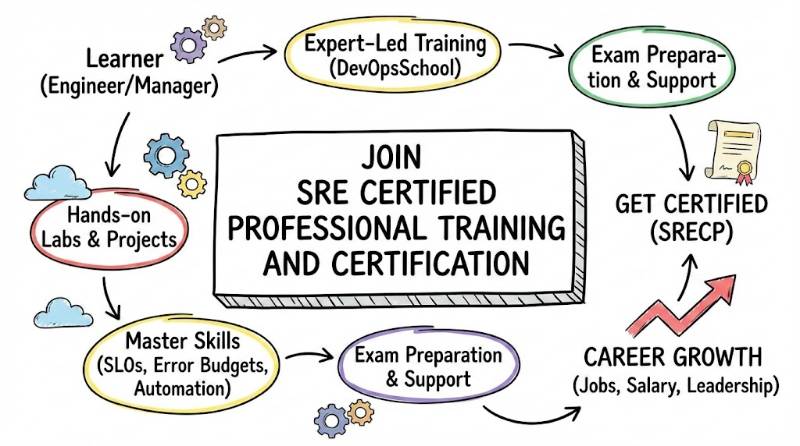
1. Introduction:
In the early days of software, we had a simple “throw it over the wall” culture. Developers wrote code, and Operations teams were expected to keep it running. When things broke, finger-pointing was common. Site Reliability Engineering (SRE) was created to end this conflict. It is a way of thinking where operations is treated as a software problem. Instead of manual fixes, we use code to manage our systems.
The SRE Certified Professional (SRECP) program is the gold standard for learning this discipline. In today’s cloud-native ecosystem, downtime is incredibly expensive. A single hour of an outage can cost a company millions. This is why SRE matters. It provides a mathematical and engineering framework to ensure that systems are “up” and performing well.
For engineers, certifications are a way to cut through the noise. There are thousands of tools out there, but a certification provides a structured learning path. It tells your manager and your peers that you don’t just know how to use a tool—you understand the high-level strategy required to run a global-scale service.
2. Certification Overview Table
| Track | Level | Who it’s for | Prerequisites | Skills Covered | Recommended Order |
| SRE | Professional | Engineers & Managers | Linux & Networking | SLOs, Error Budgets, Toil | Post-DevOps Foundation |
Why Choose DevOpsSchool?
When you decide to level up your career, the platform you choose is just as important as the subject itself. DevOpsSchool is chosen by thousands because it focuses on “The Why” before “The How.” Many bootcamps just teach you which buttons to click in a software interface. DevOpsSchool is different. The instructors are veterans who have spent years in the trenches of production environments.
The curriculum is built around real-world problems. You aren’t just reading from a slide deck; you are looking at how big tech companies handle massive traffic spikes. The support system is also a major plus. You are given access to a community where questions are encouraged, and complex topics are broken down into simple, human language. It’s about building a career, not just passing a test.
3. Certification Deep-Dive: SRE Certified Professional
What is this certification?
The SRE Certified Professional (SRECP) is an advanced training program that teaches you how to apply software engineering principles to system operations. It moves away from the old “sysadmin” mindset and focuses on building self-healing systems that can handle failures automatically.
Who should take this certification?
If you are a Software Engineer who is tired of your code breaking in production, this is for you. If you are a DevOps Engineer who wants to move beyond CI/CD pipelines into high-level system design, this is your next step. Managers who want to lead high-performing teams also find this certification essential for setting realistic goals for their staff.
Skills you will gain
- Defining SLIs and SLOs: You will learn how to measure what actually matters to the user (Latency, Availability, Throughput).
- Error Budget Management: You will learn how to use “math” to decide when it is safe to push new features and when you must stop and fix bugs.
- Observability: Moving beyond simple “up/down” monitoring to deep system visibility.
- Automation of Toil: Learning how to identify repetitive, manual tasks and write code to eliminate them forever.
- Incident Management: How to stay calm and organized during a system failure.
Real-world projects you should be able to do
- Build an Observability Stack: You will be able to set up tools that give you a “crystal ball” view into your application’s health.
- Design a Self-Healing Infrastructure: Create systems that automatically restart or scale up when they detect a problem.
- Draft a Blameless Post-Mortem: Write a report after a failure that focuses on fixing the system, not blaming the person.
Preparation Plan
7–14 Days Plan (The Intensive Path)
This is for the person who needs to get certified quickly. Spend your first three days mastering the “Gold Signals” of monitoring. Spend the next four days on automation tools. Use the final week to take practice exams and memorize the SRE vocabulary.
30 Days Plan (The Balanced Path)
This is the most popular route. Spend one hour every morning reading a chapter of the SRE handbook. Use your weekends to do the hands-on labs provided by DevOpsSchool. By the third week, you should be building your own small “reliable” system in a cloud environment.
60 Days Plan (The Comprehensive Path)
If you are coming from a non-technical background, take your time. Spend the first month mastering Linux and basic Python. Spend the second month deep-diving into the SRECP curriculum. This ensures the knowledge actually sticks for the long term.
Common mistakes to avoid
- The “Tool-First” Trap: Don’t just learn Prometheus or Grafana. Learn why you are monitoring that specific metric.
- Ignoring Culture: SRE is 50% technical and 50% cultural. If your team still blames people for mistakes, the tools won’t save you.
4. Choose Your Learning Path
Your path should be dictated by your passion. Here is how to choose:
- DevOps Path: Focus on speed. How fast can we get code from a developer’s laptop to the customer?
- DevSecOps Path: Focus on safety. How do we ensure that the speed of DevOps doesn’t create security holes?
- SRE Path: Focus on stability. How do we ensure that the system stays up even when everything else is changing?
- AIOps / MLOps Path: Focus on the future. How do we use AI to predict failures before they happen?
- DataOps Path: Focus on flow. How do we treat data pipelines with the same rigor as software pipelines?
- FinOps Path: Focus on value. How do we make sure our cloud bill doesn’t spiral out of control while we scale?
5. Role → Recommended Certifications Mapping
| Role | Why this path? |
| Platform Engineer | You build the “internal product” that developers use. SRECP helps you make that platform reliable. |
| Security Engineer | A secure system that is “down” is useless. SRE principles help you build resilient security tools. |
| Engineering Manager | You need to know how to set “Error Budgets” so your team doesn’t burn out. |
6. Next Certifications to Take
Once you have mastered SRE, you should branch out.
- Chaos Engineering: This is the “next level.” It involves purposely breaking things in production to see if your system can survive. It is the ultimate test for an SRE.
- Leadership Tracks: If you want to move into a CTO or VP of Engineering role, look for certifications that focus on “Strategic Technical Management.”
7. Training & Certification Support Institutions
- DevOpsSchool: The leader in practical, hands-on SRE training.
- Cotocus: Great for corporate teams who need high-end consulting and training combined.
- ScmGalaxy: A massive library of free and paid resources that is perfect for self-starters.
- BestDevOps: Focuses on the “human” side of DevOps, making it very beginner-friendly.
- devsecopsschool.com: Your go-to source for adding a security layer to your SRE skills.
- sreschool.com: A laser-focused community just for reliability engineers.
- aiopsschool.com: Perfect for those looking to integrate machine learning into their operations.
- dataopsschool.com: Essential for data scientists and engineers who want better data reliability.
- finopsschool.com: The best place to learn how to save money on your AWS or Azure bill.
8. FAQs Section (Deep Knowledge)
- Does SRE replace DevOps?
No. DevOps is the philosophy; SRE is a specific way of implementing that philosophy. - What is the “Golden Signal”?
These are Latency, Traffic, Errors, and Saturation. You will learn to master these. - What is an Error Budget?
It is a clear limit on how much downtime is allowed. If you go over the budget, you stop new features and fix the system. - Can I be an SRE without coding?
It is very difficult. SRE is “Engineering.” You need to be able to write scripts to automate tasks. - Is SRE only for big companies?
No. Even a startup with one server benefits from SRE principles to keep their customers happy. - What is “Toil”?
Toil is work that is manual, repetitive, and has no long-term value. SREs hate toil and automate it. - How do I start?
Start by learning how to measure your current application’s performance. - Is the SRECP exam hard?
It is challenging but fair. If you do the labs, you will be fine. - What is a blameless post-mortem?
It is a meeting where you discuss a failure without pointing fingers at people. - How does SRE handle on-call?
By using automation to make sure the “pager” only goes off for real, critical issues. - Do I need a degree?
Not necessarily. Skills and certifications often matter more in the SRE world. - Is SRE a long-term career?
Yes. As long as there is software, there will be a need for reliability.
9. Testimonials: Real Stories from the Field
“I used to spend my weekends fixing broken servers. After the SRECP training, I automated those fixes. Now I spend my weekends with my family.”
— Anil, Senior DevOps Engineer
“The concept of ‘Error Budgets’ changed how I talk to my product manager. We no longer fight about speed versus stability.”
— Kiran, SRE
“I was a developer who didn’t understand the cloud. This certification made the cloud feel like my home turf.”
— Deepika, Software Engineer
10. Conclusion:
The path to becoming a Site Reliability Engineering expert is one of the most rewarding journeys in tech today. It takes you from being a “reactive” engineer who fixes problems to a “proactive” engineer who prevents them. By earning your SRECP, you aren’t just getting a piece of paper; you are gaining a new way of looking at the world of technology.
