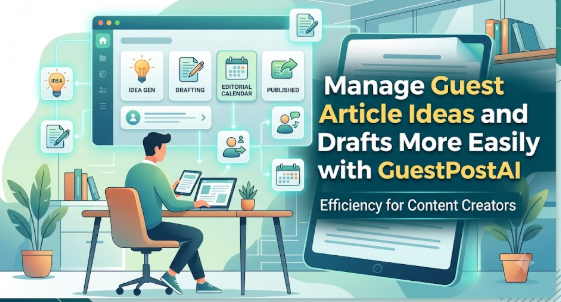
Guest posting has long been a cornerstone of digital marketing, content distribution, and search engine optimization (SEO). By publishing high-quality articles on external websites, businesses and creators can tap into existing audiences, build industry authority, and establish valuable connections across the web. However, anyone who has managed a guest posting campaign knows that behind every published article lies a complex, multi-step process involving endless spreadsheets, back-and-forth emails, content drafting, image sourcing, and manual tracking.
As content demands grow and digital ecosystems become more competitive, managing these tasks manually becomes a major bottleneck. Marketers, agencies, and publishers often find themselves spending more time managing logistics than crafting compelling strategic campaigns.
Centralized platforms powered by artificial intelligence have emerged to address this operational drag. Systems like GuestPostAI are transforming how digital teams approach outreach, content generation, publisher discovery, and campaign execution—bringing disparate tasks into a single, unified workflow.
What is GuestPostAI?
GuestPostAI is an all-in-one content creation, publisher discovery, and campaign management platform built to streamline the end-to-end guest posting lifecycle. Instead of requiring marketers to jump between word processors, email clients, stock photo libraries, and project tracking sheets, the platform unifies these disparate tools into a single operational interface.
The platform was developed to solve a fundamental operational problem: guest posting is effective, but traditional execution is fragmented and labor-intensive. By combining natural language processing, visual generation, a structured publisher marketplace, and flexible scheduling capabilities, GuestPostAI provides a cohesive environment for content buyers and publishers alike.
At its core, GuestPostAI shifts the paradigm from fragmented task management to coordinated workflow execution. It allows users to research opportunities, draft content tailored to specific editorial requirements, generate contextual images, submit publishing requests, and track performance without leaving the interface.
Why Traditional Guest Posting Can Be Time-Consuming
To understand why centralized workflows are gaining traction, it helps to examine the friction points inherent in traditional guest posting methods.
+-----------------------------------------------------------------------+
|                 TRADITIONAL GUEST POSTING BOTTLENECKS                 |
+-----------------------------------------------------------------------+
|  1. Manual Publisher Research & Vetting                               |
|  2. Unstandardized Pitching & Email Back-and-Forth                     |
|  3. Manual Content Creation & Image Sourcing                          |
|  4. Decentralized Approval & Asset Handoffs                           |
|  5. Fragmented Spreadsheet Campaign Tracking                          |
+-----------------------------------------------------------------------+
- Manual Publisher Research: Finding websites that accept guest contributions requires hours of search engine queries, domain metric analysis, and manual contact details scraping.
- Drafting and Formatting Content from Scratch: Writing custom content for external blogs—while adhering to distinct editorial guidelines—demands substantial time from content creators or ongoing management of freelance hires.
- Asset Creation and Image Sourcing: Sourcing royalty-free images or designing custom visuals for featured graphics adds another layer of coordination between writers and designers.
- Unpredictable Outreach Communication: Cold pitching often yields low response rates, resulting in lost time, buried email threads, and missed publishing windows.
- Spreadsheet Bloat: Tracking campaign statuses, live URLs, editorial guidelines, and publication timelines across multiple spreadsheets quickly leads to data errors and disorganization.
Centralizing these steps eliminates administrative drag, allowing teams to scale their publishing initiatives efficiently without sacrificing content standards.
Why AI is Changing Guest Posting Workflows
Artificial intelligence is reshaping digital marketing by automating repetitive administrative and creative tasks. In guest posting, AI serves as an efficiency accelerator rather than a replacement for strategic oversight.
- Accelerated Content Drafting: Generative models can produce well-structured article drafts based on specific topics, target keywords, and structural constraints in minutes.
- Style and Guideline Adherence: AI systems can adapt tone and structure to align with publisher guidelines, reducing editorial revisions.
- Visual Asset Generation: AI-driven image tools create relevant, unique editorial imagery instantly, eliminating reliance on overused stock photos.
- Unified Project Organization: Smart systems handle campaign statuses, scheduled dates, and content assets automatically, minimizing human error.
By leveraging an AI guest post generator alongside built-in management tools, creators spend less time on routine tasks and focus more on strategy, content polish, and relationship building.
Who Should Use GuestPostAI?
Different organizations encounter distinct roadblocks during guest blogging campaigns. GuestPostAI offers targeted features to streamline workflows across various roles:
Bloggers
- Challenge: Struggling to balance consistent blog writing with external outreach to grow their personal audience.
- How GuestPostAI Helps: Accelerates content generation and provides an accessible guest blogging marketplace to find relevant sites quickly.
SEO Professionals
- Challenge: Managing multiple content placements, maintaining publishing velocity, and tracking live links efficiently.
- How GuestPostAI Helps: Integrates content drafting with a structured SEO guest post generator process and clear order tracking features.
Digital Marketing Agencies
- Challenge: Scaling client guest posting campaigns without adding heavy administrative overhead or hiring dozens of contractors.
- How GuestPostAI Helps: Provides role-based access, reusable templates, and centralized project boards for multi-client operations.
Content Writers
- Challenge: Facing writer’s block, strict publisher guidelines, and tight delivery deadlines.
- How GuestPostAI Helps: Generates structured initial drafts and tailored outlines, allowing writers to focus on editing and refining ideas.
Content Marketing Teams
- Challenge: Coordinating content pipelines across writers, editors, and external publishers.
- How GuestPostAI Helps: Offers team collaboration roles, draft management, and editorial calendars within one hub.
Marketing Managers
- Challenge: Maintaining brand voice consistency and maintaining oversight across external publishing channels.
- How GuestPostAI Helps: Provides draft previews, approval steps, and high-level campaign status reporting.
Freelancers
- Challenge: Balancing client project execution with administrative tasks like pitch tracking and asset formatting.
- How GuestPostAI Helps: Simplifies pitch submissions, image creation, and status tracking to save billable hours.
Startups
- Challenge: Limited team bandwidth and budget to execute ambitious off-page content strategies.
- How GuestPostAI Helps: Delivers cost-effective execution by combining content creation and publisher discovery in one place.
SaaS Companies
- Challenge: Need to establish industry authority through educational content across niche tech blogs.
- How GuestPostAI Helps: Aids in producing technical, educational topic outlines and identifying relevant software publishing outlets.
eCommerce Businesses
- Challenge: Expanding brand reach and showcasing product collections across niche lifestyle or industry publications.
- How GuestPostAI Helps: Speeds up blog creation and image generation tailored to distinct product categories.
Small Businesses
- Challenge: Lack of dedicated digital outreach staff or specialized PR tools.
- How GuestPostAI Helps: Offers an intuitive, step-by-step framework that non-marketers can easily navigate.
Enterprise Marketing Teams
- Challenge: Managing cross-departmental reviews, strict security protocols, and high-volume content demands.
- How GuestPostAI Helps: Delivers robust role management, asset version control, and scalable workflow monitoring.
PR Agencies
- Challenge: Coordinating widespread brand coverage, release announcements, and guest placements on tight schedules.
- How GuestPostAI Helps: Streamlines submission scheduling and centralized tracking across various media hubs.
Link Building Specialists
- Challenge: Vetting host sites, managing outreach pitches, and verifying live link installations manual-by-manual.
- How GuestPostAI Helps: Combines an organized marketplace with transparent status tracking for easier fulfillment.
Brand Managers
- Challenge: Ensuring external posts adhere strictly to visual and messaging guidelines.
- How GuestPostAI Helps: Enables pre-publishing reviews, standardized asset templates, and centralized editorial checks.
Website Owners & Publishers
- Challenge: Managing incoming submission requests, verifying content quality, and monetizing available site placements.
- How GuestPostAI Helps: Functions as a guest post marketplace for publishers, providing direct request management and monetization avenues.
Influencers
- Challenge: Expanding thought leadership footprint to external sites without compromising core content output.
- How GuestPostAI Helps: Speeds up drafting personal insights into publication-ready guest features.
Educational Institutions
- Challenge: Sharing academic research and departmental insights across diverse educational platforms efficiently.
- How GuestPostAI Helps: Assists in organizing long-form educational posts and scheduling multi-outlet releases.
Non-Profit Organizations
- Challenge: Spreading mission-driven messaging with minimal staff and financial resource allocations.
- How GuestPostAI Helps: Reduces reliance on external marketing vendors by simplifying content distribution tools internally.
Growing Businesses
- Challenge: Transitioning from sporadic content marketing to a predictable, structured publishing schedule.
- How GuestPostAI Helps: Builds a repeatable workflow framework that grows alongside internal team expansion.
Core Features of GuestPostAI
GuestPostAI incorporates specialized features designed to solve specific bottlenecks in the publishing lifecycle:
AI Guest Post Generator
Produces complete, well-structured article drafts using advanced language models tailored to target sub-niches, keywords, and tone requirements.
AI Image Generation
Creates customized contextual featured images and body graphics designed specifically for the article’s topic, removing the need for third-party photo sites.
AI Content Templates
Offers ready-to-use structural blueprints (e.g., listicles, how-to guides, case studies, thought leadership pieces) to ensure consistent content formatting.
Prompt-Based Content Creation
Allows users to input specific guidance, key takeaways, brand constraints, or reference materials to guide the AI output precisely.
Content Editing
Provides an inline text editor equipped with real-time formatting options, letting team members polish drafts before final submission.
Draft Management
Stores, categorizes, and tracks content drafts in progress, ensuring teams never lose work or confuse active versions.
Content Preview
Simulates how articles and accompanying visuals will appear once published, helping editors catch formatting errors early.
Guest Post Marketplace
Features a searchable index of vetting publisher sites open to guest content submissions across varied industries.
Website Search & Filtering
Enables users to narrow down target publishing sites by niche category, operational parameters, topic tags, and metrics.
Website Categories
Organizes host websites into structured verticals (e.g., technology, finance, health, lifestyle, business) for faster target identification.
Website Comparison
Allows campaign managers to review metrics, guidelines, and publishing timelines of multiple sites side-by-side before committing.
Website Selection
Simplifies adding target outlets to active projects with a single click, building a customized publishing roster.
Publishing Requests
Handles formal submission requests sent directly through the platform, avoiding messy external email threads.
Instant & Scheduled Publishing
Offers options to submit content for immediate publishing or program dates using an automated guest post publishing queue.
Publishing Calendar
Displays pending, scheduled, and completed posts in a visual layout, making high-level timeline tracking straightforward.
Campaign Management
Serves as an operational dashboard where users monitor high-level metrics, active submission statuses, and overall strategy.
Guest Post Project Management
Groups specific articles, assigned writers, host sites, and milestones under dedicated campaign folders for easy categorization.
Website Management
Enables publishers and webmasters to manage domain details, upload submission guidelines, and set publishing parameters.
Publisher Management
Provides tools for campaign teams to track host relationships, platform interactions, and historical acceptance rates.
Role-Based Access
Allows teams to assign custom user permissions (e.g., Admins, Editors, Authors, Clients) to ensure safe operational boundaries.
Content Version Management
Maintains a log of edits and draft iterations, ensuring teams can restore prior content versions whenever necessary.
Payment Management
Centralizes transaction processing, order summaries, and billing history for paid placement requests directly inside the portal.
Order Tracking
Provides live update tags (e.g., Drafting, Submitted, In Review, Scheduled, Published) for every active request.
Activity History
Logs all user actions, file edits, status adjustments, and publishing updates for thorough accountability across teams.
Team Collaboration Tools
Facilitates internal comments, tag mentions, and task assignments directly beside content drafts and project boards.
Workflow Management & Reusable Templates
Saves customized workflows and recurring prompts so teams can duplicate successful campaign structures quickly.
Editorial Control
Enforces mandatory review checkpoints prior to host submission, keeping brand voice and strategic standards intact.
Reporting & Campaign Monitoring
Generates intuitive overview metrics reflecting published assets, ongoing outreach progress, and strategic reach.
Step-by-Step Guide to Using GuestPostAI
Here is how a typical user executes a campaign using GuestPostAI:
[Step 1: Define Topic] ──► [Step 2: Generate Content] ──► [Step 3: Edit & Refine]
                                                                  │
[Step 6: Choose Publisher] ◄── [Step 5: Select Template] ◄── [Step 4: AI Image]
       │
       ▼
[Step 7: Compare Sites] ──► [Step 8: Submit Request] ──► [Step 9: Schedule/Publish]
                                                                  │
                                                                  ▼
                                                      [Step 10: Track Progress]
Step 1: Choose a Guest Post Topic
Identify the core message, audience intent, and primary topic focus relevant to both your brand goals and target audience.
Step 2: Generate AI Content
Input your topic, key focus phrases, and target length into the AI guest post generator to create a tailored first draft.
Step 3: Review and Edit the Article
Refine the generated draft using the inline editor. Inject personal expertise, branded examples, and specific brand terminology.
Step 4: Generate a Featured Image
Use the integrated image tool to generate an original visual asset tailored to the post’s core message.
Step 5: Select a Reusable Template
Apply a standardized template format to ensure headings, callout boxes, and link structures follow editorial norms.
Step 6: Search for Suitable Publishing Websites
Browse the guest post marketplace using niche filters to discover host sites open to your post’s subject matter.
Step 7: Compare Available Websites
Evaluate target sites side-by-side, checking content relevance, reader guidelines, and historical editorial turnarounds.
Step 8: Select a Publisher & Submit Request
Choose the best host site and dispatch the content draft along with visual assets through the submission system.
Step 9: Choose Immediate or Scheduled Publishing
Specify whether the article should go live immediately upon publisher approval or join a guest post scheduling tool queue.
Step 10: Complete Payment (If Applicable)
Handle any required administrative or publishing fee transactions directly inside the platform’s payment workspace.
Step 11: Track Campaign Progress
Monitor the project status tab to observe host review states, scheduled publication dates, and final live link placements.
How Different Teams Can Collaborate Using GuestPostAI
Executing a content distribution strategy involves coordination across specialized internal roles:
- SEO Teams define target topics and anchor strategic goals before feeding parameters into project briefings.
- Content Teams utilize AI generation engines to write, structure, and refine drafts quickly.
- Editors conduct quality checks, verify brand alignment, and approve imagery within the preview panel.
- Outreach Specialists match completed pieces with compatible hosts using the site marketplace.
- Managers review high-level calendar progress and oversee client permission access.
- Publishers receive formatted, ready-to-publish assets directly through clean submission portals.
Unifying these groups within a single platform eliminates email siloing, prevents document duplication, and establishes clear accountability at every stage of production.
How GuestPostAI Supports Different Marketing Goals
+-------------------------------------------------------------------------+
|                  MARKETING GOALS ACCELERATED BY AI                      |
+-------------------------------------------------------------------------+
|  • Content Marketing   : Consistent distribution across niche blogs     |
|  • Thought Leadership  : Rapid deployment of industry insights           |
|  • Brand Awareness     : Broader audience reach via external channels   |
|  • SEO & Authority     : Structured discovery of quality publishers     |
|  • PR Campaigns        : Efficient syndication of news and announcements  |
+-------------------------------------------------------------------------+
GuestPostAI scales well across diverse operational objectives:
- Content Marketing: Accelerates off-site publication velocity to keep brand messaging active across digital channels.
- Thought Leadership: Converts leadership insights into publication-ready external features without heavy time investments.
- Brand Awareness: Expands visual and written brand touchpoints across niche-specific publishing communities.
- SEO Campaigns: Streamlines publisher discovery, lowering operational overhead for legitimate outreach efforts.
- PR Announcements: Facilitates coordinated launch messaging across multiple media and industry outlets simultaneously.
- Authority Building: Establishes footprint consistency by distributing useful educational content across relevant niches.
Real Business Use Cases
Scenario 1: The Freelance Blogger
- Challenge: A freelance blogger wants to pitch five external niche sites weekly but struggles with drafting pitches, creating custom graphics, and tracking follow-ups manually.
- Solution: Using GuestPostAI, the blogger generates structured post drafts, creates custom hero graphics, selects target sites from the marketplace, and dispatches submissions from a single portal.
- Practical Outcome: Weekly outreach increases from 2 to 6 pitches while reducing administrative workload by half.
Scenario 2: The Early-Stage Startup
- Challenge: A lean startup needs to build industry presence on a limited budget without hiring a dedicated PR or outreach agency.
- Solution: The team utilizes prompt-based content generation to turn internal product knowledge into educational articles, then schedules placements across targeted industry blogs using the marketplace.
- Practical Outcome: The startup achieves a consistent off-site publishing cadence without taking resources away from core product development.
Scenario 3: The B2B SaaS Business
- Challenge: A software company wants to publish thought leadership content across specialized tech sites, but internal subject experts lack time to write articles from scratch.
- Solution: Content leads record quick audio key points, convert them into structured drafts using AI generation templates, edit the pieces internally, and manage submissions within GuestPostAI.
- Practical Outcome: Subject-matter insights are published faster while keeping executive time requirements to a minimum.
Scenario 4: The Digital Marketing Agency
- Challenge: An agency managing 15 client accounts struggles with fragmented outreach spreadsheets, leading to delayed campaigns and mixed client communications.
- Solution: The agency adopts GuestPostAI, leveraging role-based access to isolate client workflows, template structures to maintain quality control, and built-in tracking for client progress reports.
- Practical Outcome: Client onboarding and campaign delivery become structured and repeatable, allowing the team to handle more accounts cleanly.
Scenario 5: The Enterprise Marketing Department
- Challenge: A corporate marketing team faces internal compliance delay hurdles and inconsistent branding in guest features written by external contractors.
- Solution: The enterprise mandates all external placements run through GuestPostAI, requiring editorial checks and visual pre-approvals built into the software’s permissions stack.
- Practical Outcome: Off-page brand consistency improves, compliance risks drop, and editorial review loops complete faster.
Scenario 6: The Digital Publisher
- Challenge: An online magazine owner spends hours daily reviewing unformatted guest submissions, emailing back and forth, and chasing image permissions.
- Solution: The publisher lists their site on the GuestPostAI marketplace, setting clear guidelines and accepting structured, formatted drafts directly through the portal.
- Practical Outcome: Administrative review overhead decreases significantly, and the publication maintains a cleaner, predictable posting schedule.
Scenario 7: The Solopreneur / Personal Brand
- Challenge: An industry consultant wants to build personal authority by contributing guest articles but lacks design skills and publishing connections.
- Solution: The consultant uses the platform’s AI visual generator to create professional editorial imagery and leverages the categorized site marketplace to find relevant industry blogs.
- Practical Outcome: The consultant builds a cohesive external article footprint complete with polished, original visuals.
Scenario 8: The Educational Non-Profit
- Challenge: A non-profit research institution wants to share policy summaries and academic insights across public interest platforms but operates with minimal staff.
- Solution: Researchers input study summaries into AI content templates to create accessible educational drafts, using the centralized calendar to coordinate distribution schedules.
- Practical Outcome: Research findings reach broader public channels efficiently without straining staff resources.
Common Mistakes to Avoid in Guest Posting Workflows
Even with robust guest post management software, strategic missteps can hinder campaign success. Avoid these common traps:
- Publishing AI Content Without Human Editorial Review: Relying entirely on raw AI output without human review can lead to generic phrasing and missed nuance. Always review, fact-check, and polish generated content.
- Selecting Host Sites Based Solely on Traffic Metrics: High overall site traffic does not guarantee audience relevance. Prioritize niche alignment and reader engagement over pure numbers.
- Ignoring Host Editorial Guidelines: Submitting content that ignores a host site’s formatting or structural rules leads to quick rejections. Tailor content templates to fit each publisher.
- Neglecting Visual Presentation: Low-quality stock photos or missing graphics make submissions look unprofessional. Take advantage of custom visual generation options.
- Managing Campaigns Through Disconnected Tools: Spreading tasks across separate tools for outreach, drafting, and tracking creates communication gaps. Keep tasks inside a single workflow.
- Inconsistent Publishing Cadence: Submitting content in sporadic bursts makes tracking and relationship building difficult. Use campaign calendars to maintain a steady cadence.
Tips for Optimization and Better Workflow Efficiency
- Refine Prompts with Specific Nuance: Provide explicit outline directions, key takeaways, and tone constraints when generating content drafts.
- Establish Quality Checklists: Run every generated piece through a clear human review step to check for brand voice, structural flow, and accuracy.
- Standardize Structural Templates: Save top-performing outline templates for quick re-use across future campaigns.
- Organize Projects by Client or Vertical: Keep client campaigns separated using dedicated project tags and folders to streamline tracking.
- Schedule Releases strategically: Use scheduling queues to stagger content publishing dates evenly across target channels.
How GuestPostAI Fits Into a Modern Content Marketing Stack
A modern marketing tech stack thrives on seamless coordination between research, production, distribution, and monitoring. GuestPostAI integrates into this process by handling the central execution phases of off-page content management:
[ Strategic Planning ] ──► [ GuestPostAI Workflow ] ──► [ Distribution & Tracking ]
                           ├─ AI Content Generation
                           ├─ Visual Creation
                           ├─ Publisher Matching
                           └─ Scheduled Submission
Instead of requiring individual apps for text generation, visual creation, pitch tracking, and email communications, GuestPostAI combines these steps into a single engine. This integration bridges the gap between early strategy and final publication.
Structured Workflow Comparisons
Table 1: GuestPostAI Feature Breakdown
| Feature | Primary Purpose | Practical Business Benefit |
| AI Guest Post Generator | Automated drafting based on topic/keyword inputs | Reduces initial article creation time significantly |
| AI Image Generation | Contextual creation of featured and inline graphics | Eliminates third-party stock photo costs and licensing friction |
| Guest Post Marketplace | Searchable directory of vetted publishing websites | Speeds up publisher discovery and site matching |
| Publishing Calendar & Queue | Automated scheduling and release date tracking | Ensures consistent, organized posting schedules across outlets |
| Centralized Order Tracking | Real-time status tags from submission to live release | Removes spreadsheet dependency and improves project clarity |
Table 2: Traditional vs. AI-Powered Guest Posting Workflows
| Operational Stage | Traditional Manual Guest Posting | AI-Powered Workflow with GuestPostAI |
| Publisher Discovery | Manual search queries, cold emails, manual vetting | Filtered search within a structured marketplace |
| Content Drafting | Manual writing or managing external freelance teams | Accelerated drafting via specialized AI generation engines |
| Visual Creation | Sourcing stock images or hiring external graphic designers | Integrated AI visual generation tailored to the topic |
| Submission & Pitching | Scattered email pitches with unpredictable response times | Direct platform submissions with structured order tracking |
| Campaign Organization | Fragmented spreadsheets and disjointed tracking sheets | Unified dashboard with built-in calendars and role access |
Examples
Example
Scenario: A digital marketing agency manages content distribution for six B2B clients. Historically, account managers spent around 15 hours per client monthly on publisher discovery, writer assignments, image sourcing, and status tracking across scattered spreadsheets.
Implementation: The agency transitions its workflow to GuestPostAI. Account leads use prompt templates to generate initial drafts, generate complementary graphics, select target host sites from the marketplace, and track submission progress within shared project boards.
Result: The administrative time required per client drops from 15 hours to under 4 hours monthly. This operational shift allows the agency to take on additional clients without adding overhead staff.
Example
Scenario: An independent tech blogger wants to publish monthly guest features on reputable industry sites but struggles to find time for outreach alongside managing their own platform.
Implementation: The blogger uses GuestPostAI to transform quick outlines into drafted articles, creates tailored hero graphics, and submits requests directly through the marketplace index.
Result: The blogger establishes a predictable rhythm of 3 published external features per month, growing their overall referral footprint while spending under two hours weekly on campaign management.
Key Benefits of Using GuestPostAI
- Centralized Dashboard: Unifies creation, pitching, and tracking in one place.
- Accelerated Content Drafting: Generates structured drafts quickly using an AI guest post generator.
- Built-in Visual Generation: Produces contextual hero visuals and supporting graphics directly inside the workflow.
- Simplified Publisher Discovery: Locates targeted sites quickly via an organized guest post marketplace.
- Consistent Quality Control: Uses structured templates and review gates to maintain editorial standards.
- Flexible Publishing Options: Offers both immediate submissions and scheduled release dates using a guest post scheduling tool.
- Improved Team Collaboration: Eliminates email back-and-forth through role-based access control.
- Reduced Administrative Drag: Replaces cluttered tracking spreadsheets with real-time status boards.
Frequently Asked Questions
What is GuestPostAI?
GuestPostAI is an all-in-one platform that combines AI content creation, visual generation, publisher discovery, and campaign tracking into a unified workflow for guest posting campaigns.
Who should use GuestPostAI?
It is built for digital agencies, SEO professionals, content writers, marketing managers, bloggers, startups, eCommerce brands, and publishers looking to streamline content distribution and guest post management.
How does the AI content generation feature work?
Users enter a target topic, keywords, tone parameters, and outline instructions. The system then generates a fully structured article draft ready for human editing and review.
Can agencies manage multiple client accounts on the platform?
Yes. The platform provides project categorization, workspace division, and role-based access management, making it easy to keep client accounts organized separately.
Can website owners and publishers join the platform?
Yes. Publishers can list their domains on the platform, set content requirements, manage incoming placement requests, and monetize site placements directly.
How does scheduled publishing work?
Users can queue approved posts for specific release dates using the built-in publishing calendar, allowing for predictable long-term distribution schedules.
How do reusable templates help with workflow efficiency?
Reusable templates store preferred article structures, heading layouts, and prompt configurations, eliminating the need to set up new campaigns from scratch.
Can teams collaborate inside GuestPostAI?
Yes. The platform supports multi-user permissions, allowing writers, editors, managers, and clients to review, comment on, and approve assets within a single workspace.
What is the primary function of the guest post marketplace?
The marketplace allows users to search, filter, compare, and select target host sites based on niche relevance, metrics, and posting guidelines.
What makes GuestPostAI different from a manual guest posting process?
Manual workflows require juggling spreadsheets, cold email pitches, stock photo sites, and separate editing tools. GuestPostAI unifies these steps into a single platform, saving time and reducing disorganization.
Conclusion
Guest posting remains an effective strategy for content distribution, brand building, and SEO authority. However, traditional manual management processes often introduce unnecessary administrative delays and drag down campaign velocity.
By centralizing content creation, image generation, host site discovery, submission queues, and campaign tracking into a single workspace, platforms like GuestPostAI make guest posting accessible and manageable for modern marketing teams. Shifting from disjointed tools to a unified workflow frees up valuable energy—allowing creators and strategists to spend less time managing spreadsheets and more time delivering great content.
If your current publishing efforts feel bogged down by administrative tasks, evaluating your workflow tools might be the key to unlocking better efficiency and cleaner campaign execution.
