Introduction
Facing an unexpected financial crisis can be an incredibly stressful experience. Whether it is a sudden medical emergency, an urgent home repair, an unexpected delay in your monthly salary, or an immediate family need, financial crises rarely give any prior warning. During these high-pressure moments, finding immediate cash can feel overwhelming. Fortunately, modern digital lending platforms have simplified access to short-term funds, making it possible to address these urgent gaps from the comfort of your home.
An instant emergency loan online can serve as a dependable financial safety net when utilized correctly. However, navigating the digital lending landscape requires a careful blend of speed and caution. While the convenience of applying online is unmatched, borrowers must remain aware of the responsibilities that come with digital credit. On EBORROW.IN, we believe in empowering Indian borrowers with transparent, accurate, and practical knowledge.
This comprehensive guide will walk you through everything you need to know about how to apply for an emergency loan online in India. You will learn about eligibility criteria, document requirements, steps to maximize your approval chances, and critical pitfalls to avoid. Our goal is to help you navigate your urgent cash needs safely, responsibly, and with absolute confidence.
What Is an Emergency Loan?
In simple words, an emergency loan is a type of personal loan designed specifically to address short-term, urgent financial needs. Unlike traditional structural loans—such as a home loan or a car loan, which are tied to a specific asset—an emergency loan is typically unsecured. This means you do not have to pledge any collateral, like gold or property, to secure the funds.
The primary feature that sets a personal loan for emergency apart from regular planned borrowing is the speed of processing and disbursal. Regular personal loans might be part of a long-term plan, such as funding a scheduled wedding or a planned home renovation, where you have weeks to compare options. An urgent cash loan online, however, prioritizes minimal documentation and rapid digital verification to ensure that funds can be accessed within a short timeframe, sometimes even on the same day.
However, this speed and convenience come with specific trade-offs. Because the lender takes a higher risk by providing unsecured funds quickly, emergency loans may carry higher interest rates and processing fees compared to traditional secured options. Therefore, understanding that this is a short-term financial tool—and not a long-term funding mechanism—is essential for maintaining your financial health. Responsible repayment is crucial; missing an Equated Monthly Installment (EMI) can quickly damage your credit score and complicate your future borrowing ability.
When Can You Consider an Emergency Loan Online?
An emergency loan online India can be useful during urgent needs, but it should be reserved exclusively for genuine financial crises. Distinguishing between a true emergency and a temporary lifestyle desire is the first step toward responsible borrowing.
Here are the most common and justifiable situations where considering a quick personal loan in India may help:
- Medical Emergencies: Sudden hospitalization, surgeries, or unexpected medical bills that exceed your current health insurance limit.
- Salary Delays: When your regular monthly income is unexpectedly delayed due to corporate restructuring or administrative issues, leaving you short on essential bills.
- Rent or Household Shortage: Facing an immediate risk of eviction or disruption of essential utilities due to temporary cash shortfalls.
- Urgent Travel: Unplanned travel obligations arising from a family emergency, illness, or the loss of a relative in another city.
- Education Fee Deadlines: Meeting strict school or college fee payment deadlines to prevent your child from missing an academic term or examinations.
- Critical Vehicle or Home Repair: Fixing the primary vehicle you use for your daily commute or addressing urgent home hazards like plumbing failures or structural leaks.
- Unexpected Utilities or Bills: Dealing with unpredicted statutory dues, taxes, or compounding bills that carry heavy legal or financial penalties if left unpaid.
In practical terms, these situations represent short-term financial needs where a temporary cash gap must be bridged immediately. On the other hand, you should avoid using an online loan application process to fund non-essential lifestyle spending, such as purchasing a new smartphone, booking a holiday, or funding a shopping spree. Using urgent credit for non-emergencies can quickly lead to an unmanageable debt cycle.
Emergency Loan Eligibility and Documents
Every digital lender, bank, and Non-Banking Financial Company (NBFC) has a distinct risk assessment framework. While they try to make the application process seamless, they must ensure that you have the capacity to repay the borrowed amount. Your eligibility depends on your eligibility profile, regular income, and credit habits.
To help you understand what lenders look for during the application process, review the detailed breakdown below.
Emergency Loan Eligibility and Documents Table
| Requirement | What It Usually Means | Why It Matters |
| Age Criteria | Applicant must meet lender age rules (typically 21 to 60 years old). | Helps lenders check basic eligibility and legal capacity to enter a contract. |
| Income Proof | Salary slips, bank statements, or official income tax documents. | Shows repayment capacity and regular cash inflow to manage EMIs. |
| Credit Score | A comprehensive summary of credit history and past repayment behavior. | May affect approval, credit limits, and the interest rate offered. |
| Employment Details | Verification of salaried or self-employed profile and work stability. | Helps the lender assess income stability and ongoing employment status. |
| KYC Documents | Officially valid documents like PAN, Aadhaar, and address proofs. | Required for identity verification and anti-money laundering compliance. |
| Bank Account | Active savings bank account with internet banking or debit card access. | Needed for loan processing, digital verification, and ultimate fund disbursal. |
Documents Required to Apply for Emergency Loan Online
When you need an instant emergency loan online, keeping your paperwork organized beforehand can significantly cut down processing times. Digital lenders use online platforms to scan and verify your records instantly, meaning blurry documents or missing proofs can lead to direct rejections.
While specific requirements vary by lender and borrower profile, the documents required for emergency loan applications generally include the following items:
- Permanent Account Number (PAN) Card: This is the single most critical document used by Indian lenders to instantly pull your credit history and assess your existing debt obligations.
- Aadhaar Card or Valid ID Proof: Used primarily for conducting digital identity verification and pulling your registered demographic details.
- Current Address Proof: If your current residential address differs from your Aadhaar card, you can provide utility bills (electricity, water, gas), a registered rent agreement, or a voter ID card.
- Income Proof for Salaried Employees: An emergency loan for salaried employees typically requires your latest 3 to 6 months of salary slips detailing your gross and net salary structure.
- Bank Account Statements: A comprehensive salary or primary business bank statement for the last 3 to 6 months, usually uploaded in a secure PDF format to demonstrate active cash flow.
- Employment Stability Proof: A company ID card, official email verification, or an appointment letter to validate your current workplace.
- Income Proof for Self-Employed Individuals: Income Tax Returns (ITR) filed for the last 1 to 2 fiscal years along with profit and loss statements.
- Passport-size Photograph: A clear digital selfie or passport-sized photo taken in good lighting through the lender’s official application portal.
- Active Mobile Number and Email Address: A mobile number linked directly to your Aadhaar card to receive One Time Passwords (OTPs) for digital signing.
- Existing Loan Details: Statements of any ongoing loans or active credit cards if requested by the lender’s verification system.
How to Apply for an Emergency Loan Online in India
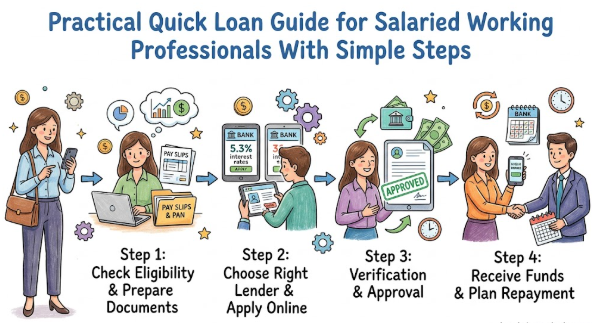
The online loan application process is designed to be highly intuitive, but approaching it systematically ensures that you do not make mistakes under emotional stress. Follow these step-by-step instructions to navigate the process cleanly:
- Identify your exact emergency cash requirement: Sit down and compute the precise amount of money needed to resolve the crisis. Do not guess or inflate the figure.
- Check your income and repayment capacity: Look at your upcoming monthly income and mandatory household expenses to identify how much room you have for a new monthly EMI.
- Compare available emergency loan options: Visit reputable financial comparison platforms or established lending apps to look at various products side by side.
- Review interest rate, processing fee, and tenure: Look beyond just the monthly payment. Examine the processing fees, documentation costs, interest rates, and total repayment tenures.
- Check eligibility criteria: Read the fine print on the lender’s website to ensure your age, location, income level, and credit score align with their baseline rules.
- Keep KYC and income documents ready: Gather clean, digital copies of your PAN, Aadhaar, recent bank statements, and salary slips on your device.
- Fill the online loan application form carefully: Navigate to the verified portal or application, entering your legal name, contact details, and professional information exactly as they appear on your government documents.
- Upload or verify required documents: Upload the digital files into the secure lender portal, ensuring no details are obscured, cropped, or blurry.
- Complete digital KYC if required: Follow the lender’s instructions to perform a video KYC or Aadhaar-based OTP verification to confirm your physical identity.
- Review loan offer and EMI details: Once the system processes your application, review the formal loan agreement sheet detailing the exact interest rate, charges, and payment dates.
- Accept the offer only if repayment is manageable: Check EMI affordability before accepting any offer. If the terms look unmanageable, re-evaluate your loan amount.
- Wait for lender verification and approval: Allow the backend team or automated underwriting system to perform final checks against your employment and credit profiles.
- Receive disbursal if approved: Once final sign-off is achieved, the funds will be electronically transferred via NEFT, IMPS, or RTGS directly into your verified bank account.
- Track EMI due dates after loan disbursal: Mark the repayment dates on your personal calendar and set up an e-NACH mandate or auto-debit to ensure you never miss a payment.
How Online Emergency Loan Verification Works
Understanding what goes on behind the scenes can demystify why some applications are approved in minutes while others are delayed or rejected outright. Digital lenders rely heavily on automated algorithms, artificial intelligence, and API integrations with credit bureaus to make quick lending decisions.
The digital underwriting process generally follows these validation layers:
- Identity Verification: The system matches your name, date of birth, and biometric details across the income tax database (via PAN) and UIDAI system (via Aadhaar) to eliminate fraud.
- Income Verification: Algorithms scan your uploaded bank statements or access your bank account via secure account aggregator networks to look for regular salary credits, average daily balances, and overall cash flow patterns.
- Credit Score Check: The lender instantly requests your credit report from credit bureaus like CIBIL, Experian, or Equifax to inspect your historic repayment behavior and check for past defaults or delayed payments.
- Employment Validation: Systems may cross-verify your employer’s corporate registration status or send a confirmation link to your official workplace email address.
- Existing Loan Obligation Review: Lenders calculate your Debt-to-Income ratio, ensuring that your total monthly loan and credit card obligations do not consume more than 40% to 50% of your net monthly income.
- EMI Affordability Assessment: The system determines whether your remaining disposable income is sufficient to pay the projected emergency loan installment safely.
Ultimately, final approval is subject to lender policy, meaning that even a minor discrepancy between your stated details and your digital footprints can cause an automated rejection.
How Much Emergency Loan Amount Should You Apply For?
When a financial emergency strikes, human panic can cloud logical judgment. It is incredibly common for first-time borrowers to request a much larger sum than necessary, thinking it is safer to have extra cash on hand. However, borrowing extra money out of fear is an expensive financial error.
Every single rupee you borrow carries an associated cost in the form of upfront processing fees and compounding interest over time. For example, if your medical bill or car repair amounts to ₹40,000, you should borrow exactly ₹40,000. Rounding that figure up to ₹70,000 “just to be safe” means you will pay interest on an additional ₹30,000 that you did not actually need for the emergency.
Furthermore, you must thoroughly check your monthly EMI affordability against your active household budget before digitally signing any loan contract. Consider your existing financial liabilities, such as grocery bills, children’s school fees, house rent, and any existing EMIs. In practical terms, your total debt commitments should never choke your disposable cash flow. If an emergency loan’s monthly installment forces you to compromise on basic survival needs, you risk slipping into a debt trap where you must take out a second loan just to repay the first one.
Real-Life Example: Applying for an Emergency Loan Online
To put these concepts into perspective, let us look at a realistic scenario featuring a working professional in India.
The Scenario
Rohan is a salaried software support executive working in Bengaluru, earning a net monthly salary of ₹35,000. Five days before his scheduled salary date, his father suffers a sudden acute medical issue requiring immediate diagnostic tests and hospitalization. The total immediate bill comes out to ₹30,000. Rohan’s dedicated emergency savings fund currently holds only ₹10,000, leaving him with an immediate cash gap of ₹20,000.
Rohan’s Step-by-Step Action Plan
- Step 1: Calculating the Needed Amount: Rohan isolates the exact deficit. He does not ask for ₹50,000; he focuses strictly on the required ₹20,000 cash gap.
- Step 2: Assessing EMI Affordability: He looks at his upcoming salary budget and realizes he can comfortably spare around ₹2,500 every month without missing his house rent or grocery obligations.
- Step 3: Comparing Terms Online: Rohan avoids downloading arbitrary mobile apps from social media links. Instead, he visits a verified financial platform to compare digital lending products. He finds an option with a 15% annual interest rate and a 10-month tenure, translating to an EMI of roughly ₹2,140 per month.
- Step 4: Document Gathering and Submission: He logs onto the platform, inputs his verified PAN and Aadhaar details, and uploads his clean, uncropped bank statements along with his last three salary slips.
- Step 5: Reviewing and Accepting: Within an hour, the system presents him with a formal digital loan agreement sheet. He confirms that there are no unlisted hidden charges and that the repayment dates align well with his monthly salary cycle. He signs the document using an Aadhaar-based OTP, and the money arrives in his bank account later that afternoon.
Important Note: This example is provided solely for educational and illustrative purposes. In real-world scenarios, your actual approval status, interest rates, processing fees, and disbursal speeds may vary drastically depending on your individual credit habits and specific lender policies.
Things to Check Before Accepting an Online Emergency Loan
In a hurry to receive cash, many borrowers make the critical mistake of blindly hitting the “Accept” or “Submit” button without reading the basic financial terms. Spending just five minutes reviewing the loan terms can save you from months of financial stress.
Before you finalize an online emergency loan application, systematically review this bulleted list of essential check-points:
- Annualized Interest Rate (APR): Make sure you understand the difference between a flat interest rate and a reducing balance rate. Always look at the total annualized percentage rate to understand the true cost of credit.
- Upfront Processing Fees: Lenders generally deduct a one-time processing fee (usually ranging from 2% to 6% of the loan amount) directly from your principal before disbursing the funds.
- Exact EMI Amount: Know the precise amount that will be automatically debited from your bank account every single month.
- Total Repayment Amount: Add up all your monthly EMIs plus upfront fees to see exactly how much total money is leaving your pocket compared to what you borrowed.
- Loan Tenure: Verify the exact duration of the loan. A shorter tenure means higher monthly EMIs but less total interest paid; a longer tenure lowers the EMI but inflates the total interest cost.
- Late Payment and Default Penalties: Check the financial consequences of missing a payment deadline. Late fees, bounce charges, and penal interest can mount rapidly.
- Prepayment and Foreclosure Charges: If you get extra cash later and want to pay off your loan early, find out if the lender charges a penalty fee for closing the account ahead of schedule.
- Lender Credibility and NBFC Registration: Ensure the platform is explicitly tied to a Reserve Bank of India (RBI) regulated bank or registered NBFC. Avoid completely anonymous digital lending apps.
- Data Privacy and Permissions: Read the mobile app permission prompts carefully. If a basic loan application demands access to your personal contact lists, private photos, or social media accounts, stop the application immediately.
Risks and Limitations of Emergency Loans
While a personal loan for emergency purposes provides undeniable speed and flexibility, it is not a perfect financial product. Borrowers must maintain deep risk awareness to keep their financial standing completely secure.
- High Cost of Rapid Credit: Because emergency online loans are processed instantly with minimal friction, their interest rates are often significantly higher than standard home, gold, or asset-backed loans.
- Stressing Your Future Income: Taking on an emergency loan means you are effectively spending your future income today. Every loan commitment reduces your usable household budget for the coming months.
- Severe Credit Score Impact: Digital lenders report all your repayment behaviors directly to major credit bureaus. Missing a single EMI due date will lower your CIBIL score, making it much harder to get a home or vehicle loan down the road.
- Hidden Charges and Penalties: Unstructured or poorly researched loans can carry unexpected processing costs, statement charges, or administrative fees that add up quietly.
- The Cycle of Over-Borrowing: The ease of tapping a screen to borrow cash can create a psychological habit of relying on credit for minor lifestyle gaps, leading straight into a compounding debt trap.
- Data Security and Privacy Harassment: Applying through unverified, illegitimate mobile applications can expose your private data to malicious actors who may use aggressive or unethical recovery tactics.
Online Emergency Loan Application Checklist
Before you submit your next digital loan form, use this simple checklist to confirm that you are making a well-thought-out, protected financial decision.
Online Emergency Loan Application Checklist Table
| Checklist Point | Status |
| Emergency amount calculated precisely without extra padding | Yes / No |
| Monthly EMI affordability checked against household expenses | Yes / No |
| Interest rates compared across at least two different lenders | Yes / No |
| Processing fee and hidden administrative charges reviewed | Yes / No |
| Clear, legible digital copies of KYC and income documents ready | Yes / No |
| Lender credibility and RBI-regulated NBFC status verified | Yes / No |
| Entire loan agreement terms and conditions reviewed carefully | Yes / No |
| Exact monthly repayment due date noted on personal calendar | Yes / No |
| App privacy permissions and data safety disclosures checked | Yes / No |
| Final loan offer reviewed carefully before entering the final OTP | Yes / No |
Common Mistakes to Avoid While Applying Online
Even experienced borrowers can make mistakes when dealing with a sudden financial crunch. Avoiding these twelve common digital borrowing mistakes will keep your finances secure:
- Applying without checking EMI affordability: Accepting a loan offer purely because it is approved, without calculating whether your monthly salary can support the payment.
- Borrowing more than required: Taking an extra ₹20,000 just because the lender offered a higher credit limit than your actual emergency required.
- Ignoring processing fees: Focusing entirely on the interest rate while overlooking heavy upfront fees deducted directly from your disbursed amount.
- Not comparing interest rates: Rushing into the first app advertisement you see on social media instead of looking at other digital alternatives.
- Applying through unverified apps or lenders: Downloading standalone mobile applications from third-party links or unverified developers that are not registered with the RBI.
- Sharing personal data carelessly: Providing your PAN, Aadhaar, and bank statements to random loan agents on WhatsApp or untrusted web forums.
- Not reading repayment terms: Ignoring the fine print concerning automated auto-debit dates, bounce charges, and loan foreclosure rules.
- Taking multiple loans together: Submitting applications to three or four different lenders at the exact same time, which creates multiple “hard inquiries” on your credit report and damages your credit score.
- Using emergency loans for lifestyle spending: Using an urgent cash loan online to fund festival shopping, electronic gadgets, or weekend leisure travel.
- Missing EMI due dates: Forgetting to keep sufficient balances in your auto-debit bank account on the repayment date, leading to bounce fees and credit downgrades.
- Ignoring credit score impact: Assuming that small-ticket loans do not affect your formal credit record or your long-term CIBIL history.
- Accepting a loan offer in panic: Signing a high-interest, short-term contract in a state of emotional rush without stopping to evaluate simpler alternatives.
Practical Tips for Responsible Emergency Borrowing
If you decide that an online emergency loan is your best path forward, practicing smart borrowing habits can help you save money and protect your financial future.
- Borrow only for genuine emergency needs: Constantly remind yourself that an emergency loan is an expensive tool meant for real crises, not everyday expenses.
- Keep EMIs within your monthly budget: Aim to keep your total monthly debt obligations well below 30% to 40% of your take-home pay.
- Read all charges carefully: Make sure you ask for a transparent breakdown of processing fees, documentation fees, and pre-closure costs before signing anything.
- Use trusted platforms only: Look for clear contact information, verified websites, valid app store reviews, and explicitly stated partner bank or NBFC details.
- Avoid multiple applications at the same time: Give lenders time to evaluate your application. Space out your loan requests to keep your credit report looking clean.
- Keep documents ready: Store high-resolution, unedited PDFs of your KYC cards and bank records in a secure folder to prevent automated rejections.
- Maintain a clear repayment plan: Decide exactly which monthly expense you will reduce to free up cash for your new loan payment before the money even arrives.
- Track EMI due dates: Set automated email alerts, calendar alarms, or mobile reminders to ensure your bank account is always funded ahead of the auto-debit date.
- Build an emergency fund slowly: Use this current crisis as a learning experience. Once your loan is repaid, try to save a small portion of your income every month into a dedicated emergency fund to avoid needing loans in the future.
- Avoid borrowing to repay another loan: Never take out a high-interest online loan just to pay off an old debt unless you have a structured, professional debt consolidation plan.
Alternatives to Emergency Loans
Before committing to a formal online loan application process, it is wise to see if you can cover the gap using options that do not involve high-interest debt. Each alternative has its own distinct benefits and limitations, but exploring them first can save you money.
- Emergency Savings: Tapping into your own rainy-day savings or fixed deposits is always the cheapest option, as it avoids processing fees and interest charges entirely.
- Salary Advance from Employer: Many established companies and public organizations offer interest-free or low-cost salary advances to employees dealing with sudden personal emergencies.
- Support from Family and Friends: Borrowing from loved ones can be an informal, stress-free way to navigate a temporary gap without dealing with rigid automated systems or credit scores. However, be sure to treat these arrangements with respect and repay them on time to protect your relationships.
- Credit Card EMI Options: If you already have an active credit card with an available limit, converting an emergency purchase into merchant EMIs can sometimes cost less than an instant cash loan—provided you pay the monthly installments on time.
- Reducing Non-Essential Expenses: Delaying major planned household purchases, canceling subscriptions, or cutting back on discretionary spending can help free up immediate cash during a minor shortfall.
- Selling Unused Household Items: Selling old electronics, unused furniture, or vehicle assets on dependable online marketplaces can generate quick, debt-free cash.
- Negotiating Bill Due Dates: For non-medical crises, simply contacting your service provider, landlord, or utility company to request a brief extension on your due date can resolve a short-term cash crunch without requiring a loan.
When Should You Avoid Taking an Emergency Loan?
Knowing when to walk away from a loan offer is just as important as knowing how to apply. You should step back from an online emergency loan application if you experience any of the following warning signs:
- If the monthly EMI is not affordable: If your budget is already stretched thin and adding another payment will make it hard to cover basic daily necessities.
- If the expense is not urgent: If you can easily postpone the purchase for a few months while you save up the cash yourself.
- If the lender is not verified: If the lending platform does not display clear physical office addresses, verified customer support lines, or a registered NBFC partner.
- If the interest rate is too high: If the lender takes advantage of your situation by offering exorbitant, compounding interest rates that exceed normal personal credit standards.
- If repayment terms are unclear: If the platform refuses to provide a clear loan summary page detailing all fees before you sign.
- If you already have too many loans: If you are currently juggling multiple active personal loans, credit card debts, or BNPL (Buy Now Pay Later) balances.
- If you are borrowing for lifestyle spending: If the underlying reason for the loan is to keep up appearances, buy luxury goods, or pay for entertainment.
- If you are taking one loan only to repay another: If you are stuck in a cycle of borrowing from one app just to pay off another without a real plan to resolve the root debt issue.
Frequently Asked Questions
1. How to apply for an emergency loan online in India?
Answer: To apply, select a verified lending platform or bank website, fill out the basic application form, upload your digital KYC and income documents, review the terms carefully, and complete your digital verification.
2. Who is eligible for an emergency loan online?
Answer: Generally, any Indian resident aged between 21 and 60 years with a stable monthly salary or verified self-employed income stream and a decent credit history can qualify for an emergency loan online India.
3. What documents are required for emergency loan approval?
Answer: You typically need your PAN card, Aadhaar card, current address proof, the last 3 to 6 months of bank account statements, and recent salary slips to complete your online loan application process.
4. How fast are instant emergency loan online funds disbursed?
Answer: Once your digital application and KYC verification are fully approved, funds are usually transferred directly into your verified bank account via electronic channels within a few hours or on the same business day.
5. Can an emergency loan for salaried employees be approved with a low credit score?
Answer: A low credit score can reduce your chances of approval or lead to higher interest rates. While some specialized lenders look at your overall income stability, approval remains entirely subject to lender policy.
6. What are the typical interest rates for an urgent cash loan online?
Answer: Interest rates vary widely based on your personal credit profile, income level, and lender guidelines. They generally range anywhere from 11% to 36% per annum, which is why comparing options is essential.
7. Are there any hidden fees in a quick personal loan in India?
Answer: Reputable lenders will list all costs on their summary sheet. However, you must always double-check for upfront processing fees, digital documentation charges, auto-debit bounce fees, and prepayment penalties.
8. Is it safe to share my PAN and Aadhaar on digital loan apps?
Answer: It is safe only if you are using platforms that belong to RBI-registered banks or verified NBFCs. Avoid uploading your personal identification documents to unverified applications downloaded from unofficial web links.
9. What happens if I miss my emergency personal loan EMI payment?
Answer: Missing an EMI due date will immediately lower your credit score, trigger late payment penalties, cause bank auto-debit bounce charges, and lead to formal recovery follow-ups from the lender.
10. What are the best alternatives to taking a personal loan for emergency?
Answer: The most practical, interest-free alternatives include using your personal rainy-day savings, asking your employer for a salary advance, or seeking short-term financial help from family or close friends.
Conclusion
Learning how to apply for an emergency loan online in India can give you peace of mind when unexpected financial challenges arise. Digital lending apps, convenient online forms, and automated verification systems have made getting cash during a crisis faster than ever. However, navigating this process successfully requires a careful, responsible approach.
In practical terms, an emergency loan should always be treated as a temporary financial tool rather than a long-term budget solution. Before you share your information or input a final OTP, remember to calculate your exact cash gap, compare multiple lenders, check processing fees, and verify your monthly EMI affordability. Borrowing responsibly means only taking out what you can comfortably pay back on time, protecting both your everyday budget and your long-term credit history.
