Introduction
Modern software runs around the clock. When a popular streaming service, banking app, or online store goes down for even a few minutes, millions of users notice, and companies lose money. To prevent these failures, organizations rely on Site Reliability Engineers.
Yet, understanding how to transition into this field can feel overwhelming. Many beginners struggle to bridge the gap between traditional IT administration and modern software-driven operations. Poor system reliability leads to stressed teams, frequent outages, and unhappy customers.
This guide explores what SRE training involves, why it matters, and how you can master the essential skills needed to build a successful career as an SRE Engineer.
What Is Site Reliability Engineering?
Site Reliability Engineering is a discipline created to solve complex operational problems using software engineering principles. Instead of manually fixing servers when they break, an SRE writes code and builds automation tools to manage systems reliably.
Why Does It Matter?
Traditional IT operations often rely on manual scripts and reactive troubleshooting. When a server crashes, someone gets paged in the middle of the night to fix it by hand. SRE changes this mindset. It focuses on proactive design, automation, and measurement to stop problems before they affect users.
Real-World Example
Imagine an online grocery store during a massive holiday sale. Millions of shoppers are browsing at the same time. Without proper capacity planning and automated traffic management, the website will crash. An SRE sets up guardrails, monitors traffic spikes, and ensures the system automatically scales up resources to handle the rush.
How SRE Works in Modern Organizations
Site Reliability Engineering bridges the gap between software developers who write code and operations teams who keep servers running.
When developers push new code, SREs ensure that the deployment process is safe, repeatable, and automated. If a bug slips through, the system should catch it quickly, roll back the changes, and alert the team without causing a total outage.
Core Responsibilities of an SRE
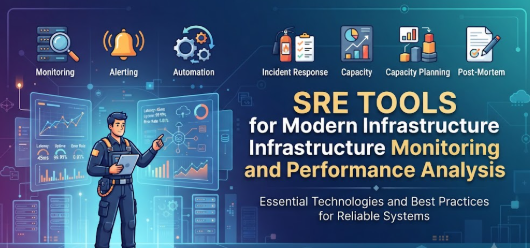
- Monitoring and Observability: Keeping a close eye on system health using metrics, logs, and traces.
- Incident Response: Managing outages calmly, finding the root cause, and writing reports to prevent future failures.
- Automation: Writing code to eliminate repetitive manual tasks, often called “toil.”
- Capacity Planning: Ensuring infrastructure can handle future growth without performance drops.
Important Concepts to Understand
To succeed in Site Reliability Training, you must master several core concepts that define how reliability is measured and managed.
Service Level Indicators (SLIs)
An SLI measures how well a system is performing. For example, it might track the percentage of successful web requests or the time it takes for a page to load.
Service Level Objectives (SLOs)
An SLO is the target goal for your SLI. If your SLI is page load time, your SLO might be that 99% of pages must load in under two seconds.
Service Level Agreements (SLAs)
An SLA is a business contract with customers. If the system fails to meet the agreed-upon reliability level, the company might have to pay financial penalties.
Error Budgets
An error budget represents how much downtime or failure is acceptable over a specific period. If your SLO is 99.9% uptime, your error budget allows for a tiny fraction of failure. This budget gives developers freedom to release new features quickly without worrying too much about minor risks.
Essential SRE Tools and Technologies
An engineer is only as good as their toolkit. Modern site reliability engineering relies on powerful software platforms that provide deep visibility into distributed systems.
- Kubernetes: A tool for automating the deployment and scaling of containerized applications.
- Terraform: A tool for defining and provisioning cloud infrastructure using code (Infrastructure as Code).
- Prometheus and Grafana: Popular tools for collecting metrics and creating visual dashboards to monitor system health.
- CI/CD Pipelines: Automation systems like GitHub Actions or GitLab CI that test and deploy code safely.
Common Mistakes Beginners Make
When learning Site Reliability Engineering, engineers often fall into common traps.
1. Focusing Only on Tools Instead of Principles
- What people do: Learn how to use a specific monitoring tool without understanding why metrics matter.
- Why it causes problems: Tools change over time, but core engineering principles remain the same.
- What to do instead: Focus on understanding system architecture, failure modes, and automation logic first.
2. Ignoring Software Engineering Fundamentals
- What people do: Treat SRE purely as an administrative or support role.
- Why it causes problems: Without coding skills, you cannot automate repetitive tasks or build reliable software solutions.
- What to do instead: Practice writing scripts and small applications using Python or Go.
3. Setting Unrealistic SLOs
- What people do: Aim for 100% uptime right away.
- Why it causes problems: Achieving absolute perfection is impossible and extremely expensive.
- What to do instead: Aim for realistic targets that balance user satisfaction with development speed.
Risks and Limitations
While SRE brings immense value, it is not a silver bullet. Organizations must understand its limitations.
- High Cultural Barrier: Shifting from traditional operations to SRE requires a massive change in company culture and mindset.
- Skill Gap: Finding experienced engineers can be difficult, making structured SRE Training in India and globally essential for workforce development.
- Over-Engineering: Smaller teams sometimes adopt complex SRE practices before they actually need them, wasting valuable time and effort.
Decision Framework: Is SRE Right for Your Organization?
Before investing time and money into an SRE Course or organizational overhaul, evaluate your needs using these steps:
- Assess System Complexity: Do you run distributed systems, microservices, or cloud-native applications that are hard to manage manually?
- Measure Downtime Impact: Do system outages directly hurt your revenue or customer trust?
- Evaluate Team Readiness: Does your team have basic coding and Linux administration skills?
- Check Automation Maturity: Are you spending most of your time fighting fires instead of building features?
- Start Small: Implement SLOs and error budgets on a single non-critical service before expanding across the entire company.
Checklist for Aspiring SRE Engineers
- Learn basic Linux administration and networking concepts.
- Master at least one programming language (such as Python or Go).
- Understand cloud platforms like AWS, Google Cloud, or Microsoft Azure.
- Practice containerization with Docker and orchestration with Kubernetes.
- Learn Infrastructure as Code using Terraform.
- Study monitoring, logging, and observability fundamentals.
- Complete a structured Site Reliability Engineering Training program.
- Prepare for an industry-recognized Site Reliability Engineering Certification.
Key Terms
- Automation: Writing scripts or software to perform repetitive tasks without human intervention.
- Containerization: Packing an application and its dependencies into a single lightweight container so it runs reliably anywhere.
- Deployment: The process of releasing new software updates into a live production environment.
- Infrastructure as Code (IaC): Managing and provisioning computing infrastructure through machine-readable definition files.
- Observability: The measure of how well you can infer the internal state of a system based on its external outputs.
- Post-Mortem: A blameless analysis conducted after an incident occurs to understand what went wrong and prevent it from happening again.
- Scalability: The ability of a system to handle growing amounts of work by adding resources.
- Toil: Repetitive, manual operational work that offers no enduring value and scales linearly with service growth.
Frequently Asked Questions
What is the difference between DevOps and SRE?
DevOps is a cultural philosophy that brings development and operations teams together to deliver software faster. SRE is a specific implementation of that philosophy, focusing heavily on measurement, automation, and reliability engineering.
Do I need to know how to code to become an SRE?
Yes. SRE is rooted in software engineering. You need coding skills to build automation tools, write infrastructure code, and troubleshoot complex system failures.
How long does it take to complete SRE training?
The timeline varies based on your background. Beginners with some IT or development experience typically take three to six months of dedicated study through an SRE course to gain practical readiness.
Is SRE certification necessary for a job?
While not always mandatory, an SRE certification helps validate your knowledge, demonstrates commitment to professional growth, and makes your resume stand out to employers.
What background is best for entering SRE?
Professionals with backgrounds in software development, system administration, cloud engineering, or DevOps find it easiest to transition into Site Reliability Engineering.
How do error budgets improve team productivity?
Error budgets balance reliability with speed. If a team has remaining error budget, they can release new features quickly. If the budget is exhausted, they must pause new releases and focus entirely on fixing reliability issues.
Conclusion
Mastering Site Reliability Engineering takes time, curiosity, and hands-on practice. Whether you are taking your first SRE Tutorial or pursuing a formal SRE Certification, the key is to focus on automation, measurement, and continuous learning. By building dependable systems and reducing manual toil, you can position yourself as a valuable asset in modern tech infrastructure.
