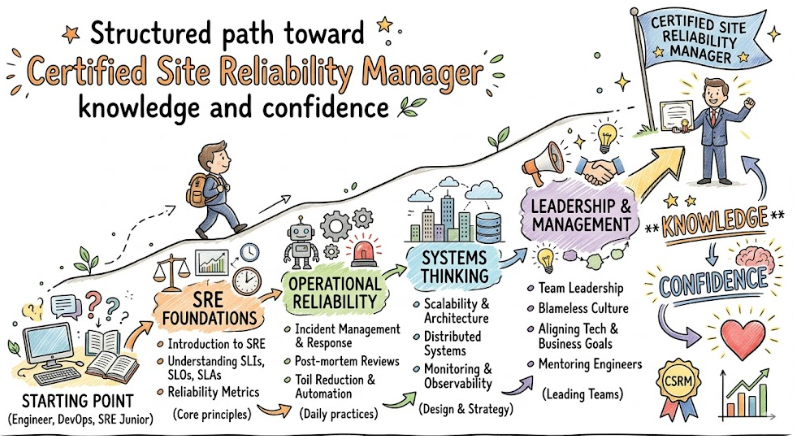
Introduction
Everything in the modern digital world is expected to be fast and always available. When websites or apps go down, money is lost and trust is broken. This is where Certified Site Reliability Engineering (SRE) becomes very important. While many people focus on the technical side of SRE, the management of these teams is just as vital.
Management of reliability requires a special set of skills. It is not just about fixing bugs or watching servers. It is about leading teams to make sure systems are stable and scalable. A deep understanding of both technology and people is needed. This guide is written to help professionals understand how to reach that level of expertise through proper certification and learning.
What is Certified Site Reliability Manager
The Certified Site Reliability Manager is a professional designation for those who lead SRE efforts. It focuses on the intersection of engineering and operations management. Instead of just focusing on individual tasks, this role looks at the big picture of system health.
It covers how to set goals for reliability, how to handle on-call shifts, and how to manage incidents when they happen. It also teaches how to build a culture where mistakes are seen as chances to learn. This certification is built for people who want to bridge the gap between high-level business goals and technical execution.
Why it matters today?
In today’s market, speed is often prioritized over stability. However, customers will quickly leave a service if it is slow or broken. Companies have realized that they need experts who can balance the need for new features with the need for a stable platform.
Manual work is being replaced by automation. This change requires a manager who understands how to guide a team through this transition. The role of a reliability manager is vital because they ensure that the platform can grow without crashing. Without this leadership, technical debt grows and teams become burnt out.
Why Certified Site Reliability Manager certifications are important
Certifications serve as a standard in the industry. They provide a common language for professionals to use. When a person is certified, it shows they have met a specific level of knowledge and skill.
- Trust is built with employers through verified skills.
- A structured learning path is followed, ensuring no important topics are missed.
- Career growth is often faster for those who hold recognized credentials.
- Professional networks are expanded by joining a community of certified experts.
- High-level management concepts are learned in a way that can be applied immediately.
Why choose SRESchool?
SRESchool is chosen by many professionals because of its focus on real-world application. The programs are designed by people who have worked in the field for a long time. The curriculum is kept updated to match what is actually happening in the industry.
The learning environment is supportive and focused on outcomes. Complex topics are broken down into simple, manageable pieces. By choosing this provider, a commitment is made to a high standard of excellence in reliability management. It is widely respected by global companies and provides the tools needed to succeed in high-pressure roles.
Certification Deep-Dive: Certified Site Reliability Manager
What is this certification?
The Certified Site Reliability Manager is a program that validates the ability to lead SRE teams. It covers the strategic side of reliability, including service level management and team culture.
Who should take this certification?
This program is intended for software engineers, DevOps leads, and engineering managers. It is also suitable for anyone responsible for the uptime and performance of digital services.
Certification Overview
| Track | Level | Who it’s for | Prerequisites | Skills Covered | Recommended Order |
| SRE | Professional | Senior Engineers / Managers | Basic IT Ops knowledge | Error budgets, SLOs, Incident Response | After Practitioner level |
Skills you will gain
- Mastery of Service Level Objectives (SLOs) and Service Level Indicators (SLIs).
- The ability to manage and reduce “toil” within an engineering team.
- Expertise in leading post-incident reviews that focus on learning, not blame.
- Strategies for managing on-call rotations without causing team burnout.
- Knowledge of how to align reliability goals with business objectives.
Real-world projects you should be able to do after this certification
- A full reliability roadmap for a production application can be designed.
- An automated incident response plan can be implemented for a large team.
- A dashboard for tracking error budgets and system health can be built.
- A culture of “blameless post-mortems” can be established within an organization.
- Capacity planning for scaling services during peak traffic can be managed.
Preparation plan
7–14 days plan
The core concepts of SRE and the management framework are studied. All official documentation provided by the school is read. Simple practice questions are answered to check understanding.
30 days plan
A deeper dive into each module is taken. Real-world scenarios are practiced daily. Discussions with peers or mentors are held to clarify complex management situations.
60 days plan
A comprehensive review of all topics is conducted. Case studies are analyzed in detail. Several full-length mock exams are taken to ensure readiness for the final assessment.
Common mistakes to avoid
- Focusing only on the technical tools while ignoring the people and culture side.
- Skipping the study of Service Level Objectives, which are the foundation of the role.
- Trying to memorize answers instead of understanding the underlying principles.
- Neglecting the importance of “blameless” culture in incident management.
Best next certification after this
- Same track: Advanced Site Reliability Architect.
- Cross-track: Certified DevSecOps Professional.
- Leadership / management: Engineering Leadership Excellence.
Choose Your Learning Path
DevOps Path
This path is best for those who want to focus on the speed of delivery. It covers the integration of development and operations teams. It is ideal for engineers who love automation and CI/CD pipelines.
DevSecOps Path
This is chosen by those who want to make security a part of every step. Security is moved to the beginning of the process. It is perfect for professionals who want to protect systems while maintaining speed.
Site Reliability Engineering (SRE) Path
This path is focused on the stability and scalability of systems. It is for those who enjoy solving complex problems related to uptime and performance. It is very popular in large tech companies.
AIOps / MLOps Path
This is the best choice for those working with artificial intelligence and machine learning. It covers how to manage the lifecycle of models and use AI to improve operations.
DataOps Path
This path is designed for data professionals. It focuses on the flow of data and ensuring its quality and availability. It is a great fit for data engineers and analysts.
FinOps Path
This is chosen by people who want to manage the costs of cloud computing. It combines finance and technology to ensure that cloud spending is optimized.
Role to Recommended Certifications Mapping
| Role | Recommended Certifications |
| DevOps Engineer | Certified DevOps Professional, Certified Kubernetes Expert |
| Site Reliability Engineer | Certified SRE Practitioner, Certified Site Reliability Manager |
| Platform Engineer | Certified Platform Architect, Infrastructure as Code Specialist |
| Cloud Engineer | Multi-Cloud Professional, Cloud Security Specialist |
| Security Engineer | Certified DevSecOps Professional, Cloud Security Expert |
| Data Engineer | Certified DataOps Professional, Big Data Architect |
| FinOps Practitioner | Certified FinOps Professional, Cloud Cost Optimizer |
| Engineering Manager | Certified Site Reliability Manager, Leadership in Engineering |
Next Certifications to Take
One same-track certification: Certified SRE Practitioner
This certification provides more hands-on technical skills for SRE. It is a great way to balance the management knowledge gained in the manager program.
One cross-track certification: Certified DevSecOps Professional
Learning about security is very valuable for any manager. It helps in understanding how to protect the systems that are being managed for reliability.
One leadership-focused certification: Engineering Leadership Excellence
This program focuses on the soft skills needed to lead large departments. It covers communication, conflict resolution, and strategic planning at a high level.
Training & Certification Support Institutions
DevOpsSchool
Training is provided for a wide range of DevOps and SRE topics. The instructors are experienced professionals who provide practical guidance. Support is offered throughout the entire certification journey.
Cotocus
This institution focuses on providing high-quality technical training. Many different cloud and automation courses are available. It is known for its focus on modern industry tools.
ScmGalaxy
A large community of learners and experts is hosted here. Resources for software configuration management and DevOps are shared. It is a great place to find study materials and advice.
BestDevOps
This site offers specialized training for those looking to advance in DevOps. Detailed courses on various tools and methodologies are provided. It is a helpful resource for career growth.
devsecopsschool.com
Specialized education in the field of security and operations is offered. The curriculum is designed to help professionals integrate security into the DevOps lifecycle.
sreschool.com
This is the primary home for Site Reliability Engineering education. A variety of certifications and training programs are provided. The focus is entirely on reliability and system health.
aiopsschool.com
Training for the next generation of operations is provided here. The use of artificial intelligence in IT operations is the main focus. It is ideal for those looking to stay ahead of technology trends.
dataopsschool.com
Education for data management and operations is delivered. The courses help in building reliable and efficient data pipelines. It is a top choice for data-focused professionals.
finopsschool.com
Courses on cloud financial management are provided. The goal is to help professionals balance cloud performance with cost. It is a vital resource for modern cloud management.
FAQs Section
- How is the difficulty level of this program perceived?
The program is considered to be of a professional level. It is challenging but can be mastered with consistent study and experience. - What amount of time is required for completion?
Most students find that 30 to 60 days of focused study is enough to prepare for the certification. - Are there any prerequisites for this course?
A basic understanding of software development and how IT systems work is recommended. - In what sequence should these certifications be taken?
Starting with a practitioner-level course is often best before moving to the manager level. - What is the career value of this certification?
High value is placed on this credential by global employers. It helps in securing leadership roles in SRE. - What job roles can be pursued after getting certified?
Roles such as SRE Lead, Engineering Manager, and Operations Director can be pursued. - Is the certification recognized globally?
Yes, it is recognized by companies all over the world as a standard for reliability management. - How often is the curriculum updated?
The content is reviewed and updated regularly to reflect the latest industry trends and practices. - What kind of support is provided during the training?
Mentorship and community forums are available to help answer questions and solve problems. - Are practice exams included in the program?
Yes, mock tests are provided to help students prepare for the actual assessment. - Can the training be done online?
All courses are designed to be accessible online for the convenience of working professionals. - How does this help with salary growth?
Certified professionals often command higher salaries due to their verified expertise in a high-demand field.
Additional FAQs for Certified Site Reliability Manager
- What is the core focus of the Certified Site Reliability Manager?
The main focus is on the strategic leadership and cultural aspects of maintaining system reliability. - Does this certification cover specific coding languages?
It focuses more on frameworks and management principles rather than specific programming languages. - How is the final exam conducted?
The exam is taken online through a secure platform provided by the school. - Is there a focus on incident management in this course?
Yes, leading incident response and post-mortem reviews is a significant part of the curriculum. - How does this differ from a standard DevOps certification?
This focuses specifically on the reliability and management side, while DevOps is often broader. - Are real-world case studies used in the training?
Many actual industry scenarios are analyzed to provide practical learning. - Can this certification help a software engineer move into management?
It is specifically designed to provide the skills needed for that transition. - Is there a community for certified managers?
A private network of certified professionals is available for ongoing discussion and networking.
Testimonials
Arjun S.
A great improvement in my understanding of system health was noticed. The way I lead my team during outages has completely changed for the better. My confidence in making big decisions has grown significantly.
Sarah K.
The concepts learned here were applied to my job immediately. We now have a much better way of tracking our error budgets. This program gave me the clarity I needed to advance my career.
Rohan M.
The focus on human factors and team culture was very eye-opening. I learned how to manage my team’s workload without causing them too much stress. It was a very valuable experience for me.
Anita P.
This was exactly what was needed to take the next step in my career. The structured path made it easy to learn complex topics quickly. I now feel much more prepared for leadership responsibilities.
Kevin L.
A lot of practical knowledge was gained from this certification. It is not just about theory; it is about what actually works in production. The quality of the training was very impressive.
Conclusion
A strong foundation for any leadership role in technology is built through continuous learning. The Certified Site Reliability Manager program is recognized as a vital step for those who want to excel in system health and team management. By completing this certification, a deep understanding of reliability principles is gained. This expertise is highly valued in an industry where uptime is the top priority.
The success is often achieved by those who plan their education strategically. A path toward higher responsibility and better opportunities is opened when this credential is held. It is encouraged that a clear roadmap for certification is created to ensure steady progress. The future of digital services is shaped by experts who know how to balance speed with stability, and this journey begins with the right training.
