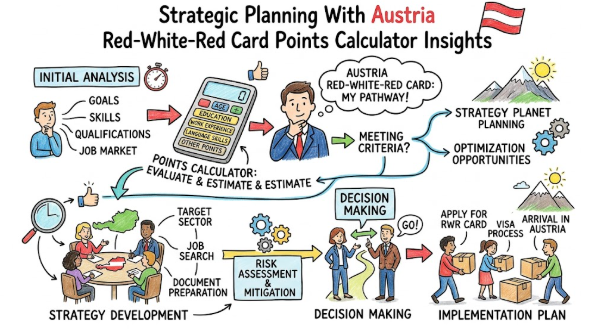
Introduction
Moving your life to a new country is a beautiful mixture of big dreams and endless checklists. If your sights are firmly set on Austria—with its breathtaking alpine landscapes, unmatched work-life balance, and historic, safe cities—you are likely looking at the Red-White-Red Card. Austria does not use a lottery or a chaotic selection process. Instead, it relies on a clear, objective criteria-based model. If you score enough points based on who you are and what you can do, the door opens.
But wrapping your head around immigration criteria can feel daunting. Let’s break down exactly how Austria evaluates potential residents, how you can look at your profile through their lens, and how to maximize your score to secure your future in Europe.
What is the Austria PR Points Calculator
The Austria PR points calculator is a digital framework modeled directly on the official Austrian immigration guidelines. It is an objective evaluation mechanism used by the Austrian Public Employment Service (AMS) to assess your long-term potential to live and work in the country. Instead of a subjective review of your resume, the system looks at specific aspects of your personal and professional profile, translating your life achievements into an official numerical score.
Why It Matters
When you apply for a Red-White-Red (RWR) Card—which is the foundational pathway toward permanent residency—your application lives or dies by this math. Knowing your score before you file forms prevents you from spending time and money on a process where you might fall short. It gives you absolute clarity on where you stand today and shows you exactly what you need to adjust to qualify tomorrow.
How It Works
- Categorization: First, you identify your specific immigration stream (such as a professional in a shortage occupation or a very highly qualified worker).
- Attribute Allocation: The system reviews your age, formal education background, years of verifiable work experience, and certified language proficiencies.
- Point Aggregation: Points are dynamically added together against a strict statutory minimum requirement. If you hit or exceed that baseline number, you meet the initial legal criteria to move forward with your visa application.
Understanding the Eligibility Framework
- Minimum Points Required: Your target baseline depends heavily on your classification. For instance, if you qualify as a “Very Highly Qualified Worker,” you need to score a minimum of 70 out of 100 points. If you fall into a “Shortage Occupation” (like specific engineering, IT, or healthcare fields) or register as an “Other Key Worker,” your required minimum sits at 55 out of 90 points.
- Language Skills: Communication is vital for integration. You can claim significant points for certified German skills starting from an entry-level A1 up to a competent B1 level. Additionally, strong English language skills (at A2 to B1 level or higher) are heavily rewarded, particularly if English is the primary operational language of your sponsoring employer.
- Work Experience: Austria rewards consistency in your professional career. You earn points for every half-year or full year of experience that matches your qualified field. Crucially, if you have prior, documented work experience inside Austria, those years are given double the weight compared to overseas experience.
- Age Factor: The system is explicitly structured to favor younger professionals to support the national demographic workforce. The highest points are reserved for applicants under 30 years old. The points scale down as you reach 40, and hit a final baseline for those up to 50 years old.
- Education Benefits: Higher education pays off well here. Points scale upwards depending on whether you hold a completed vocational training certificate, a mandatory university admission qualification, a three-year tertiary degree, or a specialized Master’s/PhD program (with extra points handed out if your degree is in a Science, Technology, Engineering, or Mathematics field).
How to Increase Your Austria PR Points
- Target a Shortage Occupation: If your background is versatile, look for roles that map explicitly to Austria’s annual national or regional shortage list. Shifting your job search focus toward a designated shortage occupation instantly lowers your mandatory passing threshold from 70 points down to 55 points.
- Level Up Your Language Credentials: This is the easiest, most controllable variable. If you only have English skills, starting basic German lessons and passing an officially recognized A1 or A2 ÖSD/Goethe certificate exam can add an instant 5 to 10 points to your profile.
- Maximize English Corporate Recognition: If you are hired by an international company based in Vienna or another major hub, ensure your employment contract explicitly states that English is the predominant operational language of the corporate environment. This detail unlocks an automatic 5-point bonus in several streams.
- Accumulate Documented Work History: If you are sitting 2 or 3 points short, it might be wise to wait an extra six months to a year in your current role. Every half-year of qualified experience adds up, moving your score across the finish line safely.
Step-by-Step Guide to Calculate Your Austria PR Points
- Identify Your Professional Category: Review the official definitions to determine if you belong under Very Highly Qualified Workers, Shortage Occupations, or Other Key Workers.
- Tabulate Your Educational Background: Match your highest completed qualification against the points criteria. Ensure you have the physical diploma and transcripts ready to back it up.
- Calculate Your Verifiable Work Experience: Write down your total years of work experience. Break it down into half-year increments and separate any domestic Austrian experience from foreign work history.
- Assess Your Age Bracket: Take your current chronological age and note down the corresponding points allocated to your bracket.
- Add Your Language Points: Gather your valid IELTS, TOEFL, Goethe, or ÖSD test results and add up the points for both German and English proficiencies.
- Sum Your Total Score: Total all the figures from steps 2 through 5 and compare your final number against the specific minimum benchmark required for your chosen category.
Common Points Pitfalls to Avoid
- Relying on Unverifiable Experience: The authorities do not accept self-declared work experience or informal recommendation letters. Every single month of experience must be backed up by tax records, social security statements, or detailed corporate reference letters on official letterheads.
- Using Expired Language Certificates: Language test results (like IELTS or Goethe certificates) usually carry a strict two-year validity window for immigration purposes. Filing an application with an expired certificate results in an immediate deduction of those points.
- Miscalculating Degree Equivalency: Holding a “Master’s Degree” in your home nation does not automatically mean it translates directly to an Austrian university degree. Your degree must be officially cross-referenced and recognized via ENIC-NARIC portals to legally claim those points.
- Ignoring the “Matching Job Offer” Rule: For the shortage and key worker paths, you cannot simply have the points—you must have a binding job offer from an Austrian employer that pays the statutory minimum wage for your field.
Essential Document Checklist
- Valid international passport
- Comprehensive birth certificate
- University degree diplomas along with full academic transcripts
- Formal employment contracts and signed employer reference letters
- Valid, certified language certificates (ÖSD, Goethe-Institut, IELTS, or TOEFL)
- Official police clearance certificates from your home country
- Proof of local Austrian accommodation and comprehensive health insurance coverage
Structural Comparisons and Point Breakdown Tables
Table 1: Austria PR Routes Comparison
| Immigration Stream | Minimum Points Needed | Job Offer Required? | Key Focus Group |
| Very Highly Qualified Workers | 70 out of 100 | No (Can enter via Job Seeker Visa) | Top-tier managers, researchers, and specialized STEM PhD holders. |
| Skilled Workers in Shortage Occupations | 55 out of 90 | Yes (Must match national shortage list) | Engineers, IT developers, nurses, and certified trade professionals. |
| Other Key Workers | 55 out of 90 | Yes (Must meet minimum wage rules) | Experienced mid-level professionals and managers outside shortage lists. |
Table 2: Points Distribution Framework
| Criteria Category | Maximum Points Allowed | Example Breakdown |
| Education & Qualifications | Max 30 – 40 points | Vocational school (20 points); University Degree (25 points); PhD (40 points). |
| Professional Work Experience | Max 20 points | 1 point per half-year of foreign experience; 2 points per half-year of Austrian experience. |
| Language Skills (German/English) | Max 10 – 25 points | German A1 (5 points); German B1 (15 points); English B1 (10 points). |
| Age Factor | Max 15 – 20 points | Under 30 years (15–20 points); Under 40 years (10–15 points). |
Real Journeys: Real-World Testimonials
Aarav from Mumbai
When I first evaluated my profile, I realized I was sitting right at 53 points for the shortage occupation track—just two points short of moving. It was a stressful moment because I already had an interview lined up with a tech firm in Vienna. My consultant advised me to pause, step back, and focus entirely on my language skills. I spent two months studying intensely for the German A1 exam. Passing that test pushed my score to 58 points. Looking back at the struggle, seeing my visa approved, and moving my family to Vienna made every evening spent studying German grammar rules completely worth it.
Elena from Belgrade
My biggest challenge wasn’t my qualifications; it was the documentation. I had over eight years of management experience, but my older employers had given me basic, vague reference letters. The Austrian public employment service initially rejected my experience points because the descriptions didn’t match my university degree closely enough. I had to track down my old HR managers to get detailed, notarized descriptions of my exact tasks. It was exhausting and felt like endless bureaucracy, but getting that final approval stamp taught me that precision is everything when dealing with the points system.
Core Advantages of Choosing Austria
- Unmatched Quality of Life: Austria regularly secures top spots in global safety, clean environment, public transport infrastructure, and healthcare indexes.
- True Work-Life Balance: The corporate culture places a deep emphasis on personal time, providing robust paid leave frameworks and family support systems.
- Strategic European Location: Nestled safely in the heart of Central Europe, living in Austria grants you effortless weekend travel access across the entire Schengen Zone.
- Clear Path to Permanent Residency: The points-based RWR card transforms smoothly into an RWR Card Plus, putting you on a reliable, predictable track to long-term EU residency.
Frequently Asked Questions
Can I apply for the Red-White-Red Card without a concrete job offer?
If you score at least 70 points under the Very Highly Qualified Workers category, you can apply for a 6-month Job Seeker Visa to find a role on the ground. All other streams require a valid job offer first.
How long are my language test results considered valid?
For Austrian immigration purposes, your German or English language certificates must have been issued within the last two years of your application date.
Do I get extra points if my degree was completed at an Austrian university?
Yes. Graduating from an Austrian institution of higher education bypasses several standard points hurdles and provides an accelerated pathway to local employment.
Does my spouse need to pass a points test to join me?
No. Your spouse does not need to pass a points assessment, though they may need to show basic A1 German skills for a family reunification visa.
What happens if the public employment service rejects my calculated points?
The assessment by the Austrian Public Employment Service (AMS) is final. If they deduct points, your application will be refused, meaning you must fix the deficiencies and reapply.
Can I combine my English and German points together?
Yes, depending on your visa stream, you can accumulate points for both languages to maximize your overall score.
Does freelance or remote work count toward my experience points?
Yes, provided you can back it up with official tax assessments, corporate contracts, and bank statements showing consistent professional income.
Is there a maximum age limit to apply for the points visa?
While there is no official ban, the points system stops awarding age points after 50, making it harder to qualify unless your education and experience scores are exceptionally high.
How long does it take for the authorities to verify my points score?
The official processing window for the public employment service to evaluate your documents typically spans between 6 to 8 weeks from your submission date.
Do I need to translate all my documents into German?
Yes. All documents not originally issued in German or English must be translated by a certified, sworn translator and appropriately apostilled or legalized.
Conclusion
The Austrian immigration system is structured to be completely fair and predictable. It does not leave your future hanging on luck or subjective opinions. By taking the time to carefully analyze your profile against the points calculator, identifying any potential weak spots early, and gathering your evidence meticulously, you can approach the process with complete confidence.
If you are ready to take your first real step toward a new chapter in Austria, take a few minutes today to check your PR points online, run your numbers, and see exactly where you stand on your journey to Europe.
