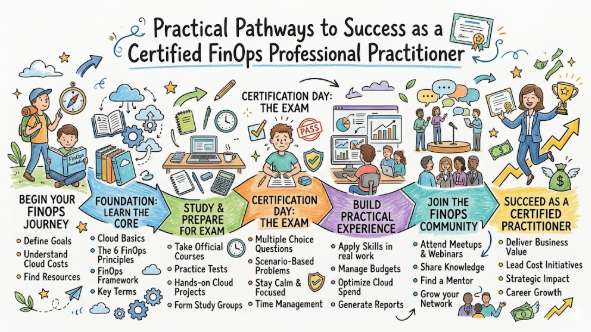
Introduction
Managing variable cloud costs has become a critical challenge for modern engineering teams. The shift from traditional data centers to cloud infrastructure has given engineers immense building power, but it has also led to unpredictable cloud bills. The continuous oversight of cloud spending requires a structured approach that bridges the gap between engineering, finance, and operations.
To solve this widespread problem, specialized operational disciplines have emerged. Adopting cost-conscious habits ensures that financial accountability is shared across all technical teams. This master-level guide explores how a formal qualification can transform an individual’s career and help organizations manage their cloud environments efficiently.
What is Certified FinOps Professional
The Certified FinOps Professional designation is an advanced credential designed for experienced individuals who want to validate their deep operational mastery of cloud financial management. This program moves past basic vocabulary to focus on complex, real-world application of cloud financial practices. It is delivered through the comprehensive educational framework hosted at FinOpsSchool.
Through this advanced validation program, a professional’s ability to architect financial accountability into a variable cloud spend environment is verified. The program tests a candidate’s grasp across the complete operational lifecycle: Inform, Optimize, and Operate.
Why It Matters Today
Modern software architecture relies heavily on microservices, automated scaling, and complex cloud resources. Because infrastructure can be spun up in seconds, costs can spiral out of control without strict monitoring. Organizations no longer look for engineering talent that only prioritizes speed and system uptime.
A modern engineer must also understand the business value of technical decisions. Managing cloud environments with fiscal discipline ensures that an organization stays profitable while delivering reliable software. This qualification proves that a professional knows how to optimize heavy cloud workloads without hurting application performance.
Why Certified FinOps Professional Certifications Are Important
Holding an advanced certification demonstrates structural maturity that transcends specific service tools. It highlights a dedication to building sustainable, cloud-native systems. Certified professionals are given preference for high-impact roles because they help eliminate massive amounts of digital waste.
- Establishes Clear Market Authority: Practical expertise in aligning engineering pipelines with financial accountability is officially validated.
- Improves Communication: A standardized vocabulary is developed, which bridges the communication gap between technical developers and corporate finance teams.
- Enhances Career Trajectory: Certified professionals stand out during competitive hiring processes for leadership roles in platform engineering and cloud operations.
- Minimizes Operational Risk: The risk of unexpected, budget-breaking cloud billing anomalies is dramatically reduced.
Why Choose Finopsschool?
Navigating the operational side of tech investments, cloud costs, and compliance tools can be incredibly overwhelming for any growing business. This is exactly where Finopsschool makes a difference. They bridge the gap between complex data frameworks and real-world business management.
By utilizing their deep educational blueprints, teams learn exactly how to budget for enterprise software, maximize their cloud tool ROI, and manage data regulations without overspending. Choosing them means you gain the practical framework needed to select, deploy, and scale compliance applications efficiently while keeping your operational costs completely optimized.
Certification Deep-Dive
What is this certification?
An advanced-level validation program that confirms an individual’s ability to lead enterprise-wide cloud financial operations, build collaborative organizational structures, and implement advanced cost optimization logic across diverse infrastructure pools.
Who should take this certification?
This program is tailored for Senior DevOps Engineers, SREs, Cloud Architects, Platform Managers, and Tech Leads who possess hands-on cloud experience and are responsible for cloud budgeting or spending efficiency.
Certification Overview Table
| Track | Level | Who it’s for | Prerequisites | Skills Covered | Recommended Order |
| FinOps Practitioner | Intermediate | Cloud Admins, Finance Analysts | Foundational Knowledge | Basic cloud billing, lifecycle stages, unit economics | First |
| FinOps Engineer | Intermediate | DevOps, SRE, Platform Engineers | Active Cloud Experience | Technical cost remediation, container tracking, tagging | Second |
| FinOps Professional | Advanced | Tech Leads, Managers, Architects | Practitioner Certification | Enterprise governance, forecasting, cultural shifts | Third |
| FOCUS Analyst | Advanced | Data Specialists, FinOps Leads | Advanced Analytical Skills | Standardized dataset correlation, schema usage | Fourth |
Skills You Will Gain
- Advanced Unit Economics: The ability to calculate and correlate precise business performance metrics directly with cloud infrastructure spending.
- Automated Cost Control Logic: Designing and implementing programmatic scripts that detect and automatically clean up underutilized digital assets.
- Commitment Optimization: Deep knowledge of negotiating and balancing complex savings instruments, such as Reserved Instances and Savings Plans, across multi-vendor setups.
- Enterprise-Grade Governance: Building global financial policy frameworks that prevent spending overruns without slowing down product release cycles.
- Cross-Team Cultural Alignment: Driving institutional shifts that make cloud cost accountability a core responsibility for every developer.
Real-World Projects You Should Be Able to Do After This Certification
- Design Multi-Tenant Allocation Systems: Build custom dashboards that track and charge back containerized costs within shared Kubernetes clusters.
- Deploy Automated Anomaly Detection Engines: Configure automated tracking mechanisms that alert engineering squads to sudden, unexpected spend spikes in real-time.
- Orchestrate Non-Disruptive Spot Migrations: Move variable non-critical testing workloads to low-cost spot infrastructure without impacting developer pipelines.
- Formulate Executive Forecasting Models: Create predictive financial spending plans based on future product growth and historical cloud telemetry.
Preparation Plan
7–14 Days Plan
- Focus entirely on the official glossary and core principles of the FinOps lifecycle.
- Review all foundational definitions regarding the Inform, Optimize, and Operate phases.
- Dedicate an hour every evening to practicing basic cost-allocation math and cloud-tagging rules.
30 Days Plan
- Dive into real-world case studies detailing successful enterprise cost-optimization programs.
- Practice navigating multiple cloud provider billing dashboards to understand how complex raw usage reports are structured.
- Take structured practice quizzes to identify gaps in your understanding of shared-cost models.
60 Days Plan
- Deeply study complex data frameworks, multi-cloud invoicing scenarios, and organizational change management methods.
- Engage in peer-to-peer mentoring circles and participate in public discussions about enterprise cloud optimization patterns.
- Complete multiple mock examinations under realistic time constraints to perfect your testing strategy.
Common Mistakes to Avoid
- Treating FinOps as a Pure Finance Task: Forgetting that successful cost optimization requires direct, technical engineering changes to infrastructure.
- Over-Optimizing Too Early: Damaging application performance or availability by cutting cloud resources too aggressively.
- Relying on Manual Reporting: Attempting to track complex, dynamic cloud bills via manual spreadsheets instead of deploying automated tracking software.
- Ignoring Container Overhead: Failing to accurately track and allocate shared container resources within microservices clusters.
Best Next Certification After This
Same Track
Progress toward deep-dive data analytical certifications that focus on open-source cloud cost data standards and advanced dataset query schemas.
Cross-Track
Pursue advanced multi-cloud solutions architecture qualifications to better understand how under-the-hood infrastructure choices impact overall enterprise costs.
Leadership / Management
Transition into executive technology management programs that emphasize strategic business management, large-scale financial planning, and organizational design.
Choose Your Learning Path
DevOps Path
The DevOps path is built for technical professionals who want to integrate continuous cost feedback loops directly into the automated delivery pipeline. This path ensures that financial visibility is established early in the development lifecycle rather than weeks after code is deployed. It is best suited for deployment specialists who want to use infrastructure-as-code patterns to enforce budget boundaries.
DevSecOps Path
This path merges financial optimization with automated security and compliance monitoring. Focus is placed on ensuring that cost-saving measures do not introduce architectural vulnerabilities or break industry security baselines. This path is ideal for security engineers who want to manage corporate risks alongside infrastructure costs.
Site Reliability Engineering (SRE) Path
The SRE path is designed for operations professionals who must carefully balance infrastructure costs with strict application availability metrics. Candidates learn to optimize heavy system workloads while maintaining necessary service level objectives. It is best for reliability experts who need to prevent service downtime while removing redundant server buffer capacity.
AIOps / MLOps Path
This learning path targets professionals who manage highly expensive artificial intelligence training models and data pipeline tasks. The curriculum explores specialized optimization methods for costly graphics processing units and distributed machine learning setups. This path is ideal for machine learning engineers facing high computing costs.
DataOps Path
The DataOps track centers on controlling the costs of massive data warehouses, cloud data lakes, and continuous analytical pipelines. Techniques are taught to optimize data query efficiency, manage lifecycle storage levels, and accurately allocate big data costs. It is perfect for data architects handling expensive analytics setups.
FinOps Path
The FinOps path provides a direct, non-stop progression through specialized cloud financial management disciplines. It guides practitioners from basic cost definitions to advanced global governance design and enterprise-wide financial forecasting. This path is tailored for professionals who want cloud cost optimization to become their primary career focus.
Role → Recommended Certifications Mapping
| Role | Recommended Certifications |
| DevOps Engineer | FinOps Certified Engineer, Cloud Provider Solutions Architect |
| Site Reliability Engineer (SRE) | FinOps Certified Engineer, Advanced Infrastructure Optimization Certifications |
| Platform Engineer | Certified FinOps Professional, Enterprise Cloud Architecture Credentials |
| Cloud Engineer | FinOps Certified Practitioner, Cloud Associate Certifications |
| Security Engineer | Cloud Security Professional, FinOps Certified Practitioner |
| Data Engineer | FinOps Certified FOCUS Analyst, Big Data Specialty Certifications |
| FinOps Practitioner | Certified FinOps Professional, FinOps Certified FOCUS Analyst |
| Engineering Manager | Certified FinOps Professional, Technical Leadership Credentials |
Next Certifications to Take
One same-track certification to consider is an advanced cloud analytical credential that focuses on using standardized open data models to solve multi-cloud business challenges cleanly.
One cross-track certification to explore is a professional cloud architecture qualification from a major platform provider to understand how system design decisions affect enterprise bills under the hood.
One leadership-focused certification to target is an executive technology management program that teaches strategic budget mapping, corporate change management, and high-level stakeholder communication.
Training & Certification Support Institutions
DevOpsSchool
Comprehensive instructional programs covering automated delivery pipelines, cloud computing platforms, and modern infrastructure-as-code methods are delivered by this platform. Practical labs and live, expert-led training sessions are consistently provided to help working professionals master complex engineering setups.
Cotocus
Specialized corporate training experiences that emphasize modern software container ecosystems, infrastructure design, and cloud optimization techniques are provided here. Hands-on learning paths are structured around solving real-world enterprise infrastructure challenges efficiently.
ScmGalaxy
A rich educational knowledge base filled with technical tutorials, configuration guides, and community-driven blueprints for configuration management is maintained by this site. It serves as an active hub for engineers looking to refine their technical deployment skills.
BestDevOps
Focused learning roadmaps and structured exam preparation pathways for modern system automation tools are offered through this learning platform. It is designed to help engineers quickly gain the exact technical skills required by top employers.
devsecopsschool.com
This online training academy focuses entirely on integrating automated security scanning tools directly into continuous deployment software pipelines. It bridges the critical operational gap between fast software delivery and corporate security compliance.
sreschool.com
Educational tracks centered on application performance monitoring, automated incident response frameworks, and system resilience patterns are hosted on this portal. It helps engineers master the skills needed to maintain enterprise uptime.
aiopsschool.com
Advanced educational frameworks exploring how artificial intelligence can be applied to automate routine system operations and detect infrastructure anomalies are found here. It prepares engineers for the future of automated IT management.
dataopsschool.com
Instructional programs focused on building efficient data delivery channels, optimizing data pipeline performance, and managing large data infrastructure costs are provided on this platform. It supports teams handling massive enterprise analytical data.
finopsschool.com
The primary platform where comprehensive cloud financial operations courses, structured learning tracks, and advanced global certifications are hosted. It provides the definitive framework for mastering modern cloud cost accountability.
FAQs Section
What is the overall difficulty level of the advanced certification exam?
The exam is considered highly challenging because it requires an advanced understanding of both technical cloud architectures and corporate accounting practices. Situational essay scenarios are used alongside multiple-choice questions to test real critical thinking.
How much study time is typically required to clear the examination?
Between 40 and 50 hours of structured preparation over a span of six to eight weeks is generally required by most candidates to thoroughly master the advanced training modules.
Are there any specific prerequisites required before registering for the professional test?
Yes, an active foundational practitioner certification must be maintained, and a minimum of six months of documented cloud financial management experience is required.
What is the recommended sequence for completing the certifications?
The path should begin with foundational cost concepts, progress through intermediate engineering modules, and conclude with advanced professional governance validations.
What clear career value does this advanced credential bring to a professional?
Significant market authority is achieved, which often leads to fast-track promotions into corporate cloud platform management and specialized leadership positions.
Which specific corporate job roles benefit the most from this program?
Senior Cloud Developers, SREs, Platform Managers, IT Budget Analysts, and Engineering Directors find this qualification highly beneficial for their career growth.
Is the testing format strictly multiple-choice or does it include other elements?
The advanced evaluation uses a hybrid approach, combining standard multiple-choice questions with deep essay responses and a graded community contribution project.
How long remains the validity of the certificate once it has been successfully earned?
The credential remains fully active and valid for a period of 36 months before a renewal process is required.
Does the curriculum focus on a single cloud vendor or is it vendor-neutral?
The core framework is completely vendor-neutral, ensuring that the financial management strategies taught can be applied effectively across any cloud provider.
Why is an active data schema qualification required before taking the final exam?
Completing the data schema module ensures that a professional can accurately read, interpret, and analyze the standardized cost files used in enterprise setups.
How does this qualification help in reducing cloud waste across engineering teams?
Clear cost visibility mechanisms are established, and teams are trained to identify and decommission idle digital assets programmatically.
Can individuals from a pure business background pass this advanced program?
While possible, it is much easier for professionals with an engineering background due to the technical nature of data pipelines and automated optimization scripts.
Certified FinOps Professional FAQs
1. What makes the Certified FinOps Professional different from other cloud certifications?
It focuses specifically on the business value pillar of cloud architecture, moving well beyond simple infrastructure configuration to teach sustainable spending habits.
2. Does the examination focus on specific third-party tools or general methodologies?
The exam concentrates primarily on general operational frameworks and core lifecycles, though candidates must know how to apply those rules using common industry tools.
3. How does earning this credential improve an engineer’s day-to-day work habits?
Engineers learn to automatically consider cost efficiency as a core design metric when initially drafting new cloud system architectures.
4. Are live interactive sessions included in the official learning course?
Yes, multiple virtual, instructor-led workshops are built into the training track to walk through complex operational business scenarios.
5. What exactly is the required community content contribution task?
Candidates must submit vetted content, such as a helpful framework guide or an open-source cost script, to the shared community knowledge pool.
6. Can this program help an organization survive sudden macroeconomic shifts?
Yes, because teams are trained to quickly adapt cloud infrastructure spending to match shifting corporate revenues in real-time.
7. Is deep programming knowledge required to understand the course material?
A basic understanding of data query logic and simple scripting is helpful, but advanced software coding skills are not mandatory.
8. How are shared cloud infrastructure costs handled under this framework?
Advanced proportional allocation models are taught to ensure that common overhead costs are distributed fairly among the teams utilizing them.
Testimonials
Weeks of manual spreadsheet tracking were cleared out within the first month of modifying our deployment pipelines. The automation strategies taught helped handle our entire cloud inventory effortlessly.
— Julian
The toughest obstacle for our platform team was identifying where forgotten data logs were sitting. The scanning methods learned allowed us to visualize our entire cloud footprint in a single afternoon.
— Elena
A clear framework for making architectural decisions based on business value was finally gained. Career confidence grew immensely once cloud cost optimization could be discussed intelligently with executives.
— Kiran
Complete clarity regarding our multi-tenant infrastructure costs was achieved after deploying the allocation rules learned. The training provided immediate, practical solutions for our day-to-day budget challenges.
— Marcus
The ability to balance strict application performance targets with changing cloud budgets was transformed. A deeper understanding of infrastructure unit economics has made our team much more efficient.
— Ananya
Conclusion
Obtaining the Certified FinOps Professional credential is a highly strategic career that effectively bridges the gap between software development and corporate financial management. By mastering automated cost monitoring, cloud-tagging rules, and enterprise governance frameworks, professionals protect their organizations from unexpected financial risks. Evaluating your available technical skills, selecting a structured learning path from this guide, and preparing thoroughly will allow you to build a secure, stable, and highly profitable career in the modern cloud landscape.
