Introduction
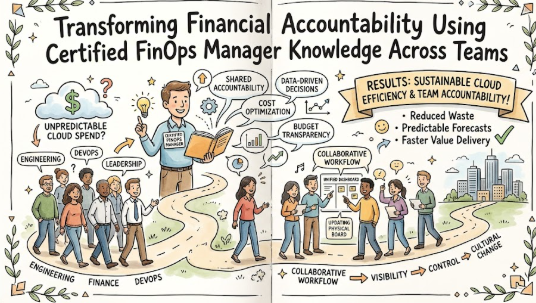
Cloud computing has transformed how software is built and shipped. With a single click or a line of code, massive virtual infrastructure can be launched instantly. However, this high-speed flexibility has introduced a major operational challenge: unpredictable and runaway monthly bills. Many engineering teams spin up powerful cloud resources without a clear understanding of their financial impact, leaving finance departments to handle massive bills they cannot decode.
To bridge this gap, a new discipline has emerged at the intersection of engineering, finance, and operations. Managing cloud spending is no longer just an accounting task; it is now a core requirement for building stable software. The Certified FinOps Manager designation has been established to provide professionals with the exact skills needed to balance infrastructure velocity with absolute financial accountability. This guide explores the complete learning path, strategic value, and structural details of this elite certification program.
What is Certified FinOps Manager
The Certified FinOps Manager is a professional designation designed to validate an individual’s capability to oversee, optimize, and govern cloud financial operations within an enterprise. It focuses on breaking down organizational silos so that engineering, finance, procurement, and business leadership can operate under a shared, data-driven framework.
Rather than teaching purely theoretical accounting models, this program emphasizes a production-focused lens. It ensures that infrastructure changes are guided by cost-awareness without sacrificing performance, security, or system reliability. The program shifts an organization away from outdated, centralized procurement models toward a decentralized, high-velocity decision-making framework where engineers take direct ownership of their cloud consumption.
Why it matters today?
In modern software architecture, a single inefficient container configuration or an unoptimized database cluster can drain thousands of dollars overnight. Traditional budgeting methods cannot keep up with the variable, pay-as-you-go nature of modern cloud environments.
The Certified FinOps Manager credential matters today because it addresses the critical shortage of professionals who understand both technical system architecture and corporate financial governance. It gives organizations the structural visibility needed to eliminate waste, accurately forecast seasonal spending, and calculate unit economics—such as the exact cloud cost required to support a single active customer or transaction.
Why Certified FinOps Manager certifications are important
Possessing a formal certification provides several distinct professional advantages:
- Standardized Operational Language: It establishes a common vocabulary across technical and non-technical teams, ensuring everyone understands complex billing terms like amortized costs, unblended rates, and commitment discounts.
- Career Protection and Growth: It moves technical practitioners from simple execution tasks into high-level strategy, cultural change leadership, and cloud governance roles that are highly insulated from basic automation.
- Verified Real-World Competency: It serves as definitive proof to global employers that a candidate can manage multi-million dollar cloud budgets using scenario-based problem-solving.
- High Return on Investment: It positions software professionals at the vital intersection of finance and technology, unlocking senior consulting and executive management opportunities in both regional and global markets.
Why choose Finopsschool?
When building a true culture of cloud cost accountability, tools alone are insufficient. Organizations need teams that possess the actual practical skills to drive those tools effectively. This is where the learning paths from specialized training institutions become critical.
Finopsschool stands out because it focuses entirely on production-grade, hands-on enterprise education. Instead of teaching pure theory, its curriculum bridges the complex technical gap between software development and corporate financial management. Real-world sandbox environments are provided where engineers, cloud architects, and managers learn how to build cost-aware systems by default. By choosing this educational path, industry-verified expertise is gained in multi-cloud budgeting, automated infrastructure rightsizing, and strategic forecasting, transforming raw dashboard alerts into measurable corporate savings.
Certification Deep-Dive: Certified FinOps Manager
What is this certification?
The Certified FinOps Manager certification validates a professional’s ability to implement, manage, and govern cloud financial operations across complex enterprise environments. It confirms mastery over cloud cost visibility, budget forecasting, resource optimization, and cross-functional team accountability.
Who should take this certification?
This certification is ideal for working software engineers, DevOps leads, cloud architects, site reliability engineers, platform engineering leads, procurement managers, finance professionals, and engineering managers who need to control infrastructure costs while scaling software operations.
Certification Overview Table
| Track | Level | Who it’s for | Prerequisites | Skills Covered | Recommended Order |
| Cloud Financial Literacy | Foundation | Junior Engineers, Project Managers, Finance Associates | Basic Cloud Awareness | Core Principles, FinOps Lifecycle, Terminology, Personas | First |
| Cloud Cost Optimization | Associate | System Administrators, Cloud Engineers, Analysts | Foundation Level | Rightsizing, Waste Elimination, Tagging Strategies, Billing APIs | Second |
| Enterprise Cost Management | Professional | SREs, DevOps Leads, Platform Architects | Associate Level | Unit Economics, Discount Management, Automated Policies | Third |
| Cloud Financial Governance | Advanced | Engineering Managers, Directors, FinOps Leads | Professional Level | Policy Creation, Cultural Change, Strategic Forecasting | Fourth |
| FinOps Leadership & Strategy | Master | CTOs, Enterprise Architects, FinOps Directors | Advanced Level | Center of Excellence Design, Executive Buy-in, Global Spend | Fifth |
Skills you will gain
- Multi-Cloud Billing Competency: The ability to navigate, interpret, and consolidate complex billing files from multiple major cloud service vendors.
- Advanced Cost Allocation: Designing and implementing robust tagging, labeling, and account structuring strategies to ensure perfect cost attribution.
- Automated Policy Enforcement: Writing and executing automated rules that detect spend anomalies or safely shut down non-compliant, idle development resources.
- Unit Economics Modeling: Calculating specific unit metrics to measure the exact business value delivered by every dollar of cloud expenditure.
- Cross-Functional Leadership: Driving cultural changes and alignment sessions between software engineering teams and corporate financial offices.
Real-world projects you should be able to do after this certification
- Design a Shared-Resource Chargeback Model: Building a systematic distribution model that accurately allocates shared multi-tenant cluster costs back to individual business units based on actual usage.
- Deploy an Automated Anomaly Detection Pipeline: Configuring an alerting system that monitors daily usage logs via APIs and flags abnormal cost spikes within hours of occurrence.
- Execute a Commitment Optimization Strategy: Analyzing historical consumption data to calculate and purchase the optimal balance of reserved instances and savings plans across an entire global infrastructure footprint.
- Construct a FinOps Executive Dashboard: Building a real-time, actionable visualization layer that presents clear cost-to-value metrics for non-technical stakeholders.
Preparation plan
7–14 days plan
Focus is placed strictly on reviewing the core framework guidelines, studying official glossaries, and mastering fundamental cloud pricing terminologies. Daily practice sessions are dedicated to understanding the distinct operational responsibilities assigned to different corporate personas within the lifecycle phases.
30 days plan
Detailed case studies regarding cloud cost management are analyzed. Practical exercises are conducted within simulated billing setups to learn how to write effective tagging policies and build basic showback reporting sheets. Automated alerting triggers are configured and tested.
60 days plan
A comprehensive study of advanced unit economics and complex multi-cloud financial frameworks is completed. Simulated enterprise environments are used to practice live architectural adjustments, rightsizing processes, and commitment contract evaluations. Full-length practice examinations are reviewed to ensure complete readiness.
Common mistakes to avoid
- Focusing Purely on Engineering Metrics: Forgetting that financial governance requires aligning technical choices with business value and corporate finance timelines.
- Over-Automating Destructive Actions: Deploying aggressive resource termination rules in live production environments without first establishing warning periods for development teams.
- Neglecting Cultural Alignment: Assuming that buying a cost tracking tool will solve spending issues without spending time educating staff on financial accountability.
- Inconsistent Resource Tagging: Attempting to build allocation models without establishing a strict, company-wide metadata strategy first.
Best next certification after this
- Same track: Advanced Cloud Financial Governance
- Cross-track: Certified DevOps Architect
- Leadership / management: Enterprise Engineering Management
Choose Your Learning Path
DevOps Path
This path is customized for infrastructure professionals focused on embedding financial guardrails directly into continuous deployment lines. It teaches practitioners how to give software developers immediate cost feedback on their code changes before systems hit production environments.
DevSecOps Path
Designed for security-minded professionals who want to balance compliance with expense tracking. This route highlights how security configurations, logging architectures, and compliance scanning tools impact the overall infrastructure bill.
Site Reliability Engineering (SRE) Path
Tailored for engineers managing large-scale system stability and uptime. This path focuses heavily on balancing service level objectives with cloud resource efficiency, ensuring systems are resilient without being wastefully over-provisioned.
AIOps / MLOps Path
This path serves professionals overseeing heavy machine learning pipelines and artificial intelligence infrastructure. It addresses the massive computing costs associated with training models and teaches methods to optimize graphics processing units.
DataOps Path
Built for data architects running high-volume storage arrays and complex analytical systems. The focus is centered on managing variable query costs, cleaning up stale data lakes, and optimizing pipeline transformation expenses.
FinOps Path
The direct, dedicated route for individuals specializing purely in cloud financial management. It covers the entire spectrum from basic allocation tracking to setting up a corporate FinOps Center of Excellence.
Role → Recommended Certifications Mapping
| Current Professional Role | Recommended Primary Certification | Recommended Secondary Certification | Focus Area |
| DevOps Engineer | Cloud Cost Optimization | Enterprise Cost Management | Pipeline Financial Guardrails |
| Site Reliability Engineer | Enterprise Cost Management | Cloud Financial Governance | Stability vs. Efficiency Balancing |
| Platform Engineer | Cloud Cost Optimization | Enterprise Cost Management | Internal Cost-Aware Tooling |
| Cloud Engineer | Cloud Financial Literacy | Cloud Cost Optimization | Resource Allocation & Tagging |
| Security Engineer | Cloud Financial Literacy | Enterprise Cost Management | Secure, Cost-Effective Logging |
| Data Engineer | Cloud Cost Optimization | Cloud Financial Governance | Large-Scale Storage Efficiency |
| FinOps Practitioner | Enterprise Cost Management | Cloud Financial Governance | Governance Policy Design |
| Engineering Manager | Cloud Financial Governance | FinOps Leadership & Strategy | Team Alignment & Business Value |
Next Certifications to Take
One same-track certification
The Certified FinOps Architect credential is a highly technical, same-track certification that deepens an individual’s ability to design complex, multi-provider cloud setups structured for maximum structural cost efficiency from day one.
One cross-track certification
The Certified DevSecOps Engineer certification serves as an ideal cross-track option, providing critical knowledge on how to inject automated security validation routines and compliance checks directly into automated application delivery channels.
One leadership-focused certification
The Certified Engineering Manager designation is an elite leadership-focused program that trains senior technical professionals to master corporate team dynamics, manage large departmental budgets, and align engineering execution with long-term business goals.
Training & Certification Support Institutions
DevOpsSchool
This institution delivers highly practical, instructor-led training programs focused on modern infrastructure automation. Comprehensive preparation materials and interactive lab ecosystems are provided to support technical professionals chasing advanced career credentials.
Cotocus
Specializing in corporate technology consulting and workforce upskilling, this organization offers deep dive bootcamps designed for enterprise teams. Their training tracks emphasize real-world scenarios to ensure direct workplace application.
ScmGalaxy
A well-established platform offering a vast depository of technical tutorials, study blueprints, and architectural guides. It acts as a major educational hub for engineering professionals preparing for rigorous industry validation assessments.
BestDevOps
This training portal focuses on providing streamlined, beginner-friendly learning experiences for foundational cloud tools. Clear instructional pathways are combined with basic practical labs to help users master core platform competencies quickly.
devsecopsschool.com
A specialized educational entity dedicated entirely to the intersection of development, operations, and security. Deep technical training modules are provided to help engineers construct secure, automated delivery systems.
sreschool.com
This online academy focuses exclusively on site reliability engineering principles, modern system monitoring techniques, and architectural resilience. Its coursework teaches teams how to maintain massive system uptime efficiently.
aiopsschool.com
An advanced educational platform centered on integrating artificial intelligence into automated system operations. Detailed study guides are provided for managing complex machine learning pipelines and modern data architectures.
dataopsschool.com
This learning institution delivers specialized training designed to streamline big data pipeline management. Engineers are taught how to improve data quality, secure massive storage arrays, and optimize processing flows.
finopsschool.com
The premier official platform focused completely on cloud financial operations, budget governance, and cost management education. It serves as the primary provider for specialized certifications that validate a professional’s ability to maximize the corporate value of cloud investments.
FAQs Section
What is the overall difficulty level of cloud financial operations exams?
The foundational assessments are generally considered moderate, focusing heavily on terminology and core principles. However, the professional and advanced level management examinations are highly challenging, requiring a deep understanding of scenario-based problem-solving and multi-cloud architectural optimization.
How much time is typically required to prepare for a professional level test?
For an experienced cloud or system engineer, a period of 30 to 60 days of consistent study is usually sufficient. Non-technical professionals or financial associates may require up to 90 days to gain necessary technical infrastructure awareness alongside the core framework patterns.
Are there strict technical prerequisites before taking these certification courses?
Formal prerequisites vary by level, but a basic understanding of cloud computing models and general infrastructure concepts is highly recommended. Advanced tracks often require candidates to hold lower-level foundation certificates or demonstrate equivalent real-world deployment experience.
What is the recommended certification sequence for a structural learning path?
A practitioner should always start with a foundational literacy certification to master basic vocabulary. This is followed sequentially by technical optimization tracks, professional enterprise management programs, and finally, advanced governance or organizational leadership credentials.
What career value does an enterprise cost management credential offer?
It significantly increases professional marketability by validating a rare skill set that directly impacts a company’s bottom line. Certified individuals frequently secure senior architecture, advisory consulting, or cloud governance roles that command premium compensation worldwide.
Which job roles experience the fastest growth after obtaining these credentials?
The fastest growth is observed in dedicated FinOps practitioner, cloud cost analyst, platform engineering lead, cloud infrastructure architect, and technical engineering management positions across both mid-market and major enterprise sectors.
How do these programs address multi-cloud spending differences?
The core training focuses on cloud-agnostic management principles and systematic optimization frameworks. Instructors then utilize specific real-world examples from major providers to show how these concepts translate across different billing data APIs.
Can an entry-level software engineer benefit from financial governance training?
Yes, learning these methodologies early helps junior developers understand how their architectural choices affect corporate budgets. This financial awareness makes their code designs highly valuable to engineering managers from day one.
How often are the training curriculum materials updated?
The instructional frameworks and study repositories are continuously monitored and updated by industry experts to reflect the latest changes in multi-cloud billing APIs, containerization technologies, and global reporting standard developments.
Is coding proficiency mandatory to succeed in cost management paths?
Basic script readability is highly beneficial for advanced automation tracks where policies are written as code. However, foundational, analytical, and leadership paths focus more heavily on data interpretation, strategy, and cross-functional management rather than raw programming.
Do these certifications cover internal corporate showback and chargeback systems?
Yes, building accurate accounting distribution structures, managing shared multi-tenant infrastructure costs, and establishing transparent internal reporting lines are core components of the professional management curricula.
How do modern governance certifications protect technical careers against automation?
By shifting a professional’s focus away from basic manual server provisioning tasks and moving them into high-level organizational strategy, cloud unit economics calculation, cultural transformation, and executive decision-making roles.
Certified FinOps Manager Specific FAQs
What is the primary objective of the Certified FinOps Manager program?
The Certified FinOps Manager program mainly validates an individual’s capability to orchestrate, analyze, and govern cloud financial workflows within an enterprise. It ensures a professional can build collaborative, cost-aware operational structures across engineering and financial departments.
How long does it take to complete the Certified FinOps Manager training track?
A dedicated path of 30 to 60 days is generally required to thoroughly absorb the management modules. This timeframe ensures a practitioner can complete all practical simulation labs and master executive reporting formats before attempting the final evaluation.
What are the core skills tested in the Certified FinOps Manager examination?
Candidates are thoroughly evaluated on their ability to build cost allocation models, configure automated spend anomaly detection, design executive dashboards, evaluate long-term compute contracts, and manage cross-departmental accountability.
Why is the Certified FinOps Manager program hosted on finopsschool.com?
The program is hosted on finopsschool.com because it serves as the official, specialized provider for this domain. This ensures that the training resources, exam materials, and practical sandboxes remain aligned with current industry best practices.
Can a traditional corporate accountant transition into a Certified FinOps Manager role?
Yes, a financial professional can successfully transition by utilizing this structured learning path. However, additional effort must be dedicated to gaining basic cloud literacy and understanding containerized application environments.
How does a Certified FinOps Manager assist engineering teams during daily operations?
The manager provides developers with clear, real-time cost visibility dashboards and actionable rightsizing recommendations, allowing engineers to optimize their infrastructure footprints without slowing down deployment speeds.
What type of real-world scenarios are encountered in the Certified FinOps Manager labs?
Learners are dropped into realistic sandbox environments where they must resolve sudden budget spikes, allocate shared microservice costs across multiple fictitious departments, and formulate long-term cloud expenditure forecasts based on growth metrics.
How does the Certified FinOps Manager designation support long-term leadership growth?
It equips technical professionals with the exact financial vocabulary and strategic planning capabilities needed to communicate effectively with executive suites, accelerating their progression into director, VP, or CTO positions.
Testimonials
The structural clarity gained through this learning path was immediately applicable. Our platform team successfully eliminated over thirty percent of our idle database waste within the first month.
— Rajesh, DevOps Engineer
Balancing system resilience with strict budget limits was always a source of friction. This program gave us the exact framework needed to align our uptime targets with cost efficiency.
— Amit, SRE
The training provided clear insights into how multi-cloud billing files are structured. I was able to transition from basic infrastructure tasks into a strategic cloud governance role with complete confidence.
— Priya, Cloud Engineer
“I finally learned how to protect our systems without running up massive auxiliary bills. The focus on automated policy tracking has completely transformed how our security routines are deployed.”
— Vikram, Security Engineer
Communicating infrastructure expenses to our corporate board used to be a major challenge. The unit economics models provided by this course allowed us to prove the direct business value of our tech stack clearly.
— Sanjay, Engineering Manager
Conclusion
Mastering cloud financial operations is no longer an optional skill; it has become a fundamental business survival requirement. The Certified FinOps Manager designation provides the definitive educational blueprint needed to navigate the complexities of variable cloud spend. It empowers technical professionals to move beyond simple system upkeep and step into vital corporate strategy roles.
By mapping out a clear, multi-level certification plan and partnering with expert training paths on finopsschool.com, long-term career growth is effectively secured. Investing time into this discipline ensures that your technical execution remains tightly aligned with corporate financial success, unlocking elite leadership opportunities across the global technology market.
